
With the amount of new subnets being added it can be hard to get up to date information across all subnets, so data may be slightly out of date from time to time
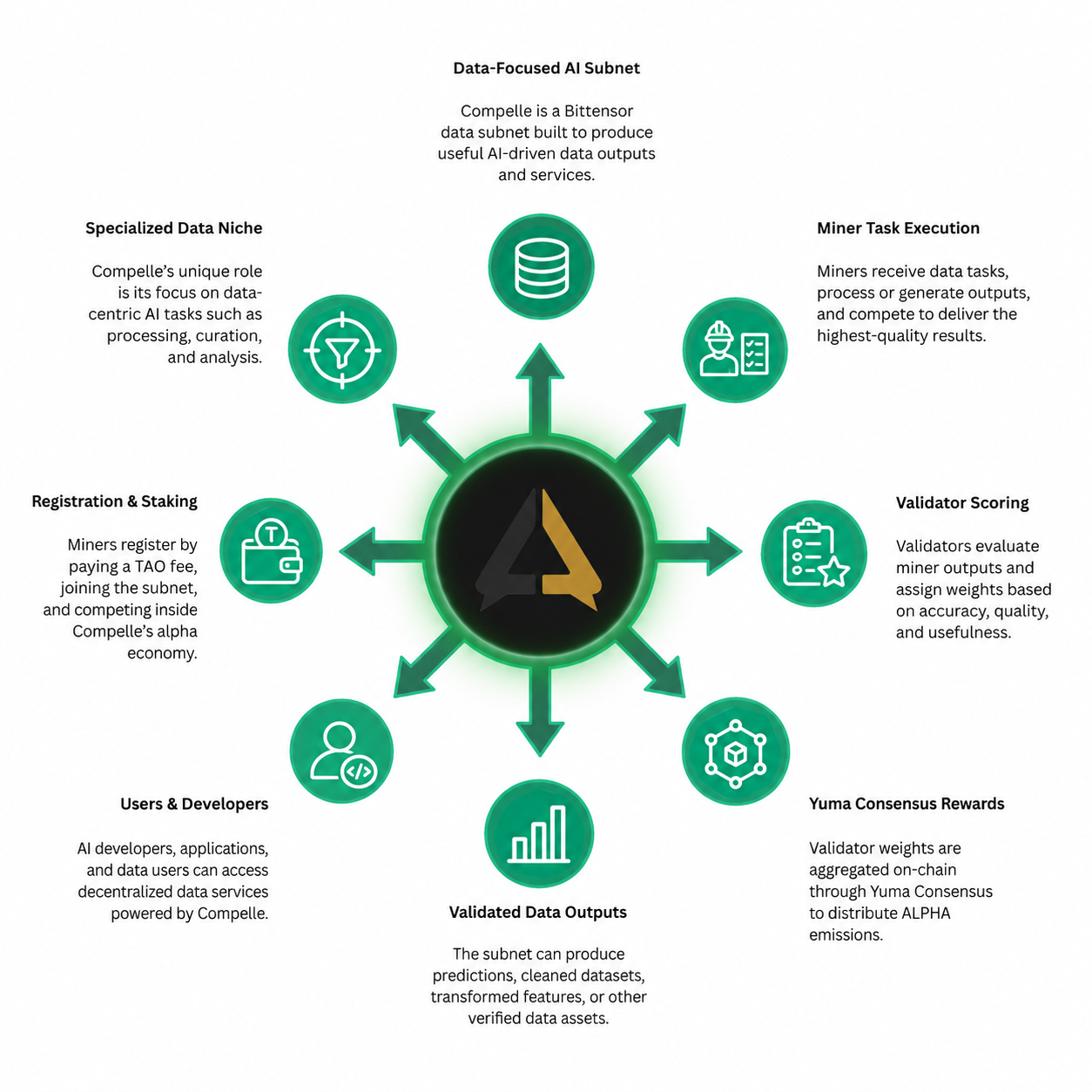
Compelle is a specialized network (subnet) on Bittensor aimed at providing AI-related services in the realm of data. Its exact mission statement has not been publicly documented, but Bittensor’s tracing tools categorize SN82 as a “Data” subnet. In the Bittensor ecosystem, each subnet is a separate AI market where participants compete to produce valuable AI outputs. Generally, miners on a subnet receive tasks from validators, execute computations or generate content, and then validators score those outputs. Official Bittensor documentation explains that “miners are the workers in Bittensor’s subnets. They receive tasks from validators, produce responses, and earn ALPHA (the subnet token) based on how well validators score their output”. This framework likely applies to Compelle: its miners will perform the data-related tasks defined by the subnet (for example, generating or processing data assets) and validators will assess their quality.
Incentive Loop
The fundamental incentive loop in Compelle mirrors the standard Bittensor Yuma consensus. Miners register by staking TAO and converting it into the subnet’s alpha token (the site’s documentation notes that a miner must pay a registration fee in TAO, which is swapped into ALPHA via the liquidity pool). Once registered, miners provide off-chain neural-network outputs on data tasks. Validators then evaluate these outputs according to Compelle’s incentive mechanism and submit numerical “weights” for each miner’s performance. The Yuma consensus algorithm on-chain aggregates these weights from all validators to determine reward distribution. Validators who accurately score miner output (in line with consensus) earn a share of the subnet’s ALPHA emissions as dividends, while miners receive the remaining emissions based on the weights assigned to them. In short: Compelle’s miners compete by producing high-quality data outputs, validators judge that work, and the protocol allocates rewards to both groups in proportion to performance and stake.
Miners’ Contribution
Compelle’s miners contribute computational work and AI output. Depending on Compelle’s scope, this could involve processing raw data, generating model predictions, cleaning datasets, or transforming information into useful features. In Bittensor subnets, outputs vary widely by project – from answering natural language queries to generating images or storing information. Compelle, being data-oriented, likely focuses on tasks such as data aggregation, annotation, or running data-specific AI models that produce valuable data artifacts or analyses. The miners’ exact models and tasks are determined by Compelle’s founders (the subnet owner), but whatever they are, the network’s incentive structure ensures only the most accurate or useful contributions receive high scores and thus greater ALPHA rewards. Over time, miners continuously improve their models or methods to maximize their weight (score) from validators.
Validators’ Role
Validators in Compelle act as the judges of quality. Each validator runs the Compelle evaluation code – for instance, a model or algorithm that scores the miners’ data outputs. Validators submit weightings reflecting how well each miner’s output matches the ideal or ground truth for the task. As the Bittensor docs state, “validators are the judges in Bittensor’s subnets. They receive miner responses, score them using the subnet’s incentive mechanism, and submit those scores as weights to the blockchain”. For Compelle, this means validators likely execute a verification step on the data outputs (such as checking labeled data against known labels, or validating data consistency) and assign scores. Validators earn a share of the subnet’s emissions (after the owner’s cut) as dividends roughly proportional to their stake and accuracy. This dual role – miners generating data-output and validators scoring it – creates a self-regulating marketplace: better data yields higher validation scores, and validators are financially motivated to provide honest, high-quality scoring.
Output/Service
The final output produced by Compelle will be whatever AI-driven results its data tasks generate. In essence, each epoch the network as a whole produces a collection of validated data outputs or model predictions. For example, if Compelle’s focus is on a data-cleaning task, the output might be cleaned and labeled datasets; if it’s on inference, the output might be predictions or embeddings on data queries. Users or external applications (those who stake and use TAO) can then utilize Compelle’s alpha pool or APIs to access this data or run inference on models. In the broader Bittensor paradigm, these outputs are “digital commodities” – marketable services produced by decentralized miners. Once miners have been scored and Alpha allocated, the validated content effectively becomes the service Compelle provides to users. The network ensures that output quality is continually improved by rewarding top performers, meaning end-users (e.g. AI researchers or developers) ultimately receive high-quality data or models.
Users and Beneficiaries
Intended users of Compelle would be those who need reliable, decentralized data services. This could include AI developers seeking training data or inference results, enterprises needing data analytics without centralized control, or even other Bittensor subnets anticipating using Compelle’s data. By staking TAO into Compelle, these users both fund the network and receive ALPHA as a token representing their shares of the subnet’s economy. Because the system is open to public stake (anyone can delegate TAO to Compelle’s validators), ordinary TAO holders who believe in data-driven AI can effectively support and benefit from the subnet’s outputs. In summary, Compelle is designed to serve the AI community’s data needs while rewarding on-chain participants for contributing computing resources and verification work.
Unique Features
At present, no explicit marketing materials describe how Compelle differs from other subnets. However, its classification under “Data” suggests a unique focus on data-centric AI tasks. Unlike more generic inference or training subnets, Compelle’s specialization likely fills a distinct niche in Bittensor’s ecosystem: providing a decentralized platform for data processing or dataset curation. This specificity could make it unique, though without an official roadmap or whitepaper it is difficult to enumerate features that clearly set it apart. If Compelle leverages any novel algorithms or partnerships, those have not been publicly disclosed. Therefore, its uniqueness currently lies mainly in its niche (data tasks) within Bittensor and the emerging Bittensor-wide model of tokenized AI services.
Compelle is a specialized network (subnet) on Bittensor aimed at providing AI-related services in the realm of data. Its exact mission statement has not been publicly documented, but Bittensor’s tracing tools categorize SN82 as a “Data” subnet. In the Bittensor ecosystem, each subnet is a separate AI market where participants compete to produce valuable AI outputs. Generally, miners on a subnet receive tasks from validators, execute computations or generate content, and then validators score those outputs. Official Bittensor documentation explains that “miners are the workers in Bittensor’s subnets. They receive tasks from validators, produce responses, and earn ALPHA (the subnet token) based on how well validators score their output”. This framework likely applies to Compelle: its miners will perform the data-related tasks defined by the subnet (for example, generating or processing data assets) and validators will assess their quality.
Incentive Loop
The fundamental incentive loop in Compelle mirrors the standard Bittensor Yuma consensus. Miners register by staking TAO and converting it into the subnet’s alpha token (the site’s documentation notes that a miner must pay a registration fee in TAO, which is swapped into ALPHA via the liquidity pool). Once registered, miners provide off-chain neural-network outputs on data tasks. Validators then evaluate these outputs according to Compelle’s incentive mechanism and submit numerical “weights” for each miner’s performance. The Yuma consensus algorithm on-chain aggregates these weights from all validators to determine reward distribution. Validators who accurately score miner output (in line with consensus) earn a share of the subnet’s ALPHA emissions as dividends, while miners receive the remaining emissions based on the weights assigned to them. In short: Compelle’s miners compete by producing high-quality data outputs, validators judge that work, and the protocol allocates rewards to both groups in proportion to performance and stake.
Miners’ Contribution
Compelle’s miners contribute computational work and AI output. Depending on Compelle’s scope, this could involve processing raw data, generating model predictions, cleaning datasets, or transforming information into useful features. In Bittensor subnets, outputs vary widely by project – from answering natural language queries to generating images or storing information. Compelle, being data-oriented, likely focuses on tasks such as data aggregation, annotation, or running data-specific AI models that produce valuable data artifacts or analyses. The miners’ exact models and tasks are determined by Compelle’s founders (the subnet owner), but whatever they are, the network’s incentive structure ensures only the most accurate or useful contributions receive high scores and thus greater ALPHA rewards. Over time, miners continuously improve their models or methods to maximize their weight (score) from validators.
Validators’ Role
Validators in Compelle act as the judges of quality. Each validator runs the Compelle evaluation code – for instance, a model or algorithm that scores the miners’ data outputs. Validators submit weightings reflecting how well each miner’s output matches the ideal or ground truth for the task. As the Bittensor docs state, “validators are the judges in Bittensor’s subnets. They receive miner responses, score them using the subnet’s incentive mechanism, and submit those scores as weights to the blockchain”. For Compelle, this means validators likely execute a verification step on the data outputs (such as checking labeled data against known labels, or validating data consistency) and assign scores. Validators earn a share of the subnet’s emissions (after the owner’s cut) as dividends roughly proportional to their stake and accuracy. This dual role – miners generating data-output and validators scoring it – creates a self-regulating marketplace: better data yields higher validation scores, and validators are financially motivated to provide honest, high-quality scoring.
Output/Service
The final output produced by Compelle will be whatever AI-driven results its data tasks generate. In essence, each epoch the network as a whole produces a collection of validated data outputs or model predictions. For example, if Compelle’s focus is on a data-cleaning task, the output might be cleaned and labeled datasets; if it’s on inference, the output might be predictions or embeddings on data queries. Users or external applications (those who stake and use TAO) can then utilize Compelle’s alpha pool or APIs to access this data or run inference on models. In the broader Bittensor paradigm, these outputs are “digital commodities” – marketable services produced by decentralized miners. Once miners have been scored and Alpha allocated, the validated content effectively becomes the service Compelle provides to users. The network ensures that output quality is continually improved by rewarding top performers, meaning end-users (e.g. AI researchers or developers) ultimately receive high-quality data or models.
Users and Beneficiaries
Intended users of Compelle would be those who need reliable, decentralized data services. This could include AI developers seeking training data or inference results, enterprises needing data analytics without centralized control, or even other Bittensor subnets anticipating using Compelle’s data. By staking TAO into Compelle, these users both fund the network and receive ALPHA as a token representing their shares of the subnet’s economy. Because the system is open to public stake (anyone can delegate TAO to Compelle’s validators), ordinary TAO holders who believe in data-driven AI can effectively support and benefit from the subnet’s outputs. In summary, Compelle is designed to serve the AI community’s data needs while rewarding on-chain participants for contributing computing resources and verification work.
Unique Features
At present, no explicit marketing materials describe how Compelle differs from other subnets. However, its classification under “Data” suggests a unique focus on data-centric AI tasks. Unlike more generic inference or training subnets, Compelle’s specialization likely fills a distinct niche in Bittensor’s ecosystem: providing a decentralized platform for data processing or dataset curation. This specificity could make it unique, though without an official roadmap or whitepaper it is difficult to enumerate features that clearly set it apart. If Compelle leverages any novel algorithms or partnerships, those have not been publicly disclosed. Therefore, its uniqueness currently lies mainly in its niche (data tasks) within Bittensor and the emerging Bittensor-wide model of tokenized AI services.
Current Status
As of now, Compelle’s infrastructure runs on the standard Bittensor Subtensor blockchain. The subnet is live on-chain as SN82 with its own ALPHA token that trades against TAO. According to available block explorer data, the alpha token of SN82 is trading at on the order of 0.0025 TAO per alpha and has a circulating market cap of roughly 4,000 TAO (with a fully diluted value around 51,660 TAO). The subnet supports up to 256 total participants (UID slots) by default and up to 64 validators. The on-chain distribution parameters follow Bittensor conventions: 18% of emissions are cut for the subnet owner (to fund development or operations), ~41% go to validating, and ~41% to mining. Exact current counts of active miners and validators can be queried on Bittensor explorers, but as of early data it appears at least one validator is fully staked in SN82 (managing ~130k TAO of stake) and presumably a few active miners are registered (miners must register by staking TAO as described above).
Architecture and Protocol
Compelle utilizes the Bittensor network’s decentralized computing protocol. Like other subnets, it operates on a Substrate-based blockchain (the Subtensor runtime) that enforces the Yuma consensus mechanism. Miners and validators communicate off-chain via Bittensor’s peer-to-peer protocol: in brief, validators send cryptographic tasks(consisting of model inputs) to registered miners; miners run models or algorithms and return outputs; validators then compute scalar scores for each miner’s output. All of these weights are submitted on-chain, after which the consensus algorithm distributes the alpha emissions.. The resulting architecture means Compelle has two logical layers: the on-chain economic layer (tokens, stake, emissions) and the off-chain compute layer (the actual data-processing code run by participants). The off-chain component would consist of the machine learning models or data-processing pipelines defined by Compelle’s developers (these are currently undisclosed).
GitHub and Codebase
No public GitHub repository specifically named “Compelle” or SN82 has been identified. Therefore concrete details on code structure and files are unavailable. It is likely that Compelle’s developers would write custom Python (or C++) code for their ML models using the Bittensor SDK, and possibly publish it on a private repository. In general, the core Bittensor codebase is open-source (see the official Bittensor GitHub), but subnet-specific code is often found in each project’s repository. In Compelle’s case, absence of a visible repo suggests either it remains private or is very new. (If a repository existed, key files would include a subnet hyperparameters file, model definition(s), and perhaps Docker or setup scripts for miners and validators. Without commits to examine, we cannot detail them.)
Network Metrics
Based on explorer snapshots, key measurable stats for SN82 include its alpha token price and distribution. As mentioned, the TAO pool indicates an alpha price around 0.00246 TAO. Emission details would show how many ALPHA are minted per block for SN82, and the Bittensor block explorer (Taostats) tracks each neuron’s (miner’s and validator’s) earnings over time. As a new subnet, its overall weight (total stake) and daily emission revenue are relatively small compared to larger subnets, but these may grow if more users stake TAO into Compelle’s pool. Additional data points (from on-chain stats) would list the exact number of registered miners, validators, total staked TAO, and so on, but such specifics are not publicly summarized outside block explorers.
Integrations and Services
Compelle presumably integrates with the existing Bittensor infrastructure: it has a liquidity pool on-chain (so TAO <-> ALPHA swaps occur automatically), and its data can be accessed via the standard Bittensor API endpoints. No specialized external API integrations (e.g. oracles or off-chain data providers) are documented specifically for Compelle. Validators likely use the Bittensor software stack (including its axon/chain APIs) to interact with the blockchain and handle peer messages. In general, any user or application can query Compelle’s data through Bittensor’s on-chain interface or through wallets that support Bittensor staking (for example TAO.app or other dapps).
Future Development
There is no public roadmap published for Compelle. Plans for new features – such as expanding task types, adding validator services, or on-chain governance rules – have not been announced. Typically, Bittensor subnets develop incrementally: early phases focus on bootstrapping miners/validators and proving the model quality, followed by broader adoption, integration with dTAO markets, and possible Layer-2 user applications. It is likely Compelle’s team (if active) is working behind the scenes to refine their models and attract more participants. Until formal updates are released, the major visible indicators of progress will be on-chain metrics (market cap and weight growth, code commits if any become public, community engagement, etc.).
Current Status
As of now, Compelle’s infrastructure runs on the standard Bittensor Subtensor blockchain. The subnet is live on-chain as SN82 with its own ALPHA token that trades against TAO. According to available block explorer data, the alpha token of SN82 is trading at on the order of 0.0025 TAO per alpha and has a circulating market cap of roughly 4,000 TAO (with a fully diluted value around 51,660 TAO). The subnet supports up to 256 total participants (UID slots) by default and up to 64 validators. The on-chain distribution parameters follow Bittensor conventions: 18% of emissions are cut for the subnet owner (to fund development or operations), ~41% go to validating, and ~41% to mining. Exact current counts of active miners and validators can be queried on Bittensor explorers, but as of early data it appears at least one validator is fully staked in SN82 (managing ~130k TAO of stake) and presumably a few active miners are registered (miners must register by staking TAO as described above).
Architecture and Protocol
Compelle utilizes the Bittensor network’s decentralized computing protocol. Like other subnets, it operates on a Substrate-based blockchain (the Subtensor runtime) that enforces the Yuma consensus mechanism. Miners and validators communicate off-chain via Bittensor’s peer-to-peer protocol: in brief, validators send cryptographic tasks(consisting of model inputs) to registered miners; miners run models or algorithms and return outputs; validators then compute scalar scores for each miner’s output. All of these weights are submitted on-chain, after which the consensus algorithm distributes the alpha emissions.. The resulting architecture means Compelle has two logical layers: the on-chain economic layer (tokens, stake, emissions) and the off-chain compute layer (the actual data-processing code run by participants). The off-chain component would consist of the machine learning models or data-processing pipelines defined by Compelle’s developers (these are currently undisclosed).
GitHub and Codebase
No public GitHub repository specifically named “Compelle” or SN82 has been identified. Therefore concrete details on code structure and files are unavailable. It is likely that Compelle’s developers would write custom Python (or C++) code for their ML models using the Bittensor SDK, and possibly publish it on a private repository. In general, the core Bittensor codebase is open-source (see the official Bittensor GitHub), but subnet-specific code is often found in each project’s repository. In Compelle’s case, absence of a visible repo suggests either it remains private or is very new. (If a repository existed, key files would include a subnet hyperparameters file, model definition(s), and perhaps Docker or setup scripts for miners and validators. Without commits to examine, we cannot detail them.)
Network Metrics
Based on explorer snapshots, key measurable stats for SN82 include its alpha token price and distribution. As mentioned, the TAO pool indicates an alpha price around 0.00246 TAO. Emission details would show how many ALPHA are minted per block for SN82, and the Bittensor block explorer (Taostats) tracks each neuron’s (miner’s and validator’s) earnings over time. As a new subnet, its overall weight (total stake) and daily emission revenue are relatively small compared to larger subnets, but these may grow if more users stake TAO into Compelle’s pool. Additional data points (from on-chain stats) would list the exact number of registered miners, validators, total staked TAO, and so on, but such specifics are not publicly summarized outside block explorers.
Integrations and Services
Compelle presumably integrates with the existing Bittensor infrastructure: it has a liquidity pool on-chain (so TAO <-> ALPHA swaps occur automatically), and its data can be accessed via the standard Bittensor API endpoints. No specialized external API integrations (e.g. oracles or off-chain data providers) are documented specifically for Compelle. Validators likely use the Bittensor software stack (including its axon/chain APIs) to interact with the blockchain and handle peer messages. In general, any user or application can query Compelle’s data through Bittensor’s on-chain interface or through wallets that support Bittensor staking (for example TAO.app or other dapps).
Future Development
There is no public roadmap published for Compelle. Plans for new features – such as expanding task types, adding validator services, or on-chain governance rules – have not been announced. Typically, Bittensor subnets develop incrementally: early phases focus on bootstrapping miners/validators and proving the model quality, followed by broader adoption, integration with dTAO markets, and possible Layer-2 user applications. It is likely Compelle’s team (if active) is working behind the scenes to refine their models and attract more participants. Until formal updates are released, the major visible indicators of progress will be on-chain metrics (market cap and weight growth, code commits if any become public, community engagement, etc.).
No official information has been released about the individuals or organization behind the Compelle subnet. Unlike large projects that publish team bios, the developers of Compelle remain pseudonymous or undisclosed. Public blockchain data shows a validator hotkey (5FCAjxt6…XseCJ) staking roughly 129,752 TAO in SN82, suggesting at least one core participant, but this address has no known public identity. We found no GitHub repository for “Compelle” or SN82 code, so no contributor names are available. The main Bittensor code repositories (in the Opentensor GitHub) do not list a “Compelle” project. On social media, the official Bittensor channels did not announce Compelle or share any handles for the team. Therefore, the following sections note only generalities:
Known Participants
–Developers: As mentioned, the team’s full names and roles are unknown. They likely consist of ML engineers or blockchain developers, but we have no verifiable data. –Validators: One validator address with a large stake is active (as above), but again the real-world identity behind it is not public. –Community and Advisors: No partnerships, investors, or advisors have been publicly cited for Compelle. By contrast, some Bittensor subnets list backers or affiliated projects in announcements; Compelle has none such visible. It seems to be a self-funded or community-driven launch without named sponsors.
GitHub and Code Contributions
Due to the lack of a public repository, we cannot provide commit history or contributor names for Compelle. The general Bittensor developer community is active on GitHub, but no commits specifically reference SN82 or Compelle as of this writing. If a repository exists privately, it has not been indexed or shared. Normally a subnet’s GitHub would contain code for model architectures, training scripts, and docker configurations; none of these for Compelle are accessible in open-source archives.
Social Media and Communications
The team has made no public announcements on Twitter/X or other blogs that we could find. On the Bittensor official Twitter (tracked via TwiCopy), there are no tweets from the project about Compelle or SN82, and the Bittensor website’s news/blog section (if any) has no reference to it. Similarly, no Medium articles, Discord posts, or Reddit threads specifically describe Compelle. It’s possible discussion is occurring privately (e.g. in team chat), but nothing is indexed publicly.
Backgrounds
Given the absence of named team members, we cannot outline professional backgrounds. Bittensor projects are typically led by AI or crypto veterans, but we have no evidence for Compelle. Similarly, no .
Launch Date
The Compelle subnet launch date is unclear. Because it occupies SN82 (a slot previously used by a different project), one could infer it became active when SN82 changed hands on-chain. There was no public press release. On-chain, we see activity indicating it was fully live by early 2026 (the alpha price appears on-chain at those times). Beyond this, there is no official announcement date.
Community Presence
Compelle does not appear to have its own community platform. We found no dedicated website, Discord server, or Telegram channel. The subnet is presumably coordinated via on-chain governance by its owner hotkey. Community engagement seems minimal at present due to its newness and low profile. This contrasts with major subnets like Corcel or Coldint, which maintain public social channels. As of now, Compelle’s public footprint is essentially only the blockchain data and its listings on aggregator sites, rather than an open community.
No official information has been released about the individuals or organization behind the Compelle subnet. Unlike large projects that publish team bios, the developers of Compelle remain pseudonymous or undisclosed. Public blockchain data shows a validator hotkey (5FCAjxt6…XseCJ) staking roughly 129,752 TAO in SN82, suggesting at least one core participant, but this address has no known public identity. We found no GitHub repository for “Compelle” or SN82 code, so no contributor names are available. The main Bittensor code repositories (in the Opentensor GitHub) do not list a “Compelle” project. On social media, the official Bittensor channels did not announce Compelle or share any handles for the team. Therefore, the following sections note only generalities:
Known Participants
–Developers: As mentioned, the team’s full names and roles are unknown. They likely consist of ML engineers or blockchain developers, but we have no verifiable data. –Validators: One validator address with a large stake is active (as above), but again the real-world identity behind it is not public. –Community and Advisors: No partnerships, investors, or advisors have been publicly cited for Compelle. By contrast, some Bittensor subnets list backers or affiliated projects in announcements; Compelle has none such visible. It seems to be a self-funded or community-driven launch without named sponsors.
GitHub and Code Contributions
Due to the lack of a public repository, we cannot provide commit history or contributor names for Compelle. The general Bittensor developer community is active on GitHub, but no commits specifically reference SN82 or Compelle as of this writing. If a repository exists privately, it has not been indexed or shared. Normally a subnet’s GitHub would contain code for model architectures, training scripts, and docker configurations; none of these for Compelle are accessible in open-source archives.
Social Media and Communications
The team has made no public announcements on Twitter/X or other blogs that we could find. On the Bittensor official Twitter (tracked via TwiCopy), there are no tweets from the project about Compelle or SN82, and the Bittensor website’s news/blog section (if any) has no reference to it. Similarly, no Medium articles, Discord posts, or Reddit threads specifically describe Compelle. It’s possible discussion is occurring privately (e.g. in team chat), but nothing is indexed publicly.
Backgrounds
Given the absence of named team members, we cannot outline professional backgrounds. Bittensor projects are typically led by AI or crypto veterans, but we have no evidence for Compelle. Similarly, no .
Launch Date
The Compelle subnet launch date is unclear. Because it occupies SN82 (a slot previously used by a different project), one could infer it became active when SN82 changed hands on-chain. There was no public press release. On-chain, we see activity indicating it was fully live by early 2026 (the alpha price appears on-chain at those times). Beyond this, there is no official announcement date.
Community Presence
Compelle does not appear to have its own community platform. We found no dedicated website, Discord server, or Telegram channel. The subnet is presumably coordinated via on-chain governance by its owner hotkey. Community engagement seems minimal at present due to its newness and low profile. This contrasts with major subnets like Corcel or Coldint, which maintain public social channels. As of now, Compelle’s public footprint is essentially only the blockchain data and its listings on aggregator sites, rather than an open community.
Milestones
There have been no publicly announced milestones or roadmap phases for Compelle. No roadmap chart or timeline has been published, and the team (if identifiable) has not released an outline of development stages. Unlike some Bittensor subnets that announced multi-phase plans (e.g. testnet, mainnet, partnerships), Compelle has remained silent on future deliverables. Kryptic data from block explorers indicates that it achieved basic functionality (validators and miners active) after the network-wide Dynamic TAO upgrade of early 2025, but no specific dates are cited. In short, aside from the initial activation of SN82 (now Compelle), we found no official schedule of enhancements or versions.
Targets
Without formal announcements, we can only conjecture that Compelle’s implicit targets follow normal subnet development. Potential targets include reaching a certain number of active miners, achieving robustness in its data models, or integrating with Bittensor marketing portals. However, none of these targets are documented in any public source. To our knowledge, the team has not defined on-chain governance proposals or future alpha emission changes specific to Compelle. Therefore, we must note that there are no confirmed deliverables with dates to report.
Vision
In the long term, Compelle’s vision would align with Bittensor’s overarching goal of creating an open market for AI services. The broader vision of Bittensor – captured in the founders’ statements – is to enable decentralized AI where “miners produce digital commodities” and the market decides value. Compelle, as an AI data subnet, would fit this vision by being the venue where valuable data-oriented AI outputs become marketable commodities. If fully realized, it would provide a self-sustaining economy around data services, where contributors are rewarded in TAO for continually improving the network’s models. But these aspirations have been inferred by the general Bittensor strategy – Compelle-specific long-term goals have not been published.
Recent Updates
Since no official channels exist, we have found no recent updates or news articles about Compelle itself. It was not mentioned in recent Bittensor newsletters or media reports. The only relevant recent Bittensor news is unrelated (for example, there was a dispute over another subnet’s emissions in April 2026【70†source】, but that did not involve SN82/Compelle). In summary, there are no new public announcements, code releases, or community briefings for Compelle. The closest proxy to an update is the on-chain alpha price and volume movements, which weekly analytics sites (like SubnetRadar) can track for signs of activity, but these are post-hoc observations rather than planned updates.
Conclusion
In absence of direct statements, any roadmap for Compelle must be treated as unknown. Observers will likely watch on-chain metrics (token price and staking activity) and any community discussions for hints of progress. As of now, all we know is that Compelle’s subnet is active, working through the standard Bittensor incentive mechanism described earlier, and is intended to serve the decentralized AI data market. Its fully realized long-term vision would mirror Bittensor’s, fostering open, incentive-aligned AI development through a tokenized protocol, with Compelle handling the data domain.
Milestones
There have been no publicly announced milestones or roadmap phases for Compelle. No roadmap chart or timeline has been published, and the team (if identifiable) has not released an outline of development stages. Unlike some Bittensor subnets that announced multi-phase plans (e.g. testnet, mainnet, partnerships), Compelle has remained silent on future deliverables. Kryptic data from block explorers indicates that it achieved basic functionality (validators and miners active) after the network-wide Dynamic TAO upgrade of early 2025, but no specific dates are cited. In short, aside from the initial activation of SN82 (now Compelle), we found no official schedule of enhancements or versions.
Targets
Without formal announcements, we can only conjecture that Compelle’s implicit targets follow normal subnet development. Potential targets include reaching a certain number of active miners, achieving robustness in its data models, or integrating with Bittensor marketing portals. However, none of these targets are documented in any public source. To our knowledge, the team has not defined on-chain governance proposals or future alpha emission changes specific to Compelle. Therefore, we must note that there are no confirmed deliverables with dates to report.
Vision
In the long term, Compelle’s vision would align with Bittensor’s overarching goal of creating an open market for AI services. The broader vision of Bittensor – captured in the founders’ statements – is to enable decentralized AI where “miners produce digital commodities” and the market decides value. Compelle, as an AI data subnet, would fit this vision by being the venue where valuable data-oriented AI outputs become marketable commodities. If fully realized, it would provide a self-sustaining economy around data services, where contributors are rewarded in TAO for continually improving the network’s models. But these aspirations have been inferred by the general Bittensor strategy – Compelle-specific long-term goals have not been published.
Recent Updates
Since no official channels exist, we have found no recent updates or news articles about Compelle itself. It was not mentioned in recent Bittensor newsletters or media reports. The only relevant recent Bittensor news is unrelated (for example, there was a dispute over another subnet’s emissions in April 2026【70†source】, but that did not involve SN82/Compelle). In summary, there are no new public announcements, code releases, or community briefings for Compelle. The closest proxy to an update is the on-chain alpha price and volume movements, which weekly analytics sites (like SubnetRadar) can track for signs of activity, but these are post-hoc observations rather than planned updates.
Conclusion
In absence of direct statements, any roadmap for Compelle must be treated as unknown. Observers will likely watch on-chain metrics (token price and staking activity) and any community discussions for hints of progress. As of now, all we know is that Compelle’s subnet is active, working through the standard Bittensor incentive mechanism described earlier, and is intended to serve the decentralized AI data market. Its fully realized long-term vision would mirror Bittensor’s, fostering open, incentive-aligned AI development through a tokenized protocol, with Compelle handling the data domain.