With the amount of new subnets being added it can be hard to get up to date information across all subnets, so data may be slightly out of date from time to time
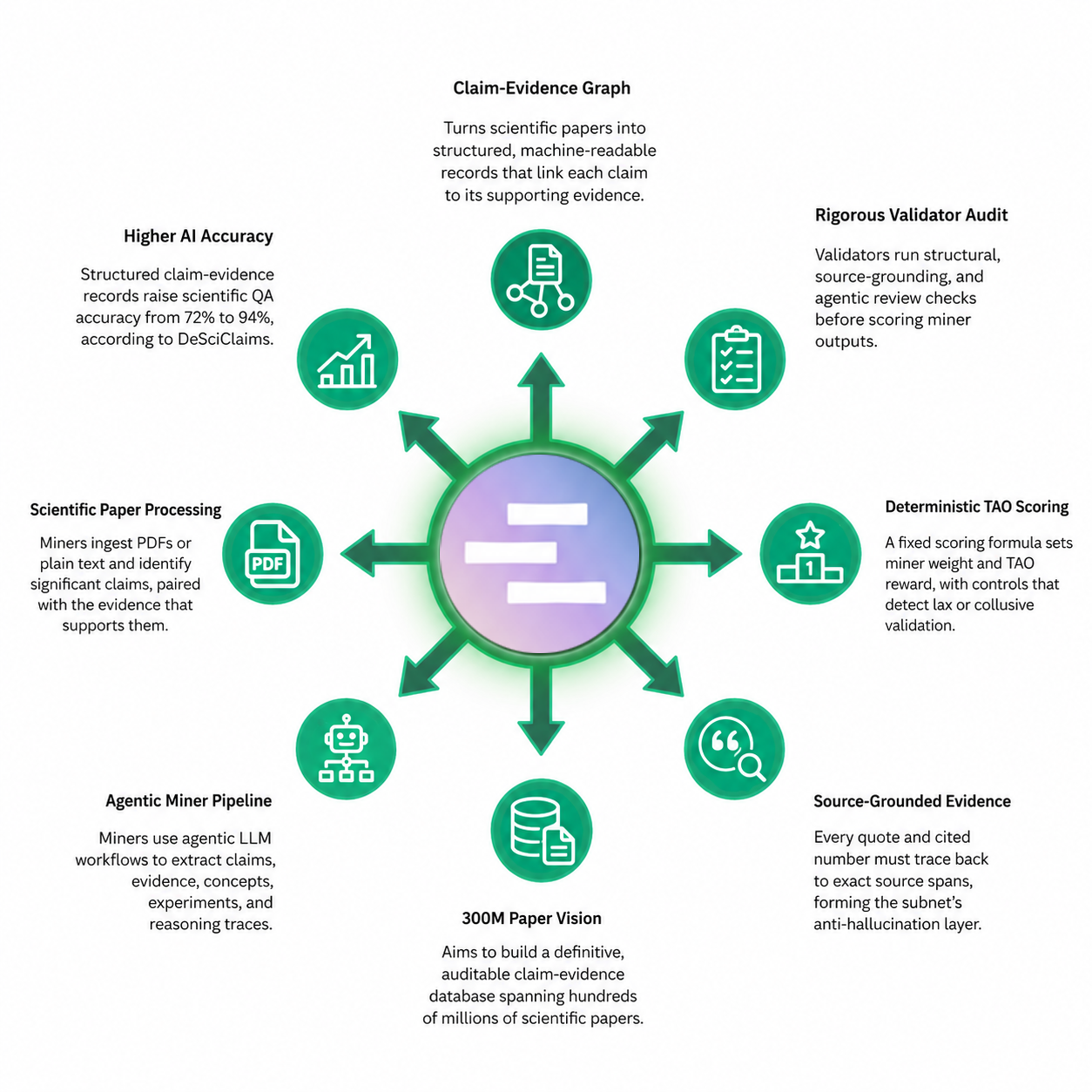
Claims is Bittensor Subnet 111 (SN111), built by DeSciClaims with one mission: to convert the world’s scientific literature into a structured, machine-readable claim-evidence graph. The problem it addresses is fundamental — scientific papers are written for human readers, not machines. While AI can summarise papers, it struggles to determine which specific claims are supported by evidence, which are contradicted, and which are merely speculative. DeSciClaims have demonstrated this gap precisely: AI systems answer scientific questions correctly 72% of the time when reading papers as prose, but accuracy rises to 94% when the same science is presented as structured claim-evidence records. That 22-percentage-point difference is what Claims is building.
The miner’s job is to process scientific papers — PDFs or plain text — and produce a structured artifact for each one. Every significant claim in the paper is identified, articulated, and paired with the specific evidence from the source text that supports it. The canonical miner pipeline, called agent_v1, uses an agentic LLM approach: a skill-capable agent loop (running via DSPy ReAct, LangChain, Hermes CLI, Codex CLI, or Claude CLI) reads the paper intelligently, uses tools for file access and validation, and emits a rich structured JSON artifact conforming to the ARA (Agent-Native Research Artifact) schema. This artifact captures not just claims and evidence, but also the paper’s logic, key concepts, experiments, conditions under which each claim holds, falsification criteria, source-grounded quotes with exact span references, and a full reasoning trace of the extraction process.
Validators on the subnet perform a rigorous multi-pass audit of every miner output. First, deterministic structural checks verify that the artifact schema is correct and all internal cross-references resolve. Second, source-grounding checks confirm that every quoted span actually exists in the source text and that any numerical value cited in a claim appears verbatim in a referenced span — this is the anti-hallucination layer. Third, a required agentic rigor review (itself running via an LLM agent) evaluates whether the evidence genuinely supports the claims, whether falsification criteria are meaningful, and whether the overall argument is coherent. Finally, a deterministic scoring formula translates findings into a numeric score that sets miner weight and TAO reward. An additional control layer runs hidden tests on validators themselves, preventing lax scoring or collusion.
What makes Claims distinctive in the DeSci space is the scale and rigour of its canonical ambition. DeSciClaims have stated a goal of converting 300 million scientific papers into a single, structured, auditable claim-evidence database — the definitive machine-readable record of what science actually says. The adversarial validation design ensures that miners cannot game the system with plausible-looking but unsupported extractions: every claim must be grounded in the actual paper text, traceable to exact source spans.
Claims is Bittensor Subnet 111 (SN111), built by DeSciClaims with one mission: to convert the world’s scientific literature into a structured, machine-readable claim-evidence graph. The problem it addresses is fundamental — scientific papers are written for human readers, not machines. While AI can summarise papers, it struggles to determine which specific claims are supported by evidence, which are contradicted, and which are merely speculative. DeSciClaims have demonstrated this gap precisely: AI systems answer scientific questions correctly 72% of the time when reading papers as prose, but accuracy rises to 94% when the same science is presented as structured claim-evidence records. That 22-percentage-point difference is what Claims is building.
The miner’s job is to process scientific papers — PDFs or plain text — and produce a structured artifact for each one. Every significant claim in the paper is identified, articulated, and paired with the specific evidence from the source text that supports it. The canonical miner pipeline, called agent_v1, uses an agentic LLM approach: a skill-capable agent loop (running via DSPy ReAct, LangChain, Hermes CLI, Codex CLI, or Claude CLI) reads the paper intelligently, uses tools for file access and validation, and emits a rich structured JSON artifact conforming to the ARA (Agent-Native Research Artifact) schema. This artifact captures not just claims and evidence, but also the paper’s logic, key concepts, experiments, conditions under which each claim holds, falsification criteria, source-grounded quotes with exact span references, and a full reasoning trace of the extraction process.
Validators on the subnet perform a rigorous multi-pass audit of every miner output. First, deterministic structural checks verify that the artifact schema is correct and all internal cross-references resolve. Second, source-grounding checks confirm that every quoted span actually exists in the source text and that any numerical value cited in a claim appears verbatim in a referenced span — this is the anti-hallucination layer. Third, a required agentic rigor review (itself running via an LLM agent) evaluates whether the evidence genuinely supports the claims, whether falsification criteria are meaningful, and whether the overall argument is coherent. Finally, a deterministic scoring formula translates findings into a numeric score that sets miner weight and TAO reward. An additional control layer runs hidden tests on validators themselves, preventing lax scoring or collusion.
What makes Claims distinctive in the DeSci space is the scale and rigour of its canonical ambition. DeSciClaims have stated a goal of converting 300 million scientific papers into a single, structured, auditable claim-evidence database — the definitive machine-readable record of what science actually says. The adversarial validation design ensures that miners cannot game the system with plausible-looking but unsupported extractions: every claim must be grounded in the actual paper text, traceable to exact source spans.
The product Claims is building is a canonical claim-evidence graph for all of science — a structured knowledge base where every significant scientific claim is linked to the exact evidence from the source paper that supports it, complete with conditions, falsification criteria, and source-grounded quotes. This is the structured scientific knowledge layer that AI systems need in order to reason precisely over scientific literature rather than merely summarise it. The commercial framing, as described by Bitstarter and DeSciClaims, centres on metered API access, MCP (Model Context Protocol) server support for AI agent integration, and custom enterprise ontologies — meaning research organisations, AI developers, and data platforms could query the Claims graph through standard AI tooling, pulling structured scientific knowledge directly into their workflows.
Target users span multiple verticals. Academic researchers and AI systems can query structured claim-evidence records far faster than reading full papers, and with much higher precision. Journals and publishers can use the graph to cross-reference claims against prior literature, detect unsupported assertions, and automate aspects of peer review. AI training pipelines can use high-quality claim-evidence data to improve scientific reasoning models. Fact-checkers and science communicators can trace the exact evidence behind any given scientific claim to its source. Pharma and biotech teams — the kinds of organisations that spend heavily on extracting signal from scientific literature — are a natural enterprise customer for a queryable, structured scientific knowledge database at scale.
The technical architecture layers Bittensor network mechanics over an agentic AI pipeline. Miners run locally with standard GPU or CPU compute, using open-source LLMs via OpenRouter and a Python-based miner runtime. Each miner run produces a structured agent_output.json artifact whose schema includes: a paper identity layer (title, authors, DOI, domain, keywords, abstract); a logic layer (claims, concepts, experiments, related work, problem observations, key insights, gaps); an evidence layer (records with source references and linked claims); a reasoning trace tree; environment and artifact metadata; and runtime telemetry (elapsed time, token usage, cost). Validators run the same agent backends for the rigor review pass, supporting DSPy, LangChain, Hermes, and Codex runtimes.
The incentive design is deliberately adversarial to ensure data quality. Validators do not accept miner output on face value — they perform source-grounding checks requiring every quote to appear verbatim in the source text, and numerical grounding checks requiring any numbers in claim statements to trace back to cited spans. Miners that produce elegant structure with unsupported references score poorly. The scoring formula starts at 1.0 and deducts for findings by severity, with hard floor rules for critical failures such as invalid JSON, missing schema layers, or failed source grounding. This means the TAO emission system directly rewards accurate extraction and penalises hallucination — aligning economic incentives with scientific rigour in a way that no prior scientific data pipeline has managed at this scale.
The product Claims is building is a canonical claim-evidence graph for all of science — a structured knowledge base where every significant scientific claim is linked to the exact evidence from the source paper that supports it, complete with conditions, falsification criteria, and source-grounded quotes. This is the structured scientific knowledge layer that AI systems need in order to reason precisely over scientific literature rather than merely summarise it. The commercial framing, as described by Bitstarter and DeSciClaims, centres on metered API access, MCP (Model Context Protocol) server support for AI agent integration, and custom enterprise ontologies — meaning research organisations, AI developers, and data platforms could query the Claims graph through standard AI tooling, pulling structured scientific knowledge directly into their workflows.
Target users span multiple verticals. Academic researchers and AI systems can query structured claim-evidence records far faster than reading full papers, and with much higher precision. Journals and publishers can use the graph to cross-reference claims against prior literature, detect unsupported assertions, and automate aspects of peer review. AI training pipelines can use high-quality claim-evidence data to improve scientific reasoning models. Fact-checkers and science communicators can trace the exact evidence behind any given scientific claim to its source. Pharma and biotech teams — the kinds of organisations that spend heavily on extracting signal from scientific literature — are a natural enterprise customer for a queryable, structured scientific knowledge database at scale.
The technical architecture layers Bittensor network mechanics over an agentic AI pipeline. Miners run locally with standard GPU or CPU compute, using open-source LLMs via OpenRouter and a Python-based miner runtime. Each miner run produces a structured agent_output.json artifact whose schema includes: a paper identity layer (title, authors, DOI, domain, keywords, abstract); a logic layer (claims, concepts, experiments, related work, problem observations, key insights, gaps); an evidence layer (records with source references and linked claims); a reasoning trace tree; environment and artifact metadata; and runtime telemetry (elapsed time, token usage, cost). Validators run the same agent backends for the rigor review pass, supporting DSPy, LangChain, Hermes, and Codex runtimes.
The incentive design is deliberately adversarial to ensure data quality. Validators do not accept miner output on face value — they perform source-grounding checks requiring every quote to appear verbatim in the source text, and numerical grounding checks requiring any numbers in claim statements to trace back to cited spans. Miners that produce elegant structure with unsupported references score poorly. The scoring formula starts at 1.0 and deducts for findings by severity, with hard floor rules for critical failures such as invalid JSON, missing schema layers, or failed source grounding. This means the TAO emission system directly rewards accurate extraction and penalises hallucination — aligning economic incentives with scientific rigour in a way that no prior scientific data pipeline has managed at this scale.
DeSciClaims launched on Bittensor in June 2026. The team has kept individual profiles relatively low-key, but a July 2026 thread introduced the three core roles behind the project: a scientist with direct experience fixing a replication crisis, an engineer who drove AI hallucination rates to near-zero, and an economist who designs the subnet’s incentive mechanisms. This combination is not accidental — it maps precisely onto the three hardest problems in building a trustworthy scientific knowledge graph: getting the science right, getting the AI extraction right, and designing the economic system so miners are rewarded for accuracy rather than volume.
The publicly named team member is Ogban Ugot (@OgbanUgot), the AI Software Engineer. Ugot is the lead engineer behind SciWeave, a prior project in AI-assisted scientific data processing. His background spans scalable AI systems, retrieval-augmented generation (RAG), vector databases, MLOps, and high-scale distributed systems. At DeSciClaims, his role is described as owning the execution layer: building and maintaining the pipeline that converts raw scientific papers into structured, validated, machine-readable claim-evidence records — the core engineering challenge of the entire subnet.
DeSciClaims received backing from Bitstarter, a Bittensor-focused launchpad, and was co-funded by the Beyond Finance Collective, which purchased the initial subnet slot and provided ecosystem support through launch. This institutional support within the Bittensor ecosystem gave the team the runway to focus on building, and situates Claims firmly within the broader Decentralised Science (DeSci) movement — the effort to make scientific knowledge more open, verifiable, and machine-accessible.
DeSciClaims launched on Bittensor in June 2026. The team has kept individual profiles relatively low-key, but a July 2026 thread introduced the three core roles behind the project: a scientist with direct experience fixing a replication crisis, an engineer who drove AI hallucination rates to near-zero, and an economist who designs the subnet’s incentive mechanisms. This combination is not accidental — it maps precisely onto the three hardest problems in building a trustworthy scientific knowledge graph: getting the science right, getting the AI extraction right, and designing the economic system so miners are rewarded for accuracy rather than volume.
The publicly named team member is Ogban Ugot (@OgbanUgot), the AI Software Engineer. Ugot is the lead engineer behind SciWeave, a prior project in AI-assisted scientific data processing. His background spans scalable AI systems, retrieval-augmented generation (RAG), vector databases, MLOps, and high-scale distributed systems. At DeSciClaims, his role is described as owning the execution layer: building and maintaining the pipeline that converts raw scientific papers into structured, validated, machine-readable claim-evidence records — the core engineering challenge of the entire subnet.
DeSciClaims received backing from Bitstarter, a Bittensor-focused launchpad, and was co-funded by the Beyond Finance Collective, which purchased the initial subnet slot and provided ecosystem support through launch. This institutional support within the Bittensor ecosystem gave the team the runway to focus on building, and situates Claims firmly within the broader Decentralised Science (DeSci) movement — the effort to make scientific knowledge more open, verifiable, and machine-accessible.
Claims’ immediate technical roadmap centres on completing the agent_v1 transition across the full network. The legacy v0 direct-extraction pipeline is being deprecated in favour of the richer ARA-schema agentic pipeline, which captures logic, evidence, trace, and metadata in a form that validators can score with far greater precision. The next infrastructure milestone is validator.agent_v1 — bringing the same agentic rigour to the validation side and enabling the subnet to score miner outputs against a multi-dimensional standard rather than flat row-level auditing. Benchmarking infrastructure is also planned: a backend leaderboard comparing miner models and harnesses, mutation-style validator tests that inject known defects and measure detection recall, and PaperBench-style QA evaluations that measure how well extracted artifacts support downstream AI reasoning.
On the product side, DeSciClaims has signalled plans for metered API access, MCP server support (making the claim-evidence graph queryable by AI agents and assistants through standard tooling), and custom enterprise ontologies for specific research domains. The stated long-run ambition is to process 300 million scientific papers — the bulk of all published science — into a single, structured, auditable claim-evidence database. If realised, this would represent the most comprehensive machine-readable scientific knowledge graph ever built, and a foundational data layer for the next generation of AI scientific reasoning.
Claims’ immediate technical roadmap centres on completing the agent_v1 transition across the full network. The legacy v0 direct-extraction pipeline is being deprecated in favour of the richer ARA-schema agentic pipeline, which captures logic, evidence, trace, and metadata in a form that validators can score with far greater precision. The next infrastructure milestone is validator.agent_v1 — bringing the same agentic rigour to the validation side and enabling the subnet to score miner outputs against a multi-dimensional standard rather than flat row-level auditing. Benchmarking infrastructure is also planned: a backend leaderboard comparing miner models and harnesses, mutation-style validator tests that inject known defects and measure detection recall, and PaperBench-style QA evaluations that measure how well extracted artifacts support downstream AI reasoning.
On the product side, DeSciClaims has signalled plans for metered API access, MCP server support (making the claim-evidence graph queryable by AI agents and assistants through standard tooling), and custom enterprise ontologies for specific research domains. The stated long-run ambition is to process 300 million scientific papers — the bulk of all published science — into a single, structured, auditable claim-evidence database. If realised, this would represent the most comprehensive machine-readable scientific knowledge graph ever built, and a foundational data layer for the next generation of AI scientific reasoning.