
With the amount of new subnets being added it can be hard to get up to date information across all subnets, so data may be slightly out of date from time to time
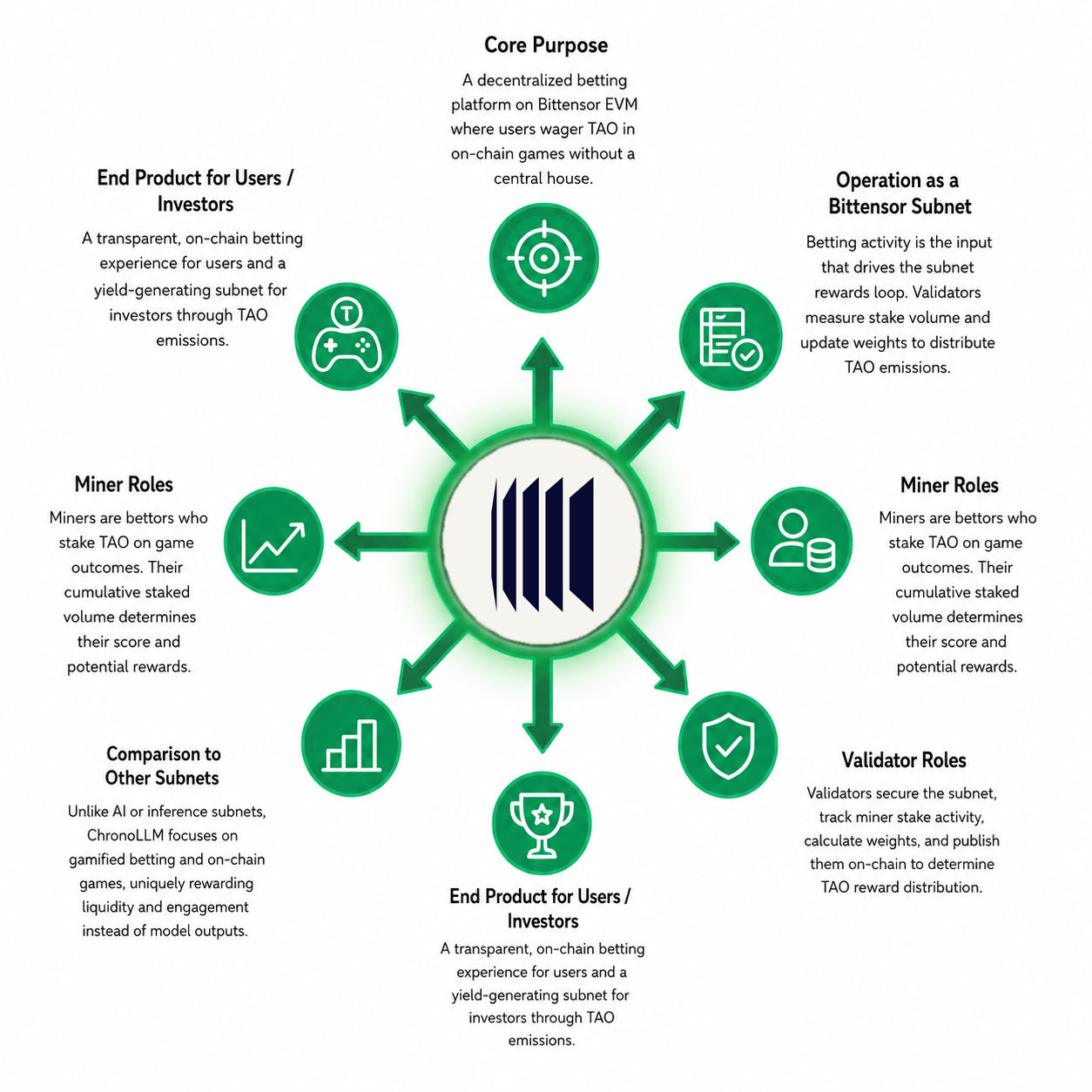
Core Purpose: ChronoLLM is a decentralized peer-to-peer betting subnet on Bittensor’s blockchain. As a gaming platform on the Bittensor EVM, it lets users wager TAO directly against each other in on-chain games. By eliminating a centralized “house,” ChronoLLM addresses trust and transparency issues of traditional betting: all rules and settlement are enforced by smart contracts on-chain. In effect, it creates a marketplace of strategic games (“Red vs Blue” RPS tournaments and other future games) where the network itself ensures fairness and rewards. This is fundamentally different from most Bittensor subnets (which focus on AI model inference or data tasks) and is classified by the project as “Strategic games” on the chain.
Operation as a Bittensor Subnet: Like any Bittensor subnet, ChronoLLM follows the miner/validator model where participants earn TAO (the native token) based on their contributions. In ChronoLLM’s context, the “contribution” is betting activity. Miners in this subnet participate by placing bets (staking TAO) in the active games via the TAO Colosseum smart contract. Meanwhile, validators maintain the chain and measure each miner’s (bettor’s) stake volume to compute rewards. The validators then update the Bittensor network weights, which determine how the subnet’s emission of TAO is distributed. In short, betting activity becomes the input that drives the reward loop on the Bittensor incentive layer..)
Miner Roles: In ChronoLLM, miners are essentially the game participants or bettors. They use their wallet to select a side and stake TAO (for example, choosing Red or Blue in the RPS tournament). Each bet is submitted as a transaction on the Bittensor EVM, creating an immutable record of that miner’s stake. A miner’s “score” in the subnet comes from the cumulative volume they stake over time. Thus, miners are contributing TAO liquidity and transaction work, similar to how miners in other subnets contribute model outputs. However, instead of supplying AI model responses, ChronoLLM miners supply betting volume.
Validator Roles: Validators in ChronoLLM are the network nodes that secure the Bittensor EVM and enforce the subnet rules. They observe the on-chain betting contract and collect data on each miner’s staked TAO. Based on this data, validators compute a weighted score for each miner (for example, applying a time-decay so that recent bets count more). They then write those scores into the Bittensor Metagraph as “weights”. Those weights instruct the next emission of TAO, so that miners with higher weighted stake earn more. This validator loop (collecting bet volumes and updating weights) typically runs every epoch (e.g. every ~360 blocks, ~72 minutes) so that rewards reflect recent betting behavior. In practice, the ChronoLLM subnet has had numerous validators participating even when few miners were active, indicating that validators see value in running this game network. The validators’ main job is to accurately measure everyone’s bets and to publish the reward schedules – their incentive is to earn a share of the network emission.
End Product for Users/Investors: For participants (users), the immediate “product” of ChronoLLM is the betting platform itself – they place bets and then claim winnings based on game outcomes. For investors or stakers, the output is the TAO rewards they earn from their network weight. The subnet does not produce a new AI model output; rather, it produces data (blockchain transaction history) and on-chain state (miner weights and balances). Users can inspect a public leaderboard or their own wallets to see how much reward they’ve earned. In effect, the product is a yield-generating betting game. Investors (or speculators) might hold ChronoLLM’s alpha token to capture a share of future rewards as the network grows, similar to staking in other subnets.
Comparison to Other Subnets: Unlike compute or inference subnets that reward running AI models, ChronoLLM is essentially a decentralized casino / prediction market. It competes with other Bittensor subnets only in the broad sense of an incentive platform, but its content is unique: betting games on-chain. The Bittensor directory explicitly labels the original Colosseum as “Strategic games”, whereas most high-profile subnets are tagged “LLM inference”, “Vision”, “Reasoning”, etc. ChronoLLM’s validator incentive mechanism is also noted as unusual – it was explicitly designed to reward game liquidity providers, rather than AI providers. In summary, ChronoLLM stands apart from typical subnets by focusing on gamified betting rather than AI tasks, converting user crypto tokens directly into interactive staking games on the blockchain.
Core Purpose: ChronoLLM is a decentralized peer-to-peer betting subnet on Bittensor’s blockchain. As a gaming platform on the Bittensor EVM, it lets users wager TAO directly against each other in on-chain games. By eliminating a centralized “house,” ChronoLLM addresses trust and transparency issues of traditional betting: all rules and settlement are enforced by smart contracts on-chain. In effect, it creates a marketplace of strategic games (“Red vs Blue” RPS tournaments and other future games) where the network itself ensures fairness and rewards. This is fundamentally different from most Bittensor subnets (which focus on AI model inference or data tasks) and is classified by the project as “Strategic games” on the chain.
Operation as a Bittensor Subnet: Like any Bittensor subnet, ChronoLLM follows the miner/validator model where participants earn TAO (the native token) based on their contributions. In ChronoLLM’s context, the “contribution” is betting activity. Miners in this subnet participate by placing bets (staking TAO) in the active games via the TAO Colosseum smart contract. Meanwhile, validators maintain the chain and measure each miner’s (bettor’s) stake volume to compute rewards. The validators then update the Bittensor network weights, which determine how the subnet’s emission of TAO is distributed. In short, betting activity becomes the input that drives the reward loop on the Bittensor incentive layer..)
Miner Roles: In ChronoLLM, miners are essentially the game participants or bettors. They use their wallet to select a side and stake TAO (for example, choosing Red or Blue in the RPS tournament). Each bet is submitted as a transaction on the Bittensor EVM, creating an immutable record of that miner’s stake. A miner’s “score” in the subnet comes from the cumulative volume they stake over time. Thus, miners are contributing TAO liquidity and transaction work, similar to how miners in other subnets contribute model outputs. However, instead of supplying AI model responses, ChronoLLM miners supply betting volume.
Validator Roles: Validators in ChronoLLM are the network nodes that secure the Bittensor EVM and enforce the subnet rules. They observe the on-chain betting contract and collect data on each miner’s staked TAO. Based on this data, validators compute a weighted score for each miner (for example, applying a time-decay so that recent bets count more). They then write those scores into the Bittensor Metagraph as “weights”. Those weights instruct the next emission of TAO, so that miners with higher weighted stake earn more. This validator loop (collecting bet volumes and updating weights) typically runs every epoch (e.g. every ~360 blocks, ~72 minutes) so that rewards reflect recent betting behavior. In practice, the ChronoLLM subnet has had numerous validators participating even when few miners were active, indicating that validators see value in running this game network. The validators’ main job is to accurately measure everyone’s bets and to publish the reward schedules – their incentive is to earn a share of the network emission.
End Product for Users/Investors: For participants (users), the immediate “product” of ChronoLLM is the betting platform itself – they place bets and then claim winnings based on game outcomes. For investors or stakers, the output is the TAO rewards they earn from their network weight. The subnet does not produce a new AI model output; rather, it produces data (blockchain transaction history) and on-chain state (miner weights and balances). Users can inspect a public leaderboard or their own wallets to see how much reward they’ve earned. In effect, the product is a yield-generating betting game. Investors (or speculators) might hold ChronoLLM’s alpha token to capture a share of future rewards as the network grows, similar to staking in other subnets.
Comparison to Other Subnets: Unlike compute or inference subnets that reward running AI models, ChronoLLM is essentially a decentralized casino / prediction market. It competes with other Bittensor subnets only in the broad sense of an incentive platform, but its content is unique: betting games on-chain. The Bittensor directory explicitly labels the original Colosseum as “Strategic games”, whereas most high-profile subnets are tagged “LLM inference”, “Vision”, “Reasoning”, etc. ChronoLLM’s validator incentive mechanism is also noted as unusual – it was explicitly designed to reward game liquidity providers, rather than AI providers. In summary, ChronoLLM stands apart from typical subnets by focusing on gamified betting rather than AI tasks, converting user crypto tokens directly into interactive staking games on the blockchain.
Current Status vs Development: As of mid-2026, ChronoLLM (formerly Colosseum) is live on mainnet but still early stage. Its first game (the Red-vs-Blue “RPS Tournament”) is operational (the project’s own site shows “RPS Tournament Live”). Other planned games (named “Threshold Catastrophe,” “Last Stander,” “Anti-Coordination Slots,” and “Werewolf AI”) are listed on the site as coming soon but not yet launched. There are no formal version releases or published changelogs; independent explorers note the team has not published a roadmap or news updates yet. The minting/distribution of ChronoLLM’s alpha token is also underway).
Architecture Overview: ChronoLLM runs on the Bittensor EVM layer, meaning its core logic is implemented in Ethereum-compatible smart contracts on the Subtensor chain. The on-chain component likely includes one or more Solidity (or Vyper) contracts implementing the betting rules (e.g. the Red-vs-Blue contract highlighted on the website). Off-chain, there must be a validator program that monitors these contracts and updates Bittensor weights. Although official details are scarce, hints from analytics suggest the codebase includes a Python validator script and supporting modules to interact with the network. In other words, the project’s GitHub repo (TAO-Colosseum) presumably contains the smart contract code plus a Python folder for the validator logic (as is typical for EVM-based subnets).
GitHub Repository: The ChronoLLM/Colosseum code is public on GitHub (see TAO-Colosseum/tao-colosseum-subnet). While direct browsing requires login, external analysis indicates the repo has documentation and a test suite, suggesting the developer provided usage instructions and examples. The repo likely features files for the EVM contract and the Python validator module. Independent observers noted this single-developer project surprisingly included CI tests and docs, though no new commits have appeared recently.
Metrics and Tokenomics: The ChronoLLM alpha token is trading around 0.020 TAO (about $5 USD given TAO’s ~$250 price). Market data aggregator OpenTAO reports a circulating supply of about 1.13M α (out of a 21M max) and a 24-hour emission of only 60 τ — a modest rate reflecting the subnet’s early stage. OpenTAO also shows ~244 of 256 miner slots currently filled, with about 12 active validators. This implies broad participant interest (most slots in use) but only one miner currently earning reward (the “1 earning” note). The subnet’s transaction volume and TVL remain small), consistent with a niche gaming project.
Integrations and Tools: ChronoLLM primarily relies on Bittensor’s own EVM runtime. To participate, users can use standard Bittensor wallets (or Ethereum-compatible tools) to send TAO to the betting contracts. There is no announced external API; all logic runs on-chain or in the validator. (Notably, the official site mentions verifiable random bits for anti-sniping, implying an external randomness source, but independent confirmation is lacking.) Otherwise, ChronoLLM integrates with Bittensor’s mining ecosystem: any automation or inference in this subnet must pass through the official Bittensor miner ABI and weight-setting conventions.
End Users/Customers: The target audience for ChronoLLM is crypto-savvy users who enjoy decentralized games and betting. Typical users are those who buy ChronoLLM tokens and place bets in the games to win TAO payouts. Investors or stakers can simply hold ChronoLLM alpha and passively earn a share of token emissions as validators process the subnet (similar to staking in other AI subnets). There is no obvious corporate customer; instead, it’s a community-driven experiment. In that sense, ChronoLLM’s users overlap strongly with Bittensor miners and ecosystem participants rather than traditional product customers.
Current Status vs Development: As of mid-2026, ChronoLLM (formerly Colosseum) is live on mainnet but still early stage. Its first game (the Red-vs-Blue “RPS Tournament”) is operational (the project’s own site shows “RPS Tournament Live”). Other planned games (named “Threshold Catastrophe,” “Last Stander,” “Anti-Coordination Slots,” and “Werewolf AI”) are listed on the site as coming soon but not yet launched. There are no formal version releases or published changelogs; independent explorers note the team has not published a roadmap or news updates yet. The minting/distribution of ChronoLLM’s alpha token is also underway).
Architecture Overview: ChronoLLM runs on the Bittensor EVM layer, meaning its core logic is implemented in Ethereum-compatible smart contracts on the Subtensor chain. The on-chain component likely includes one or more Solidity (or Vyper) contracts implementing the betting rules (e.g. the Red-vs-Blue contract highlighted on the website). Off-chain, there must be a validator program that monitors these contracts and updates Bittensor weights. Although official details are scarce, hints from analytics suggest the codebase includes a Python validator script and supporting modules to interact with the network. In other words, the project’s GitHub repo (TAO-Colosseum) presumably contains the smart contract code plus a Python folder for the validator logic (as is typical for EVM-based subnets).
GitHub Repository: The ChronoLLM/Colosseum code is public on GitHub (see TAO-Colosseum/tao-colosseum-subnet). While direct browsing requires login, external analysis indicates the repo has documentation and a test suite, suggesting the developer provided usage instructions and examples. The repo likely features files for the EVM contract and the Python validator module. Independent observers noted this single-developer project surprisingly included CI tests and docs, though no new commits have appeared recently.
Metrics and Tokenomics: The ChronoLLM alpha token is trading around 0.020 TAO (about $5 USD given TAO’s ~$250 price). Market data aggregator OpenTAO reports a circulating supply of about 1.13M α (out of a 21M max) and a 24-hour emission of only 60 τ — a modest rate reflecting the subnet’s early stage. OpenTAO also shows ~244 of 256 miner slots currently filled, with about 12 active validators. This implies broad participant interest (most slots in use) but only one miner currently earning reward (the “1 earning” note). The subnet’s transaction volume and TVL remain small), consistent with a niche gaming project.
Integrations and Tools: ChronoLLM primarily relies on Bittensor’s own EVM runtime. To participate, users can use standard Bittensor wallets (or Ethereum-compatible tools) to send TAO to the betting contracts. There is no announced external API; all logic runs on-chain or in the validator. (Notably, the official site mentions verifiable random bits for anti-sniping, implying an external randomness source, but independent confirmation is lacking.) Otherwise, ChronoLLM integrates with Bittensor’s mining ecosystem: any automation or inference in this subnet must pass through the official Bittensor miner ABI and weight-setting conventions.
End Users/Customers: The target audience for ChronoLLM is crypto-savvy users who enjoy decentralized games and betting. Typical users are those who buy ChronoLLM tokens and place bets in the games to win TAO payouts. Investors or stakers can simply hold ChronoLLM alpha and passively earn a share of token emissions as validators process the subnet (similar to staking in other AI subnets). There is no obvious corporate customer; instead, it’s a community-driven experiment. In that sense, ChronoLLM’s users overlap strongly with Bittensor miners and ecosystem participants rather than traditional product customers.
Team and Contributors: ChronoLLM (formerly Colosseum) appears to have been developed by a single pseudonymous author. Independent analysis notes that 100% of the project’s GitHub commits came from one developer, indicating no formal team at launch. No public names or identities for the developer have been disclosed; the project was simply published under the moniker “TAO-Colosseum”. After the rebranding to ChronoLLM, on-chain records show a change in the owner’s coldkey, suggesting control passed to a new party, but neither individual has revealed a public persona. There are no known partnerships or institutional backers; the project seems to be community-driven with decentralized participation. The developers’ background in AI is unclear — this subnet is primarily a crypto-gaming project. Its sole contributor likely has some blockchain and Python expertise (given the codebase structure), but no formal AI/decentralized-work history is documented.
Community Engagement: There is limited evidence of official outreach or marketing. The team has not announced its own website overhaul or social media..) Community-written analyses and listings (like TAOstats, TAOMinal, and Backprop Finance) provide most of what is known. In summary, ChronoLLM’s team remains anonymous beyond on-chain footprints, and no formal team roster or roadmap publications exist.
Team and Contributors: ChronoLLM (formerly Colosseum) appears to have been developed by a single pseudonymous author. Independent analysis notes that 100% of the project’s GitHub commits came from one developer, indicating no formal team at launch. No public names or identities for the developer have been disclosed; the project was simply published under the moniker “TAO-Colosseum”. After the rebranding to ChronoLLM, on-chain records show a change in the owner’s coldkey, suggesting control passed to a new party, but neither individual has revealed a public persona. There are no known partnerships or institutional backers; the project seems to be community-driven with decentralized participation. The developers’ background in AI is unclear — this subnet is primarily a crypto-gaming project. Its sole contributor likely has some blockchain and Python expertise (given the codebase structure), but no formal AI/decentralized-work history is documented.
Community Engagement: There is limited evidence of official outreach or marketing. The team has not announced its own website overhaul or social media..) Community-written analyses and listings (like TAOstats, TAOMinal, and Backprop Finance) provide most of what is known. In summary, ChronoLLM’s team remains anonymous beyond on-chain footprints, and no formal team roster or roadmap publications exist.
Milestones Achieved: The only documented milestone is the subnet’s deployment. Blockchain explorers note that ChronoLLM (as Colosseum SN38) was launched on Jan 09, 2026. At launch, all of its alpha tokens entered circulation and its smart contract went live on the Bittensor EVM. Following that, the core betting game (Red vs Blue RPS tournament) became operational, as indicated by the live status on the official site. No other phases are logged.
Upcoming Plans: The original project roadmap envisioned multiple game formats beyond RPS. The website’s tournament board lists several slated games under development (Threshold Catastrophe, Last Stander, etc.), implying the team planned a multi-game platform. However, no dates or deliverables for these have been announced. There have been no new commits or releases to signal their completion. The rebranding to ChronoLLM itself may reflect a revised plan (possibly tying in large-language-model references), but again no official explanation is available.
Fully Realized Vision: From available hints, the long-term vision is a full casino of on-chain games with integrated Bittensor incentives. In a complete rollout, ChronoLLM would continuously run its suite of games, rewarding participants with a share of the TAO token emission, and maintaining leaderboards. The validator nodes would periodically distribute TAO based on a time-weighted score of each player’s bets. In essence, it aims to embed social betting dynamics into Bittensor’s decentralized economy.
Status and Announcements: As of now, there have been no recent publications or social media announcements about ChronoLLM since rebrand. Explorers like Taominal still list updates as “No transmissions yet,” meaning no roadmap entries or news posts have been released. The only visible changes are on-chain (owner key change, token trading under ChronoLLM) and the updated site status. In summary, ChronoLLM’s roadmap is unannounced beyond what the community can observe from the live network: games live/coming soon as listed on the front end. Stakeholders should watch the project’s wallet/contract activity for clues to future releases.
Milestones Achieved: The only documented milestone is the subnet’s deployment. Blockchain explorers note that ChronoLLM (as Colosseum SN38) was launched on Jan 09, 2026. At launch, all of its alpha tokens entered circulation and its smart contract went live on the Bittensor EVM. Following that, the core betting game (Red vs Blue RPS tournament) became operational, as indicated by the live status on the official site. No other phases are logged.
Upcoming Plans: The original project roadmap envisioned multiple game formats beyond RPS. The website’s tournament board lists several slated games under development (Threshold Catastrophe, Last Stander, etc.), implying the team planned a multi-game platform. However, no dates or deliverables for these have been announced. There have been no new commits or releases to signal their completion. The rebranding to ChronoLLM itself may reflect a revised plan (possibly tying in large-language-model references), but again no official explanation is available.
Fully Realized Vision: From available hints, the long-term vision is a full casino of on-chain games with integrated Bittensor incentives. In a complete rollout, ChronoLLM would continuously run its suite of games, rewarding participants with a share of the TAO token emission, and maintaining leaderboards. The validator nodes would periodically distribute TAO based on a time-weighted score of each player’s bets. In essence, it aims to embed social betting dynamics into Bittensor’s decentralized economy.
Status and Announcements: As of now, there have been no recent publications or social media announcements about ChronoLLM since rebrand. Explorers like Taominal still list updates as “No transmissions yet,” meaning no roadmap entries or news posts have been released. The only visible changes are on-chain (owner key change, token trading under ChronoLLM) and the updated site status. In summary, ChronoLLM’s roadmap is unannounced beyond what the community can observe from the live network: games live/coming soon as listed on the front end. Stakeholders should watch the project’s wallet/contract activity for clues to future releases.
A special thanks to Mark Jeffrey for his amazing Hash Rate series! In this series, he provides valuable insights into Bittensor Subnets and the world of decentralized AI. Be sure to check out the full series on his YouTube channel for more expert analysis and deep dives.
Recorded in July 2026, Mark Jeffrey speaks with Jean Hurel of Crunch about Kronos (Subnet 38), which is building what Jean describes as the first chronologically consistent large language model designed specifically to eliminate look-ahead bias in financial analysis. Instead of one model trained on everything, Kronos creates a series of yearly “vintages” from 1999 through 2025, with each version only knowing information available up to that point in time, allowing hedge funds and quantitative traders to backtest strategies without an AI accidentally using knowledge of future events such as COVID, financial crises or later market developments. The project currently starts with a roughly 2B-parameter model and plans to scale toward 14B and potentially 72B, while miners compete to improve each version by adding more historically accurate knowledge without introducing future-data leaks. Crunch’s existing community of around 12,000 data scientists, including roughly 1,200 PhDs, acts as an additional adversarial layer by searching for temporal leaks and creating new tests for validators. Jean explains that the commercial opportunity is primarily aimed at hedge funds, asset managers and other financial institutions that already spend heavily on point-in-time data, with Kronos potentially being customized using a client’s proprietary financial datasets and sold either through usage-based pricing or enterprise licensing. He estimates the initial quantitative-finance opportunity at roughly $3–5 billion and argues Bittensor makes the project viable by shifting much of the enormous model-training cost onto incentivized miners, reducing the capital requirement by around 90% compared with building it conventionally. They also discuss future token value capture through revenue-funded market purchases, as well as broader Bittensor developments including subnet-token shorting, hedging and centralized exchange listings.
Big shoutout to Gordon Frayne for his incredible work on his TAO Pill podcast! His deep dives into Bittensor Subnets break down the decentralized AI landscape like few others can. Head over to his YouTube channel to catch the full series for top-tier analysis and insights.
Recorded in July 2026. Gordon Frayne speaks with Gan, co-founder of Chrono LLM, Bittensor Subnet 38, about building chronologically consistent large language models designed specifically for financial research and backtesting. Gan explains how conventional LLMs create a serious problem for hedge funds and quantitative researchers because they have been trained on information from the future, meaning historical simulations can suffer from look-ahead bias and appear far more successful than they really are. Chrono LLM aims to solve this by creating a chain of separate “vintage” models, each trained only on information available up to a specific point in time, allowing users to ask historical questions and test investment ideas without the model secretly knowing what happened afterwards. The conversation explores how miners are incentivised to source and train on correctly timestamped data, while Gan’s existing CrunchDAO community acts as an additional verification layer by devising questions designed to uncover information leaks in each model. He also explains how these point-in-time models could allow financial institutions to create entirely new historical indicators from documents such as central bank releases, helping them discover relationships and signals that were never formally measured at the time. They discuss Chrono LLM’s commercial focus on quantitative hedge funds, discretionary asset managers and institutional investors, with monetisation expected to come largely from fine-tuning and deploying specialised versions of the models for individual clients. Gan also outlines the technical roadmap, beginning with roughly 1.5-billion-parameter models before progressing towards 14 billion and eventually 72 billion parameters, with the goal of proving the architecture, beginning institutional pilots and ultimately producing a frontier-quality financial model that combines Bittensor’s decentralized compute with CrunchDAO’s network of thousands of financial machine-learning specialists.