
With the amount of new subnets being added it can be hard to get up to date information across all subnets, so data may be slightly out of date from time to time
Cascade is Bittensor Subnet 91, built by TensorLink AI with a single ambitious objective: produce the world’s most capable time-series foundation model through decentralised competition. Rather than training a model once with a fixed dataset, Cascade turns synthetic data generation into the competitive resource — miners race every round to discover the prior that produces the sharpest forecaster, and the network continuously distils the winner into a growing model.
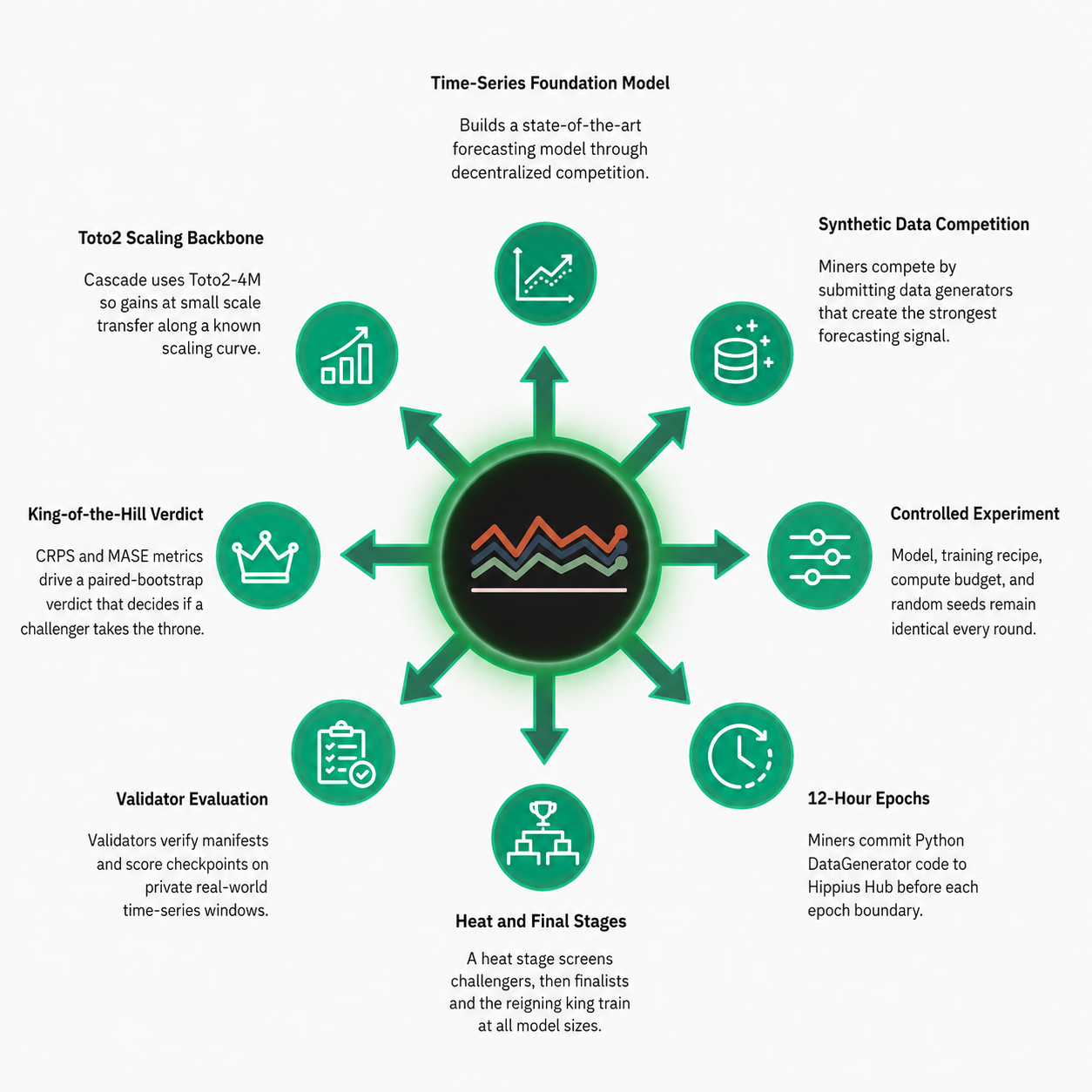
The mechanism is a controlled experiment enforced on-chain. The model architecture, training recipe, compute budget, and random seeds are held byte-identical for every competitor in a round. The only variable is the data generator each miner submits. By holding everything else constant, the subnet converts a noisy question — “is this model good?” — into a clean, measurable one: “is this data good?” This attribution is only possible because training starts from a random initialisation, not a fine-tuned checkpoint, so the corpus is the sole source of learned signal.
Each round follows a 12-hour epoch. Miners write a DataGenerator in Python, push the code to the Hippius Hub registry, and commit an on-chain pointer before the epoch boundary. The subnet operator’s trainer then runs a heat stage — training every eligible challenger cheaply at the primary model size (~30 minutes) — and screens down to the top finalist. The final stage trains the reigning king and each finalist from a shared random seed at all configured sizes (currently Toto2-4M and Toto2-22M), giving both identical wall-clock compute on the operator’s reference GPU.
Validators handle evaluation without ever training. Each epoch they verify the signed TrainingManifest, pull king and challenger checkpoints, and score them on a private rotating set of real-world time-series windows using CRPS and MASE metrics. Scores are pooled across model sizes into a single paired-bootstrap King-of-the-Hill verdict. If the challenger’s data trains a decisively better forecaster, it takes the throne and inherits all emission weight. The result is a winner-takes-all, highly competitive incentive structure designed to push forecasting quality towards state of the art as fast as possible.
The fixed backbone is Toto2-4M — a 4-million-parameter model from Datadog’s Toto 2.0 family, which has demonstrated clean scaling laws across four model sizes and tops GIFT-Eval benchmarks despite being trained on 57.5% synthetic data with no public real series. Cascade adopts this backbone precisely because it sits on a known scaling curve: skill improvements at the small size are expected to transfer predictably as the subnet scales up, making every round a meaningful step in a long-horizon programme.
Cascade is Bittensor Subnet 91, built by TensorLink AI with a single ambitious objective: produce the world’s most capable time-series foundation model through decentralised competition. Rather than training a model once with a fixed dataset, Cascade turns synthetic data generation into the competitive resource — miners race every round to discover the prior that produces the sharpest forecaster, and the network continuously distils the winner into a growing model.
The mechanism is a controlled experiment enforced on-chain. The model architecture, training recipe, compute budget, and random seeds are held byte-identical for every competitor in a round. The only variable is the data generator each miner submits. By holding everything else constant, the subnet converts a noisy question — “is this model good?” — into a clean, measurable one: “is this data good?” This attribution is only possible because training starts from a random initialisation, not a fine-tuned checkpoint, so the corpus is the sole source of learned signal.
Each round follows a 12-hour epoch. Miners write a DataGenerator in Python, push the code to the Hippius Hub registry, and commit an on-chain pointer before the epoch boundary. The subnet operator’s trainer then runs a heat stage — training every eligible challenger cheaply at the primary model size (~30 minutes) — and screens down to the top finalist. The final stage trains the reigning king and each finalist from a shared random seed at all configured sizes (currently Toto2-4M and Toto2-22M), giving both identical wall-clock compute on the operator’s reference GPU.
Validators handle evaluation without ever training. Each epoch they verify the signed TrainingManifest, pull king and challenger checkpoints, and score them on a private rotating set of real-world time-series windows using CRPS and MASE metrics. Scores are pooled across model sizes into a single paired-bootstrap King-of-the-Hill verdict. If the challenger’s data trains a decisively better forecaster, it takes the throne and inherits all emission weight. The result is a winner-takes-all, highly competitive incentive structure designed to push forecasting quality towards state of the art as fast as possible.
The fixed backbone is Toto2-4M — a 4-million-parameter model from Datadog’s Toto 2.0 family, which has demonstrated clean scaling laws across four model sizes and tops GIFT-Eval benchmarks despite being trained on 57.5% synthetic data with no public real series. Cascade adopts this backbone precisely because it sits on a known scaling curve: skill improvements at the small size are expected to transfer predictably as the subnet scales up, making every round a meaningful step in a long-horizon programme.
Cascade’s product is a continuously improving time-series foundation model (TSFM) that is trained, ranked, and refined entirely on-chain. Unlike closed proprietary forecasting APIs, every component of Cascade’s training pipeline is publicly auditable: the model architecture is fixed and published, the training seeds are derived from Bittensor block hashes, the generated checkpoints are stored on Hippius Hub with content-addressed digests, and the scoring methodology is open-source. The result is a foundation model whose provenance can be reproduced and verified by anyone with a copy of the generator code and the round manifest.
The primary product surface today is the public dashboard at testnet.cascadesub.net, which shows the current king generator, real-time heat leaderboards, model error curves over rounds, and historical reign records. Researchers, developers, and validators can inspect winning data mixes, download generator code, and monitor upcoming epoch deadlines. As the model matures, Cascade’s roadmap points towards a stakeholder-facing inference API — a single foundation model trained by decentralised competition and available for general time-series forecasting tasks.
The target users span two audiences. On the supply side, Cascade attracts machine-learning researchers and engineers who write synthetic data generators and earn TAO emissions for advancing model quality — no GPU required to mine, only algorithmic insight into what makes synthetic time-series distributions useful for training. On the demand side, data-science teams, enterprise AI groups, and forecasting practitioners benefit from a model trained on the broadest competitive synthetic corpus the Bittensor network can discover, in domains ranging from financial markets and energy grids to weather and industrial systems.
The technical architecture reflects a deliberate separation of concerns. Miners require no GPU — their role is purely algorithmic: produce a deterministic DataGenerator that, given a fixed seed, generates a byte-identical corpus every time. The trainer (operated by the subnet owner) holds the GPU boundary, running each submission under a sandboxed environment that prevents any model weights from being embedded in a generator. The validator holds the evaluation boundary, scoring on held-out windows that miners never see. This three-role design prevents overfitting, eliminates weight distillation cheats, and ensures the only path to winning is better data.
Cascade’s Bittensor incentive design directly aligns economic rewards with scientific progress. Emissions flow entirely to the generator whose data produces the best-performing checkpoint, with optional rewards for recently dethroned kings to acknowledge lasting contributions. The King-of-the-Hill structure, inspired by Bittensor SN3, means there is no plateau — every round the reigning king can be challenged, and each dethroning moves the model forward. As the programme scales through its phases, the incentive surface will widen to include model architecture, enabling the Bittensor network to compete the full training stack.
Cascade’s product is a continuously improving time-series foundation model (TSFM) that is trained, ranked, and refined entirely on-chain. Unlike closed proprietary forecasting APIs, every component of Cascade’s training pipeline is publicly auditable: the model architecture is fixed and published, the training seeds are derived from Bittensor block hashes, the generated checkpoints are stored on Hippius Hub with content-addressed digests, and the scoring methodology is open-source. The result is a foundation model whose provenance can be reproduced and verified by anyone with a copy of the generator code and the round manifest.
The primary product surface today is the public dashboard at testnet.cascadesub.net, which shows the current king generator, real-time heat leaderboards, model error curves over rounds, and historical reign records. Researchers, developers, and validators can inspect winning data mixes, download generator code, and monitor upcoming epoch deadlines. As the model matures, Cascade’s roadmap points towards a stakeholder-facing inference API — a single foundation model trained by decentralised competition and available for general time-series forecasting tasks.
The target users span two audiences. On the supply side, Cascade attracts machine-learning researchers and engineers who write synthetic data generators and earn TAO emissions for advancing model quality — no GPU required to mine, only algorithmic insight into what makes synthetic time-series distributions useful for training. On the demand side, data-science teams, enterprise AI groups, and forecasting practitioners benefit from a model trained on the broadest competitive synthetic corpus the Bittensor network can discover, in domains ranging from financial markets and energy grids to weather and industrial systems.
The technical architecture reflects a deliberate separation of concerns. Miners require no GPU — their role is purely algorithmic: produce a deterministic DataGenerator that, given a fixed seed, generates a byte-identical corpus every time. The trainer (operated by the subnet owner) holds the GPU boundary, running each submission under a sandboxed environment that prevents any model weights from being embedded in a generator. The validator holds the evaluation boundary, scoring on held-out windows that miners never see. This three-role design prevents overfitting, eliminates weight distillation cheats, and ensures the only path to winning is better data.
Cascade’s Bittensor incentive design directly aligns economic rewards with scientific progress. Emissions flow entirely to the generator whose data produces the best-performing checkpoint, with optional rewards for recently dethroned kings to acknowledge lasting contributions. The King-of-the-Hill structure, inspired by Bittensor SN3, means there is no plateau — every round the reigning king can be challenged, and each dethroning moves the model forward. As the programme scales through its phases, the incentive surface will widen to include model architecture, enabling the Bittensor network to compete the full training stack.
Cascade was founded and is led by Christensor, who goes by the handle @tensorlink_dev. With nearly two years dedicated to time-series modelling and more than 700 commits across the TensorLink AI project history, Christensor brings deep, specialised focus to an area most AI teams treat as secondary. He has direct experience mining several Bittensor subnets, which informs the practical design choices behind Cascade’s miner-friendly, no-GPU architecture. The TensorLink AI GitHub organisation houses the cascade repo alongside complementary projects including cascade-miner, AionBench, and earlier infrastructure work in the ganglion family of tools.
The operational side of the project is led by @macrozack, who brings more than eight years of experience in complex infrastructure industries and prior experience through the Bitstarter launchpad. Cascade was one of Bitstarter’s early featured launches, and this relationship has provided both community exposure and operational support for the subnet’s go-to-market. Incentive design and subnet architecture have been shaped with input from @const_reborn, the architect behind Bittensor SN3’s King-of-the-Hill mechanism — a structure Cascade deliberately adapts and extends for the time-series domain. No further team members have been publicly named at this time.
Cascade was founded and is led by Christensor, who goes by the handle @tensorlink_dev. With nearly two years dedicated to time-series modelling and more than 700 commits across the TensorLink AI project history, Christensor brings deep, specialised focus to an area most AI teams treat as secondary. He has direct experience mining several Bittensor subnets, which informs the practical design choices behind Cascade’s miner-friendly, no-GPU architecture. The TensorLink AI GitHub organisation houses the cascade repo alongside complementary projects including cascade-miner, AionBench, and earlier infrastructure work in the ganglion family of tools.
The operational side of the project is led by @macrozack, who brings more than eight years of experience in complex infrastructure industries and prior experience through the Bitstarter launchpad. Cascade was one of Bitstarter’s early featured launches, and this relationship has provided both community exposure and operational support for the subnet’s go-to-market. Incentive design and subnet architecture have been shaped with input from @const_reborn, the architect behind Bittensor SN3’s King-of-the-Hill mechanism — a structure Cascade deliberately adapts and extends for the time-series domain. No further team members have been publicly named at this time.
Cascade is executing a deliberate three-phase programme. Phase 1 — live today — holds the model byte-identical across all competitors so that only synthetic data quality determines who wins. This phase proves the core thesis: that the right synthetic prior is sufficient to train a state-of-the-art forecaster, and that this quality signal is cleanly measurable per round. Recent results from the live subnet have already shown the Cascade 4M checkpoint matching or exceeding models tens of times larger on standard benchmarks such as GIFT-Eval, validating the approach.
Phase 2 will validate that the data advantage discovered at the small model size transfers as the fixed model scales. Cascade’s choice of the Toto2 family is deliberate here: Toto 2.0 is the first time-series foundation family to demonstrate a clean, monotonic scaling law across four sizes (4M → 22M → 313M → 1B → 2.5B) using unit-μP parametrisation — hyperparameters tuned once at 4M transfer to 2.5B without retuning. This makes inexpensive small-model rounds predictive of large-model performance, enabling the subnet to rank data recipes cheaply before paying full compute to confirm them. Phase 3 will open the training contract to let miners compete on model architecture as well as data, widening the competitive surface to the full training pipeline. The long-run north star is multimodal forecasting — a model that reasons across time series, language, and vision, turning Cascade into a universal temporal intelligence engine.
Cascade is executing a deliberate three-phase programme. Phase 1 — live today — holds the model byte-identical across all competitors so that only synthetic data quality determines who wins. This phase proves the core thesis: that the right synthetic prior is sufficient to train a state-of-the-art forecaster, and that this quality signal is cleanly measurable per round. Recent results from the live subnet have already shown the Cascade 4M checkpoint matching or exceeding models tens of times larger on standard benchmarks such as GIFT-Eval, validating the approach.
Phase 2 will validate that the data advantage discovered at the small model size transfers as the fixed model scales. Cascade’s choice of the Toto2 family is deliberate here: Toto 2.0 is the first time-series foundation family to demonstrate a clean, monotonic scaling law across four sizes (4M → 22M → 313M → 1B → 2.5B) using unit-μP parametrisation — hyperparameters tuned once at 4M transfer to 2.5B without retuning. This makes inexpensive small-model rounds predictive of large-model performance, enabling the subnet to rank data recipes cheaply before paying full compute to confirm them. Phase 3 will open the training contract to let miners compete on model architecture as well as data, widening the competitive surface to the full training pipeline. The long-run north star is multimodal forecasting — a model that reasons across time series, language, and vision, turning Cascade into a universal temporal intelligence engine.