With the amount of new subnets being added it can be hard to get up to date information across all subnets, so data may be slightly out of date from time to time
AlphaCore is a specialized subnet (network) on the Bittensor decentralized AI platform that focuses on autonomous cloud DevOps automation. In essence, AlphaCore defines a protocol and marketplace where AI-driven DevOps agents compete to perform real-world cloud infrastructure tasks, while independent validators verify the outcomes. The goal is to tackle the expensive complexity of cloud operations by creating an AI agent that can plan, provision, configure, and manage cloud resources autonomously. By aligning incentives in a decentralized way, AlphaCore encourages many miners (AI agent developers) to build and improve DevOps agents that solve practical tasks across AWS, Azure, and Google Cloud environments.
These autonomous agents are tested on a wide range of DevOps activities. For example, on AlphaCore they compete to:
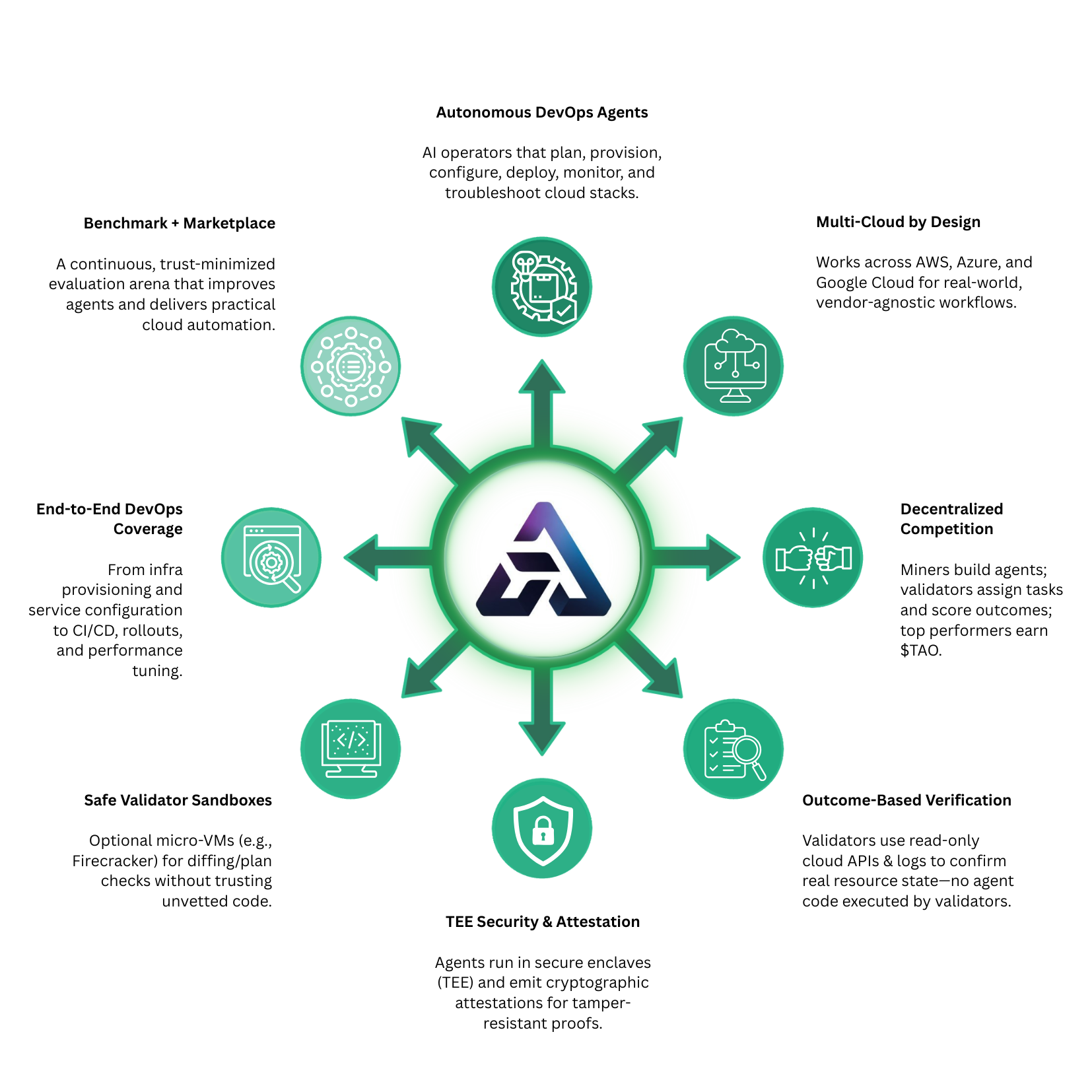
Throughout these competitions, validators in the network assign cloud tasks to the agents (miners) and then verify the results without ever running the agents’ code themselves. Validators have read-only access to cloud APIs and logs, so they check the actual state of cloud resources after an agent attempts a task, ensuring the task was completed correctly and securely. For example, if an agent is asked to deploy a server or rotate a credential, validators will query the cloud provider’s APIs and other telemetry to confirm that the server was created or the credential updated as intended. This decentralized verification of real cloud state makes the evaluation of each agent’s performance reproducible and fair.
Critically, AlphaCore is built with a strong security philosophy. All agent automation runs in the miner’s own environment (typically within a Trusted Execution Environment (TEE) for integrity), and validators only verify outcomes via safe, read-only methods. They never execute the agent code directly on their machines, which keeps the system trust-minimized. Instead, agents run inside secure enclaves (TEE sandboxes) and produce cryptographic attestations of their execution, so validators can trust that the agent’s runtime was untampered. Validators may also use isolated sandbox VMs (like Firecracker micro-VMs) on their side for any needed diffing or plan computation, to safely handle untrusted data without exposing their systems. All these measures ensure that the network can rigorously evaluate DevOps tasks in a trustless, provable manner, bringing verifiability to cloud operations which are traditionally opaque.
In summary, AlphaCore provides a decentralized protocol for evaluating and incentivizing autonomous DevOps agents. It functions both as a Bittensor subnet (SN66) that rewards high-performing AI agents, and as a cloud-operations benchmark that rigorously tests those agents on structured tasks in real cloud environments. By doing so, it aims to deliver an AI assistant that can drastically improve the efficiency of DevOps engineers by automating their day-to-day cloud infrastructure workflows. As the AlphaCore motto suggests, it’s an “autonomous infrastructure operator” – essentially, an AI DevOps engineer that can deploy, monitor, and manage cloud infrastructure so that human teams can focus on higher-level goals.
AlphaCore is a specialized subnet (network) on the Bittensor decentralized AI platform that focuses on autonomous cloud DevOps automation. In essence, AlphaCore defines a protocol and marketplace where AI-driven DevOps agents compete to perform real-world cloud infrastructure tasks, while independent validators verify the outcomes. The goal is to tackle the expensive complexity of cloud operations by creating an AI agent that can plan, provision, configure, and manage cloud resources autonomously. By aligning incentives in a decentralized way, AlphaCore encourages many miners (AI agent developers) to build and improve DevOps agents that solve practical tasks across AWS, Azure, and Google Cloud environments.
These autonomous agents are tested on a wide range of DevOps activities. For example, on AlphaCore they compete to:
Throughout these competitions, validators in the network assign cloud tasks to the agents (miners) and then verify the results without ever running the agents’ code themselves. Validators have read-only access to cloud APIs and logs, so they check the actual state of cloud resources after an agent attempts a task, ensuring the task was completed correctly and securely. For example, if an agent is asked to deploy a server or rotate a credential, validators will query the cloud provider’s APIs and other telemetry to confirm that the server was created or the credential updated as intended. This decentralized verification of real cloud state makes the evaluation of each agent’s performance reproducible and fair.
Critically, AlphaCore is built with a strong security philosophy. All agent automation runs in the miner’s own environment (typically within a Trusted Execution Environment (TEE) for integrity), and validators only verify outcomes via safe, read-only methods. They never execute the agent code directly on their machines, which keeps the system trust-minimized. Instead, agents run inside secure enclaves (TEE sandboxes) and produce cryptographic attestations of their execution, so validators can trust that the agent’s runtime was untampered. Validators may also use isolated sandbox VMs (like Firecracker micro-VMs) on their side for any needed diffing or plan computation, to safely handle untrusted data without exposing their systems. All these measures ensure that the network can rigorously evaluate DevOps tasks in a trustless, provable manner, bringing verifiability to cloud operations which are traditionally opaque.
In summary, AlphaCore provides a decentralized protocol for evaluating and incentivizing autonomous DevOps agents. It functions both as a Bittensor subnet (SN66) that rewards high-performing AI agents, and as a cloud-operations benchmark that rigorously tests those agents on structured tasks in real cloud environments. By doing so, it aims to deliver an AI assistant that can drastically improve the efficiency of DevOps engineers by automating their day-to-day cloud infrastructure workflows. As the AlphaCore motto suggests, it’s an “autonomous infrastructure operator” – essentially, an AI DevOps engineer that can deploy, monitor, and manage cloud infrastructure so that human teams can focus on higher-level goals.
The AlphaCore product is the real-world deployment of the best AI DevOps agent to come out of this subnet competition. In practice, the team takes the top-performing open-source agent from the network (the “winning” miner) and packages it into a tool that enterprises and developers can run locally for their own cloud automation needs. The result is a terminal-driven AI agent, akin to OpenAI’s Codex or Anthropic’s Claude for code, but specialized for DevOps – a conversational assistant you run in your terminal that can connect to your cloud accounts and carry out infrastructure tasks on your behalf. This agent understands high-level requests in natural language (for example, “Deploy an EC2 instance with X specs”), then proposes a structured plan and executes it with the user’s approval on the actual cloud environment.
From a user’s perspective, AlphaCore is delivered as a simple CLI (Command-Line Interface) tool. Installation and setup are straightforward – it’s distributed as a Python package and can be installed via pip, then configured to authenticate with your cloud provider of choice. For example, using AlphaCore looks like this:
Key features of the AlphaCore agent product include:
Prompt-Driven Interface: You simply describe what infrastructure or operation you need in plain English, and the agent figures out the how. It interprets your intent and translates it into cloud API calls or Terraform scripts automatically. This dramatically lowers the barrier to performing complex cloud tasks.
Real Cloud Integration: The agent connects to real AWS, Azure, or GCP environments through your credentials, so it is actually deploying and managing resources in your accounts (not a simulation). This means it can do things like spin up servers, configure networks, or deploy applications directly in the cloud.
Structured Plans with Approval: Before making changes, the agent can present a plan of actions. It executes steps with the user’s oversight or confirmation, adding a safety layer for enterprise use. For example, it might show the Terraform plan or list of changes it will perform, so you can review and approve.
Production-Parity Execution: Each deployment of AlphaCore’s agent uses the exact same toolchain and code that was validated in the subnet competition. In other words, the version of the agent you run locally is the verifiably best agent that emerged from the decentralized training ground. It includes the same integrated tools – access to language models, cloud SDKs, CLI tools, Terraform – that it had during testing. This ensures the results you get in your environment will match the proven performance from the network’s evaluations.
Continuous Improvement: Because AlphaCore’s agents are open-source and continually competing on the subnet, any improvements made by the community can feed into future versions of the product. The open-source flywheel means best practices and new features discovered by any miner can be adopted by others. Over time, the enterprise agent will evolve as the subnet competition yields more advanced techniques for cloud automation.
In summary, the AlphaCore build is essentially an AI DevOps assistant that you install and interact with via the terminal. It leverages powerful AI (Large Language Models and logic) along with direct cloud API control to let you deploy, manage, and troubleshoot cloud infrastructure by simply describing what you need. It’s delivered as a local tool but powered by the collective intelligence of the Bittensor subnet: the agent was battle-tested and refined through countless cloud tasks in a decentralized setting before being put in your hands.
The AlphaCore product is the real-world deployment of the best AI DevOps agent to come out of this subnet competition. In practice, the team takes the top-performing open-source agent from the network (the “winning” miner) and packages it into a tool that enterprises and developers can run locally for their own cloud automation needs. The result is a terminal-driven AI agent, akin to OpenAI’s Codex or Anthropic’s Claude for code, but specialized for DevOps – a conversational assistant you run in your terminal that can connect to your cloud accounts and carry out infrastructure tasks on your behalf. This agent understands high-level requests in natural language (for example, “Deploy an EC2 instance with X specs”), then proposes a structured plan and executes it with the user’s approval on the actual cloud environment.
From a user’s perspective, AlphaCore is delivered as a simple CLI (Command-Line Interface) tool. Installation and setup are straightforward – it’s distributed as a Python package and can be installed via pip, then configured to authenticate with your cloud provider of choice. For example, using AlphaCore looks like this:
Key features of the AlphaCore agent product include:
Prompt-Driven Interface: You simply describe what infrastructure or operation you need in plain English, and the agent figures out the how. It interprets your intent and translates it into cloud API calls or Terraform scripts automatically. This dramatically lowers the barrier to performing complex cloud tasks.
Real Cloud Integration: The agent connects to real AWS, Azure, or GCP environments through your credentials, so it is actually deploying and managing resources in your accounts (not a simulation). This means it can do things like spin up servers, configure networks, or deploy applications directly in the cloud.
Structured Plans with Approval: Before making changes, the agent can present a plan of actions. It executes steps with the user’s oversight or confirmation, adding a safety layer for enterprise use. For example, it might show the Terraform plan or list of changes it will perform, so you can review and approve.
Production-Parity Execution: Each deployment of AlphaCore’s agent uses the exact same toolchain and code that was validated in the subnet competition. In other words, the version of the agent you run locally is the verifiably best agent that emerged from the decentralized training ground. It includes the same integrated tools – access to language models, cloud SDKs, CLI tools, Terraform – that it had during testing. This ensures the results you get in your environment will match the proven performance from the network’s evaluations.
Continuous Improvement: Because AlphaCore’s agents are open-source and continually competing on the subnet, any improvements made by the community can feed into future versions of the product. The open-source flywheel means best practices and new features discovered by any miner can be adopted by others. Over time, the enterprise agent will evolve as the subnet competition yields more advanced techniques for cloud automation.
In summary, the AlphaCore build is essentially an AI DevOps assistant that you install and interact with via the terminal. It leverages powerful AI (Large Language Models and logic) along with direct cloud API control to let you deploy, manage, and troubleshoot cloud infrastructure by simply describing what you need. It’s delivered as a local tool but powered by the collective intelligence of the Bittensor subnet: the agent was battle-tested and refined through countless cloud tasks in a decentralized setting before being put in your hands.
AlphaCore was founded by Dustin Jackson, and he leads the core development of the project. The project emerged as a standout in the Bittensor ecosystem – in fact, AlphaCore was the first subnet ever launched on BitStarter, Bittensor’s decentralized launchpad for AI subnets. This means the team successfully ran a community crowdfunding campaign to secure support for building AlphaCore, marking a foundational moment for Bittensor’s subnet development. The funding and launch through BitStarter also connected AlphaCore with a strong support network: the BitStarter program brought in some of the most experienced advisors, validators, and vendors from the Bittensor community to back the AlphaCore team’s efforts.
Dustin Jackson’s vision for AlphaCore is rooted in solving one of the most expensive pain points in software engineering – the complexity of cloud operations. With that mission, the team (centered around Dustin and contributors he’s attracted via the Bittensor community) is focused on delivering a reliable autonomous DevOps agent that can be trusted in enterprise settings. The open-source nature of the project means that, beyond the core team, community contributors (miners) also play a role in AlphaCore’s success by developing candidate agents and sharing improvements on GitHub. This collaborative approach blurs the line between the “team” and the community: the best ideas from any contributor can be integrated into the agent. Nevertheless, the AlphaCore core team is responsible for the subnet’s development roadmap, the enterprise product packaging, and ensuring the agent meets security and reliability standards for end users.
As of the latest updates in 2025, Dustin Jackson is the public figurehead of AlphaCore (e.g., presenting at BitStarter’s demo events and engaging with the Bittensor community). Additional team members or advisors have not been widely publicized by name, but the project’s BitStarter launch suggests they have mentor support from figures in the Opentensor (Bittensor) ecosystem. Overall, the team’s composition is a mix of in-house developers and a growing community of open-source contributors, all aligned on the goal of revolutionizing DevOps through decentralized AI. The successful crowdfunding and launch indicate a vote of confidence from the community that this team can deliver on the ambitious vision of AlphaCore.
AlphaCore was founded by Dustin Jackson, and he leads the core development of the project. The project emerged as a standout in the Bittensor ecosystem – in fact, AlphaCore was the first subnet ever launched on BitStarter, Bittensor’s decentralized launchpad for AI subnets. This means the team successfully ran a community crowdfunding campaign to secure support for building AlphaCore, marking a foundational moment for Bittensor’s subnet development. The funding and launch through BitStarter also connected AlphaCore with a strong support network: the BitStarter program brought in some of the most experienced advisors, validators, and vendors from the Bittensor community to back the AlphaCore team’s efforts.
Dustin Jackson’s vision for AlphaCore is rooted in solving one of the most expensive pain points in software engineering – the complexity of cloud operations. With that mission, the team (centered around Dustin and contributors he’s attracted via the Bittensor community) is focused on delivering a reliable autonomous DevOps agent that can be trusted in enterprise settings. The open-source nature of the project means that, beyond the core team, community contributors (miners) also play a role in AlphaCore’s success by developing candidate agents and sharing improvements on GitHub. This collaborative approach blurs the line between the “team” and the community: the best ideas from any contributor can be integrated into the agent. Nevertheless, the AlphaCore core team is responsible for the subnet’s development roadmap, the enterprise product packaging, and ensuring the agent meets security and reliability standards for end users.
As of the latest updates in 2025, Dustin Jackson is the public figurehead of AlphaCore (e.g., presenting at BitStarter’s demo events and engaging with the Bittensor community). Additional team members or advisors have not been widely publicized by name, but the project’s BitStarter launch suggests they have mentor support from figures in the Opentensor (Bittensor) ecosystem. Overall, the team’s composition is a mix of in-house developers and a growing community of open-source contributors, all aligned on the goal of revolutionizing DevOps through decentralized AI. The successful crowdfunding and launch indicate a vote of confidence from the community that this team can deliver on the ambitious vision of AlphaCore.
AlphaCore’s development roadmap is broken into multiple phases, each adding more capabilities and ensuring higher levels of trust and autonomy in the agent’s operations. The roadmap spans from the initial core functionality (verifying basic tasks) to a long-term vision of AlphaCore as a general automation layer. Key phases include:
Phase 1: State Validation – Outcome verification. In this initial phase, the focus is on validating the results of cloud operations. Validators will confirm the cloud state changes that an agent claims to have made. For example, after an agent runs a deployment, validators use tools like Terraform in a sandbox (Firecracker VM) to compare the intended plan vs. actual cloud state and ensure the outcome matches expectations. This establishes the baseline of trust: only agents that demonstrably achieve the desired end state get rewarded.
Phase 2: Build Provenance – Source-to-build integrity. Here the project introduces supply chain verification. Miners (agent developers) must provide attestations for their software builds, proving that the agent code they ran comes from a specific audited source (e.g. a public git repo and commit) and that the binary or container image hasn’t been tampered with. Validators will check these signed attestations (such as a hash linking the code commit to the agent’s runtime image). This ensures trust in the agent’s origin – that the code executing tasks is exactly what was open-sourced and reviewed.
Phase 3: Runtime Integrity (TEE) – Execution correctness. In this phase, the agents run inside Trusted Execution Environments during task execution, and validators verify cryptographic evidence of what happened at runtime. By using TEEs (like Intel SGX or similar secure enclaves), the agent can produce a signed report of its internal state and actions. Validators will verify these runtime measurements and signatures to be sure the agent actually followed the intended logic and wasn’t subverted during execution. This step elevates the trust further by proving the agent’s behavior was secure and as expected when it performed the cloud operation.
Phase 4: App Workload Validation – Full DevOps lifecycle. By this stage, AlphaCore expands to validating more complex, end-to-end scenarios. Agents will not just provision infrastructure but also deploy and operate applications on that infrastructure. For example, an agent might launch a web service and then ensure it’s running correctly. Validators will check application-level metrics and health checks (e.g., is the service responding to requests? Are performance metrics within acceptable ranges?). This phase is about handling deployment and ongoing operations (monitoring, updates) in a real-world manner.
Phase 5: Autonomous Operations – Continuous optimization. At this point, the agent moves into proactive operations mode. The best agents will be capable of activities like auto-scaling services based on load, optimizing cloud costs by shutting down underutilized resources, performing diagnostics when anomalies are detected, and even automatically remediating common issues. Essentially, the agent becomes a self-driving DevOps engineer that can not only react to tasks but also continuously improve the state of systems under its management.
Phase 6: Global Automation Layer – Ecosystem integration. This is the long-term vision for AlphaCore. Here, AlphaCore evolves into a decentralized automation backend that can power external platforms, other subnets, or even decentralized organizations (DAOs) in need of infrastructure management. In this phase, the agent could be integrated as an “invisible hand” managing cloud operations behind various services. For instance, other Bittensor subnets or dApps could call upon AlphaCore to handle their deployments and upkeep. The idea is that AlphaCore becomes a general-purpose, widely trusted service for autonomously running infrastructure – a fundamental layer in the decentralized AI stack by the end of its roadmap.
Each phase builds upon the previous, progressively increasing both the capabilities of the AlphaCore agent and the trust guarantees to end users. Milestones like the introduction of TEEs and provenance checks underscore the project’s commitment to security and verifiability at every step. According to the team, this phased approach will culminate in a mature product that can be confidently used in production environments, with the backing of a robust decentralized network ensuring its intelligence and reliability. The roadmap is also tightly coupled with Bittensor’s own evolution – as the subnet grows (AlphaCore token incentives, community contributions, etc.), these phases will be executed, driving AlphaCore from a promising prototype into a critical piece of the autonomous DevOps future.
AlphaCore’s development roadmap is broken into multiple phases, each adding more capabilities and ensuring higher levels of trust and autonomy in the agent’s operations. The roadmap spans from the initial core functionality (verifying basic tasks) to a long-term vision of AlphaCore as a general automation layer. Key phases include:
Phase 1: State Validation – Outcome verification. In this initial phase, the focus is on validating the results of cloud operations. Validators will confirm the cloud state changes that an agent claims to have made. For example, after an agent runs a deployment, validators use tools like Terraform in a sandbox (Firecracker VM) to compare the intended plan vs. actual cloud state and ensure the outcome matches expectations. This establishes the baseline of trust: only agents that demonstrably achieve the desired end state get rewarded.
Phase 2: Build Provenance – Source-to-build integrity. Here the project introduces supply chain verification. Miners (agent developers) must provide attestations for their software builds, proving that the agent code they ran comes from a specific audited source (e.g. a public git repo and commit) and that the binary or container image hasn’t been tampered with. Validators will check these signed attestations (such as a hash linking the code commit to the agent’s runtime image). This ensures trust in the agent’s origin – that the code executing tasks is exactly what was open-sourced and reviewed.
Phase 3: Runtime Integrity (TEE) – Execution correctness. In this phase, the agents run inside Trusted Execution Environments during task execution, and validators verify cryptographic evidence of what happened at runtime. By using TEEs (like Intel SGX or similar secure enclaves), the agent can produce a signed report of its internal state and actions. Validators will verify these runtime measurements and signatures to be sure the agent actually followed the intended logic and wasn’t subverted during execution. This step elevates the trust further by proving the agent’s behavior was secure and as expected when it performed the cloud operation.
Phase 4: App Workload Validation – Full DevOps lifecycle. By this stage, AlphaCore expands to validating more complex, end-to-end scenarios. Agents will not just provision infrastructure but also deploy and operate applications on that infrastructure. For example, an agent might launch a web service and then ensure it’s running correctly. Validators will check application-level metrics and health checks (e.g., is the service responding to requests? Are performance metrics within acceptable ranges?). This phase is about handling deployment and ongoing operations (monitoring, updates) in a real-world manner.
Phase 5: Autonomous Operations – Continuous optimization. At this point, the agent moves into proactive operations mode. The best agents will be capable of activities like auto-scaling services based on load, optimizing cloud costs by shutting down underutilized resources, performing diagnostics when anomalies are detected, and even automatically remediating common issues. Essentially, the agent becomes a self-driving DevOps engineer that can not only react to tasks but also continuously improve the state of systems under its management.
Phase 6: Global Automation Layer – Ecosystem integration. This is the long-term vision for AlphaCore. Here, AlphaCore evolves into a decentralized automation backend that can power external platforms, other subnets, or even decentralized organizations (DAOs) in need of infrastructure management. In this phase, the agent could be integrated as an “invisible hand” managing cloud operations behind various services. For instance, other Bittensor subnets or dApps could call upon AlphaCore to handle their deployments and upkeep. The idea is that AlphaCore becomes a general-purpose, widely trusted service for autonomously running infrastructure – a fundamental layer in the decentralized AI stack by the end of its roadmap.
Each phase builds upon the previous, progressively increasing both the capabilities of the AlphaCore agent and the trust guarantees to end users. Milestones like the introduction of TEEs and provenance checks underscore the project’s commitment to security and verifiability at every step. According to the team, this phased approach will culminate in a mature product that can be confidently used in production environments, with the backing of a robust decentralized network ensuring its intelligence and reliability. The roadmap is also tightly coupled with Bittensor’s own evolution – as the subnet grows (AlphaCore token incentives, community contributions, etc.), these phases will be executed, driving AlphaCore from a promising prototype into a critical piece of the autonomous DevOps future.
AlphaCore Release Update
Quick update on timelines and next steps:
- Testnet Update
We’re going live on testnet on the 23rd. This will include:
• detailed mining & validation guidance
• testnet instructions so everyone can start participating
- Holiday window
The core team
DevOps has automated how systems change, but it never solved how those changes are proven correct.
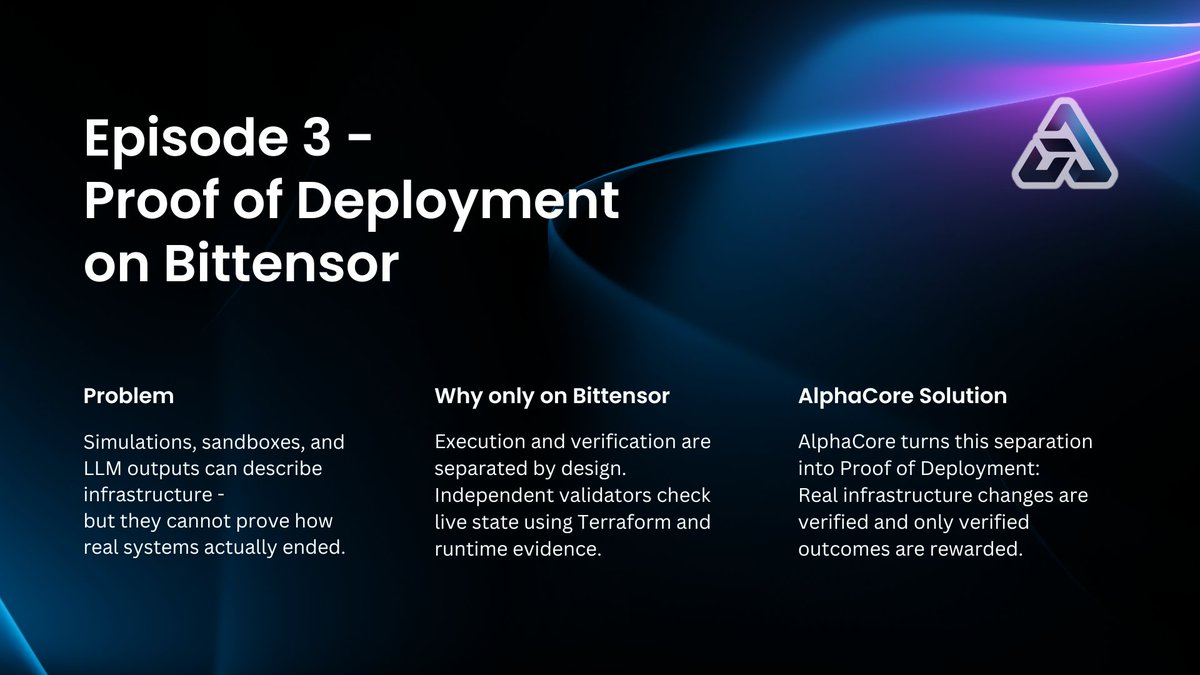
AlphaCore introduces something fundamentally new: Proof of Deployment—cryptographic evidence that an operation reached its intended state.
This works because AlphaCore does not
🧩 Proof of Deployment
During the last Bitstarter live raise, Dustin spoke about a core pain point in modern DevOps: the iterative, fragile loop of stitching tools, scripts, and systems together — where each added step increases overall complexity and failure risk.
This is
AlphaCore Update: First Distribution Complete
We’ve successfully completed our first Alpha distribution to early supporters!
Thank you to everyone who backed the @bitstarterAI launch.
As mentioned earlier, we’ve moved to a bi-weekly distribution cadence to avoid sub-1
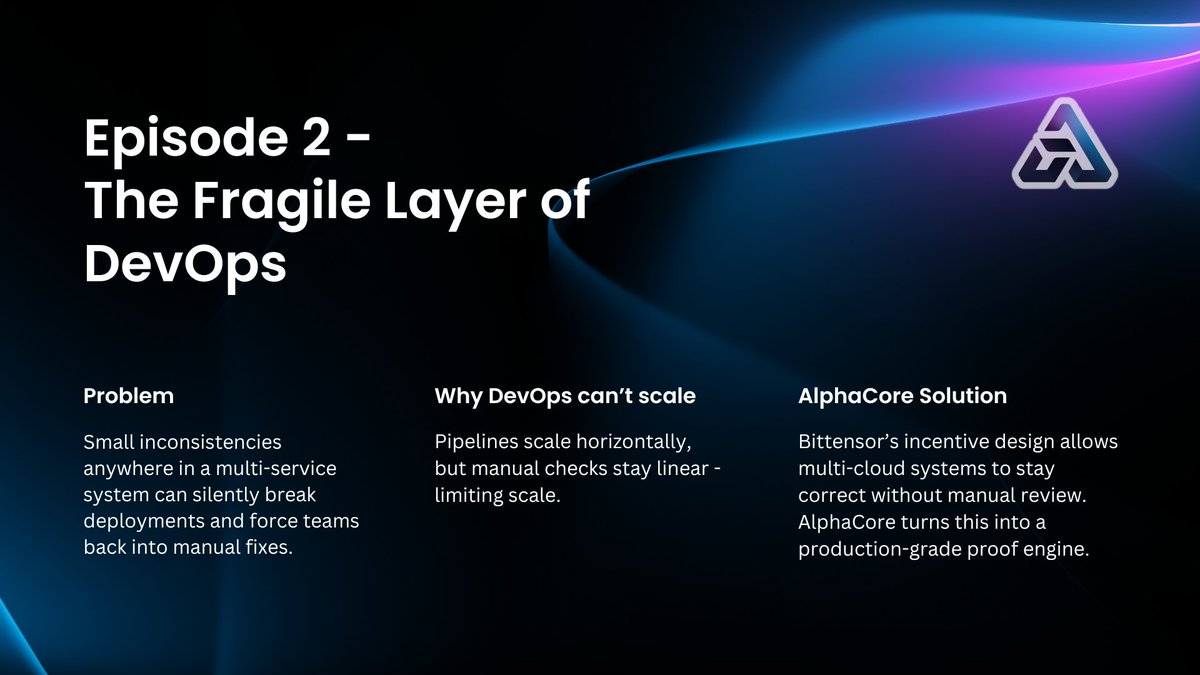
Every software change triggers a complex sequence under the surface. Minimal mismatches can silently break the entire flow: This fragility is the core weakness of DevOps.
When everything goes right, no one notices. But when anything drifts even slightly out of sync, teams get
Our founder, Dustin, on why AlphaCore (Bittensor subnet 66) is important.