With the amount of new subnets being added it can be hard to get up to date information across all subnets, so data may be slightly out of date from time to time

Subnet 28

GM

Alpha Price
Value
Market Cap
Value
Neurons
Value
Registration Cost
Value
TAO Liquidity
Value
Alpha in Pool
Value
Total Alpha Supply
Value
% Alpha Staked
Value

ABOUT

What exactly does it do?

Core Problem and Purpose

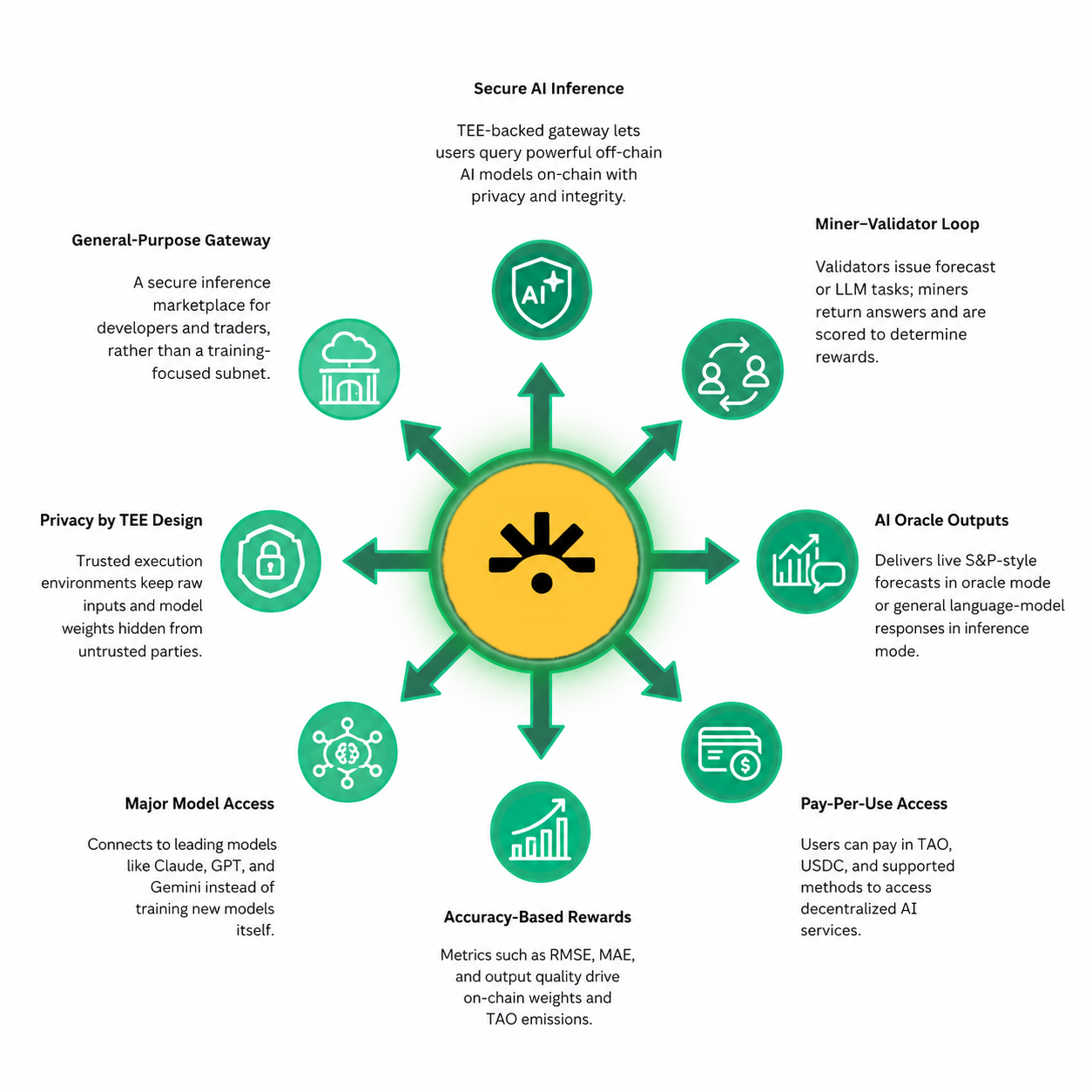
Good Morning (SN28) is a specialized Bittensor subnet designed as an AI inference marketplace, originally framed as an S&P 500 forecasting “Oracle” but now focused on general large language model (LLM) queries. In effect, SN28 tackles the problem of securely integrating powerful off-chain AI models into Bittensor’s decentralized network. By running an AI gateway within trusted execution environments (TEEs), it allows users to query models like GPT or Claude on-chain without exposing data or models to untrusted parties. This enables the monetization of AI services in a trust-minimized way – a sandbox where clients can pay (e.g. in TAO or USDC) to get AI outputs while cryptographically ensuring privacy and integrity. Earlier descriptions label SN28 the “S&P 500 Oracle” subnet, incentivizing short-term stock forecasts to create a reliable price data feed, but under the Good Morning (GM) branding it now aims to be a broader inference platform. The core loop remains typical for Bittensor: validators propose tasks and miners respond with AI-generated answers or forecasts, which are then scored to determine rewards. In SN28’s original Oracle design, validators assigned future timestamps for miners to predict the SPX price; Good Morning extends this concept to arbitrary model queries. The ultimate output is thus an on-chain AI service: for example, live S&P predictions in its original form or arbitrary language model responses in its current form. End users (traders or developers) experience it as a TAO-denominated AI API – they send inputs and recieve high-quality predictions or text, secured by enclave execution.

Miner/Validator Mechanics

Within SN28, Bittensor’s usual consensus of miner/validator dynamics applies. Miners are participants who deploy models or interfaces to API providers and produce answers to challenges. Validators are the judges: they issue tasks (e.g. query requests or prediction timestamps) and score the miners’ responses according to the subnet’s incentive mechanism. For instance, in the S&P oracle mode, validators would provide checkpoints (timestamps) and miners supply price forecasts; once real prices arrive, validators measure accuracy and assign scores. These scores (often based on metrics like RMSE) drive rewards distribution. The Richtao model (a miner on SN28) exemplifies a miner’s role: it ingests macroeconomic and sentiment features every minute to forecast the next 5–30 minute S&P 500 value. Such predictions are published to validators who later compute error metrics (RMSE/MAE) between forecasts and actual prices, forming the basis for weight assignments on-chain. Validators then submit weights reflecting each miner’s performance; those weightings are processed by Bittensor’s consensus to allocate TAO emissions. In summary, SN28 miners contribute ‘intelligence’ (prices or model outputs) and validators award tokens to the most accurate. The Smart Carrot-style reward leads miners to continually improve their models or strategies (e.g. retraining or using new data sources) to gain higher scores.

End Product and User Experience

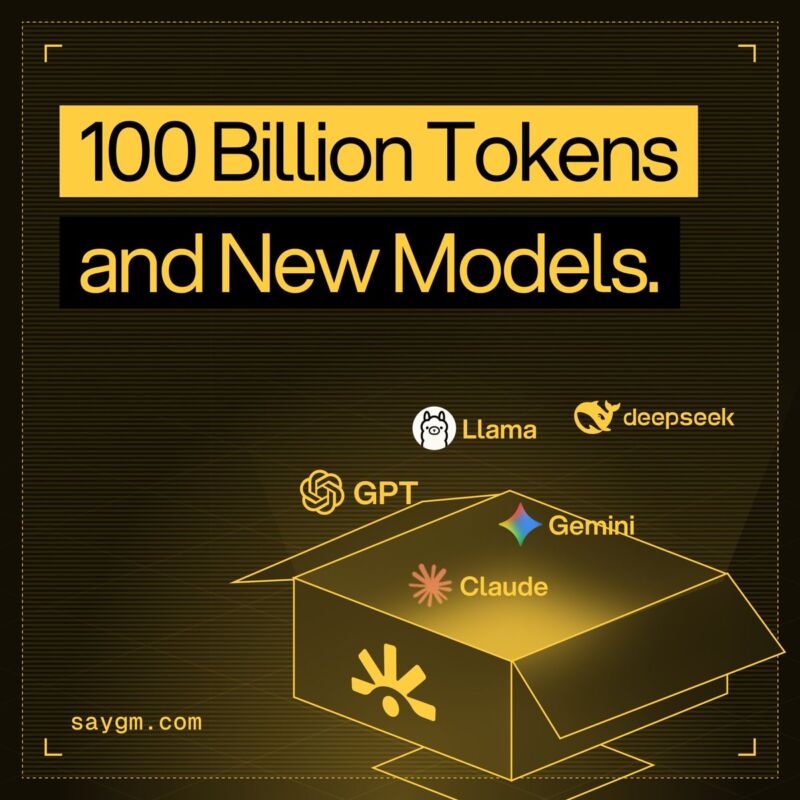
Users and investors ultimately experience SN28 through its live outputs and token. In its Oracle form, GM would provide a continuously updated S&P 500 price forecast feed on-chain, useful for traders or other subnets as a market-data oracle. In its inference gateway form, it functions like a decentralized API: users can submit queries (e.g. natural language questions) and receive AI-generated answers. The Good Morning team has integrated multiple LLM sources – including Claude, GPT, and Gemini via TEE providers – rather than training new models themselves. Payment for queries can be made in TAO or supported tokens (USDC, soon possibly other cryptos), with usage tracked on-chain. From the investor perspective, SN28’s native token (the α token) accrues value as the subnet grows; its price (~0.018 TAO at writing) and staking metrics can be monitored on block explorers. Users stake TAO to become miners or validators, earning GN (Good Morning) alpha tokens as rewards. The combination of decentralized AI service provision and financial incentives means that SN28’s product is both the useful data (model outputs) and the investment thesis around its usage.

Comparison with Other Subnets

SN28 (GM) resembles some existing inference platforms but also has distinct features. Its design is akin to subnets like Chutes (SN64) or ReadyAI (SN33), which also facilitate model inference or data pipelines, and to mechanisms like OpenRouter/Venice which aggregate model providers. However, GM uniquely emphasizes privacy and pay-per-use: by using Trusted Execution Environments, it assures that neither gateway operators nor miners can see raw input data or model weights. It effectively turns Bittensor into a secure marketplace for LLMs. Unlike training-focused subnets (e.g. Templar on decentralized model training), SN28 does not itself train large models; instead, it brokers inference. Compared to narrower AI use-case subnets (e.g. Dippy Roleplay for conversational AI, or Mainframe for structured data), GM is a general-purpose gateway. It also stands out by supporting real-world payment methods (USDC, bank cards) out of the box. In short, SN28 sits at the intersection of “Agents/Inference” category, differentiating itself by scale (connecting to major AI models) and security (TEE-backed execution) rather than domain specificity.

Core Problem and Purpose

Good Morning (SN28) is a specialized Bittensor subnet designed as an AI inference marketplace, originally framed as an S&P 500 forecasting “Oracle” but now focused on general large language model (LLM) queries. In effect, SN28 tackles the problem of securely integrating powerful off-chain AI models into Bittensor’s decentralized network. By running an AI gateway within trusted execution environments (TEEs), it allows users to query models like GPT or Claude on-chain without exposing data or models to untrusted parties. This enables the monetization of AI services in a trust-minimized way – a sandbox where clients can pay (e.g. in TAO or USDC) to get AI outputs while cryptographically ensuring privacy and integrity. Earlier descriptions label SN28 the “S&P 500 Oracle” subnet, incentivizing short-term stock forecasts to create a reliable price data feed, but under the Good Morning (GM) branding it now aims to be a broader inference platform. The core loop remains typical for Bittensor: validators propose tasks and miners respond with AI-generated answers or forecasts, which are then scored to determine rewards. In SN28’s original Oracle design, validators assigned future timestamps for miners to predict the SPX price; Good Morning extends this concept to arbitrary model queries. The ultimate output is thus an on-chain AI service: for example, live S&P predictions in its original form or arbitrary language model responses in its current form. End users (traders or developers) experience it as a TAO-denominated AI API – they send inputs and recieve high-quality predictions or text, secured by enclave execution.

Miner/Validator Mechanics

Within SN28, Bittensor’s usual consensus of miner/validator dynamics applies. Miners are participants who deploy models or interfaces to API providers and produce answers to challenges. Validators are the judges: they issue tasks (e.g. query requests or prediction timestamps) and score the miners’ responses according to the subnet’s incentive mechanism. For instance, in the S&P oracle mode, validators would provide checkpoints (timestamps) and miners supply price forecasts; once real prices arrive, validators measure accuracy and assign scores. These scores (often based on metrics like RMSE) drive rewards distribution. The Richtao model (a miner on SN28) exemplifies a miner’s role: it ingests macroeconomic and sentiment features every minute to forecast the next 5–30 minute S&P 500 value. Such predictions are published to validators who later compute error metrics (RMSE/MAE) between forecasts and actual prices, forming the basis for weight assignments on-chain. Validators then submit weights reflecting each miner’s performance; those weightings are processed by Bittensor’s consensus to allocate TAO emissions. In summary, SN28 miners contribute ‘intelligence’ (prices or model outputs) and validators award tokens to the most accurate. The Smart Carrot-style reward leads miners to continually improve their models or strategies (e.g. retraining or using new data sources) to gain higher scores.

End Product and User Experience

Users and investors ultimately experience SN28 through its live outputs and token. In its Oracle form, GM would provide a continuously updated S&P 500 price forecast feed on-chain, useful for traders or other subnets as a market-data oracle. In its inference gateway form, it functions like a decentralized API: users can submit queries (e.g. natural language questions) and receive AI-generated answers. The Good Morning team has integrated multiple LLM sources – including Claude, GPT, and Gemini via TEE providers – rather than training new models themselves. Payment for queries can be made in TAO or supported tokens (USDC, soon possibly other cryptos), with usage tracked on-chain. From the investor perspective, SN28’s native token (the α token) accrues value as the subnet grows; its price (~0.018 TAO at writing) and staking metrics can be monitored on block explorers. Users stake TAO to become miners or validators, earning GN (Good Morning) alpha tokens as rewards. The combination of decentralized AI service provision and financial incentives means that SN28’s product is both the useful data (model outputs) and the investment thesis around its usage.

Comparison with Other Subnets

SN28 (GM) resembles some existing inference platforms but also has distinct features. Its design is akin to subnets like Chutes (SN64) or ReadyAI (SN33), which also facilitate model inference or data pipelines, and to mechanisms like OpenRouter/Venice which aggregate model providers. However, GM uniquely emphasizes privacy and pay-per-use: by using Trusted Execution Environments, it assures that neither gateway operators nor miners can see raw input data or model weights. It effectively turns Bittensor into a secure marketplace for LLMs. Unlike training-focused subnets (e.g. Templar on decentralized model training), SN28 does not itself train large models; instead, it brokers inference. Compared to narrower AI use-case subnets (e.g. Dippy Roleplay for conversational AI, or Mainframe for structured data), GM is a general-purpose gateway. It also stands out by supporting real-world payment methods (USDC, bank cards) out of the box. In short, SN28 sits at the intersection of “Agents/Inference” category, differentiating itself by scale (connecting to major AI models) and security (TEE-backed execution) rather than domain specificity.

PURPOSE

What exactly is the 'product/build'?

Live Deployment & Roadmap

As of mid-2026, SN28 (Good Morning) has transitioned from testnet to a mainnet beta. According to community reports, the subnet “went live on May 28th” with its core functionality. At launch, this meant that miners could serve as the inference gateway via TEEs and initial payment options were enabled. The official roadmap (per a June 2026 announcement) placed the AI gateway in a TEE on testnet, preparing for an imminent mainnet beta. In practice, GM’s team has already integrated the first-generation components: an SGX (or equivalent) enclave that routes user queries to major LLM providers (Anthropic’s Claude, OpenAI’s GPT, Google’s Gemini) and returns results on-chain. The focus now is on moving from beta to stable operation, which likely includes scaling up the TEE infrastructure, adding more model endpoints, and refining the user interface/API.

Technical Architecture

Technically, Good Morning’s architecture is built on Bittensor’s standard substrate blockchain for coordination, combined with off-chain AI computation inside secure enclaves. Miners run code that handles API calls to external AI services; these computations happen in TEE partners (such as Phala Network or Near’s metalab) so that sensitive data remains encrypted even during processing. Validators run the “GM subnet runtime” (likely a modified Bittensor node) which issues queries and verifies responses. The architecture avoids building its own GPU platform: instead it “leverages existing API providers… via TEE”. On the payment side, the system supports on-chain token payments: at launch, USDC and traditional bank card payments were enabled, with plans for integrating TAO-compatible methods (e.g. X402, a bridge payment protocol) post-launch.

Codebase and Metrics

No public GitHub repository for SN28/Good Morning has been identified, suggesting the core code may be proprietary or maintained privately. The subnet presumably reuses the official Bittensor SDK and smart contracts, with custom modules for enclave orchestration and billing. As a Bittensor subnet, SN28 also has on-chain metrics: it shows a maximum of 256 UIDs, with only 1 active miner and ~14 validators currently. The subnet’s α-token economics are straightforward: emission is routed 100% to miners (100% mechanism split). Alpha supply is ~1.07 million units, with about 5.1% currently circulating (the rest unlocks over time). The token trades around 0.017–0.018 TAO), yielding a market cap on the order of 19K TAO (roughly a few hundred thousand USD). Governance and dev activity appear modest; commit counts or community codespaces are not public (likely while still in closed beta).

APIs and Integrations

Externally, GM has integrated with major AI model providers and blockchain services. The team uses Claude Haiku 4.5 internally to distill information, and has built connections to providers like Anthropic, OpenAI, Google (Gemini), etc.. The Trusted Execution Environment partners mentioned (e.g. Chutes, Phala, Near) indicate that the code is containerized for secure compute. Payment-wise, integration with USDC implies use of on-chain stablecoin contracts, while “bank card” support implies a fiat-to-crypto gateway. The mention of “x402” suggests upcoming support for XDAI or another L2 token (X402 is a proprietary scheme/bridge). Good Morning may also tap into Bittensor’s own wallet and staking system, so that miners/validators just use the standard TAO staking interfaces.

End Users / Customers

Potential end users of SN28’s services include quantitative traders, AI researchers, and developers seeking reliable AI inference. For example, hedge funds or DeFi protocols might use it to obtain short-term S&P forecasts or probabilistic market signals (the original use-case); software platforms could use it as a drop-in LLM backend that rewards the decentralized network. Any TAO investor who stakes on SN28 also becomes a user, benefiting from token rewards if the subnet gains adoption. As a consumer-facing product, it could be viewed as an “AI-as-a-service” offering built on Bittensor tokenomics. However, the subnet’s user base is still small and growing: detailed demographics or usage stats have not been publicly released by the team. It is clear that the product is aimed at mainstream AI consumers (e.g. those familiar with GPT usage) but delivered in a blockchain-powered, decentralized manner.

Live Deployment & Roadmap

As of mid-2026, SN28 (Good Morning) has transitioned from testnet to a mainnet beta. According to community reports, the subnet “went live on May 28th” with its core functionality. At launch, this meant that miners could serve as the inference gateway via TEEs and initial payment options were enabled. The official roadmap (per a June 2026 announcement) placed the AI gateway in a TEE on testnet, preparing for an imminent mainnet beta. In practice, GM’s team has already integrated the first-generation components: an SGX (or equivalent) enclave that routes user queries to major LLM providers (Anthropic’s Claude, OpenAI’s GPT, Google’s Gemini) and returns results on-chain. The focus now is on moving from beta to stable operation, which likely includes scaling up the TEE infrastructure, adding more model endpoints, and refining the user interface/API.

Technical Architecture

Technically, Good Morning’s architecture is built on Bittensor’s standard substrate blockchain for coordination, combined with off-chain AI computation inside secure enclaves. Miners run code that handles API calls to external AI services; these computations happen in TEE partners (such as Phala Network or Near’s metalab) so that sensitive data remains encrypted even during processing. Validators run the “GM subnet runtime” (likely a modified Bittensor node) which issues queries and verifies responses. The architecture avoids building its own GPU platform: instead it “leverages existing API providers… via TEE”. On the payment side, the system supports on-chain token payments: at launch, USDC and traditional bank card payments were enabled, with plans for integrating TAO-compatible methods (e.g. X402, a bridge payment protocol) post-launch.

Codebase and Metrics

No public GitHub repository for SN28/Good Morning has been identified, suggesting the core code may be proprietary or maintained privately. The subnet presumably reuses the official Bittensor SDK and smart contracts, with custom modules for enclave orchestration and billing. As a Bittensor subnet, SN28 also has on-chain metrics: it shows a maximum of 256 UIDs, with only 1 active miner and ~14 validators currently. The subnet’s α-token economics are straightforward: emission is routed 100% to miners (100% mechanism split). Alpha supply is ~1.07 million units, with about 5.1% currently circulating (the rest unlocks over time). The token trades around 0.017–0.018 TAO), yielding a market cap on the order of 19K TAO (roughly a few hundred thousand USD). Governance and dev activity appear modest; commit counts or community codespaces are not public (likely while still in closed beta).

APIs and Integrations

Externally, GM has integrated with major AI model providers and blockchain services. The team uses Claude Haiku 4.5 internally to distill information, and has built connections to providers like Anthropic, OpenAI, Google (Gemini), etc.. The Trusted Execution Environment partners mentioned (e.g. Chutes, Phala, Near) indicate that the code is containerized for secure compute. Payment-wise, integration with USDC implies use of on-chain stablecoin contracts, while “bank card” support implies a fiat-to-crypto gateway. The mention of “x402” suggests upcoming support for XDAI or another L2 token (X402 is a proprietary scheme/bridge). Good Morning may also tap into Bittensor’s own wallet and staking system, so that miners/validators just use the standard TAO staking interfaces.

End Users / Customers

Potential end users of SN28’s services include quantitative traders, AI researchers, and developers seeking reliable AI inference. For example, hedge funds or DeFi protocols might use it to obtain short-term S&P forecasts or probabilistic market signals (the original use-case); software platforms could use it as a drop-in LLM backend that rewards the decentralized network. Any TAO investor who stakes on SN28 also becomes a user, benefiting from token rewards if the subnet gains adoption. As a consumer-facing product, it could be viewed as an “AI-as-a-service” offering built on Bittensor tokenomics. However, the subnet’s user base is still small and growing: detailed demographics or usage stats have not been publicly released by the team. It is clear that the product is aimed at mainstream AI consumers (e.g. those familiar with GPT usage) but delivered in a blockchain-powered, decentralized manner.

WHO

Team Info

Team and Affiliations

The identities of GM’s developers and operators are not fully public. Bittensor’s community directory lists the company behind SN28 as “Foundry Accelerate” (the corporate arm of Foundry), but it provides no individual names. The only concrete contributor identified is Raúl Cel – a data scientist who designed the subnet’s Richtao forecasting model and dataset. Raúl’s model card explicitly credits him as developer (and notes it was “self-funded under the Bittensor ecosystem”), indicating he worked independently rather than through a well-known firm. No social media or LinkedIn profiles are associated with “Good Morning” SN28, and the project’s Discord/Telegram presence is either private or non-existent. The background of the (unlisted) team seems to span AI and finance: Foundry Accelerate is known for crypto investing, and Cel’s work deals with quantitative market AI. There are no known partnerships or community grants reported for SN28; it appears to be an internally funded subnet. Given the timing and the subnet launched in mid-2026), the core team likely began work in 2025. In summary, aside from the Foundry affiliation and Raúl Cel’s involvement, virtually nothing is publicly known about the individuals behind GM.

Team and Affiliations

The identities of GM’s developers and operators are not fully public. Bittensor’s community directory lists the company behind SN28 as “Foundry Accelerate” (the corporate arm of Foundry), but it provides no individual names. The only concrete contributor identified is Raúl Cel – a data scientist who designed the subnet’s Richtao forecasting model and dataset. Raúl’s model card explicitly credits him as developer (and notes it was “self-funded under the Bittensor ecosystem”), indicating he worked independently rather than through a well-known firm. No social media or LinkedIn profiles are associated with “Good Morning” SN28, and the project’s Discord/Telegram presence is either private or non-existent. The background of the (unlisted) team seems to span AI and finance: Foundry Accelerate is known for crypto investing, and Cel’s work deals with quantitative market AI. There are no known partnerships or community grants reported for SN28; it appears to be an internally funded subnet. Given the timing and the subnet launched in mid-2026), the core team likely began work in 2025. In summary, aside from the Foundry affiliation and Raúl Cel’s involvement, virtually nothing is publicly known about the individuals behind GM.

FUTURE

Roadmap

Published Milestones

Good Morning has outlined a phased rollout for SN28, but detailed public milestones are limited. The team announced in late June 2026 that the subnet’s “AI gateway” was running in a Trusted Execution Environment on testnet, with a mainnet beta forthcoming. In fact, community reports confirm SN28 went live on mainnet (beta) on May 28, 2026, so the initial launch phase has already been achieved. Key features at launch included the core model-routing infrastructure and initial payment options (USDC and credit cards). Beyond this, the roadmap indicates plans for adding “x402” support – likely a crypto bridge – to expand payment flexibility.

Future Phases

The fully realized vision of GM is an open, user-friendly AI marketplace on Bittensor. This would ultimately include a stable, secure mainnet service offering many LLM options under one roof, seamless fiat/crypto payments, and robust community tools. Specific future targets (like Q3/Q4 2026 or beyond) have not been publicly scheduled. However, logical next steps would include: 1) scaling up model capacity (integrating more AI providers or open-source models via TEE), 2) expanding financial infrastructure (e.g. adding TAO or other crypto payments, launching a usage dashboard), and 3) improving user experience (documentation, APIs, maybe third-party integrations). The team’s mention of a beta mainnet suggests they will refine the system through mid-2026 and likely aim for a stable release soon after. No fundraising or additional partnerships for the subnet have been announced alongside these phases.

Long-Term Goal

Ultimately, Good Morning aims to be synonymous with a decentralized AI inference gateway. The end-state would let any developer or business send an AI query to Bittensor and get a vetted, private response without trusting a single cloud provider. Achieving that requires not just software readiness but also network effects (many high-quality miners/models), which will take time. As of this writing, the project’s public updates have focused on core deployment; additional milestones relating to user growth, multi-subnet collaboration, or enterprise adoption have yet to be detailed. The roadmap is thus to prove the concept (secure LLM inference on-chain) and then expand outward.

Published Milestones

Good Morning has outlined a phased rollout for SN28, but detailed public milestones are limited. The team announced in late June 2026 that the subnet’s “AI gateway” was running in a Trusted Execution Environment on testnet, with a mainnet beta forthcoming. In fact, community reports confirm SN28 went live on mainnet (beta) on May 28, 2026, so the initial launch phase has already been achieved. Key features at launch included the core model-routing infrastructure and initial payment options (USDC and credit cards). Beyond this, the roadmap indicates plans for adding “x402” support – likely a crypto bridge – to expand payment flexibility.

Future Phases

The fully realized vision of GM is an open, user-friendly AI marketplace on Bittensor. This would ultimately include a stable, secure mainnet service offering many LLM options under one roof, seamless fiat/crypto payments, and robust community tools. Specific future targets (like Q3/Q4 2026 or beyond) have not been publicly scheduled. However, logical next steps would include: 1) scaling up model capacity (integrating more AI providers or open-source models via TEE), 2) expanding financial infrastructure (e.g. adding TAO or other crypto payments, launching a usage dashboard), and 3) improving user experience (documentation, APIs, maybe third-party integrations). The team’s mention of a beta mainnet suggests they will refine the system through mid-2026 and likely aim for a stable release soon after. No fundraising or additional partnerships for the subnet have been announced alongside these phases.

Long-Term Goal

Ultimately, Good Morning aims to be synonymous with a decentralized AI inference gateway. The end-state would let any developer or business send an AI query to Bittensor and get a vetted, private response without trusting a single cloud provider. Achieving that requires not just software readiness but also network effects (many high-quality miners/models), which will take time. As of this writing, the project’s public updates have focused on core deployment; additional milestones relating to user growth, multi-subnet collaboration, or enterprise adoption have yet to be detailed. The roadmap is thus to prove the concept (secure LLM inference on-chain) and then expand outward.