With the amount of new subnets being added it can be hard to get up to date information across all subnets, so data may be slightly out of date from time to time
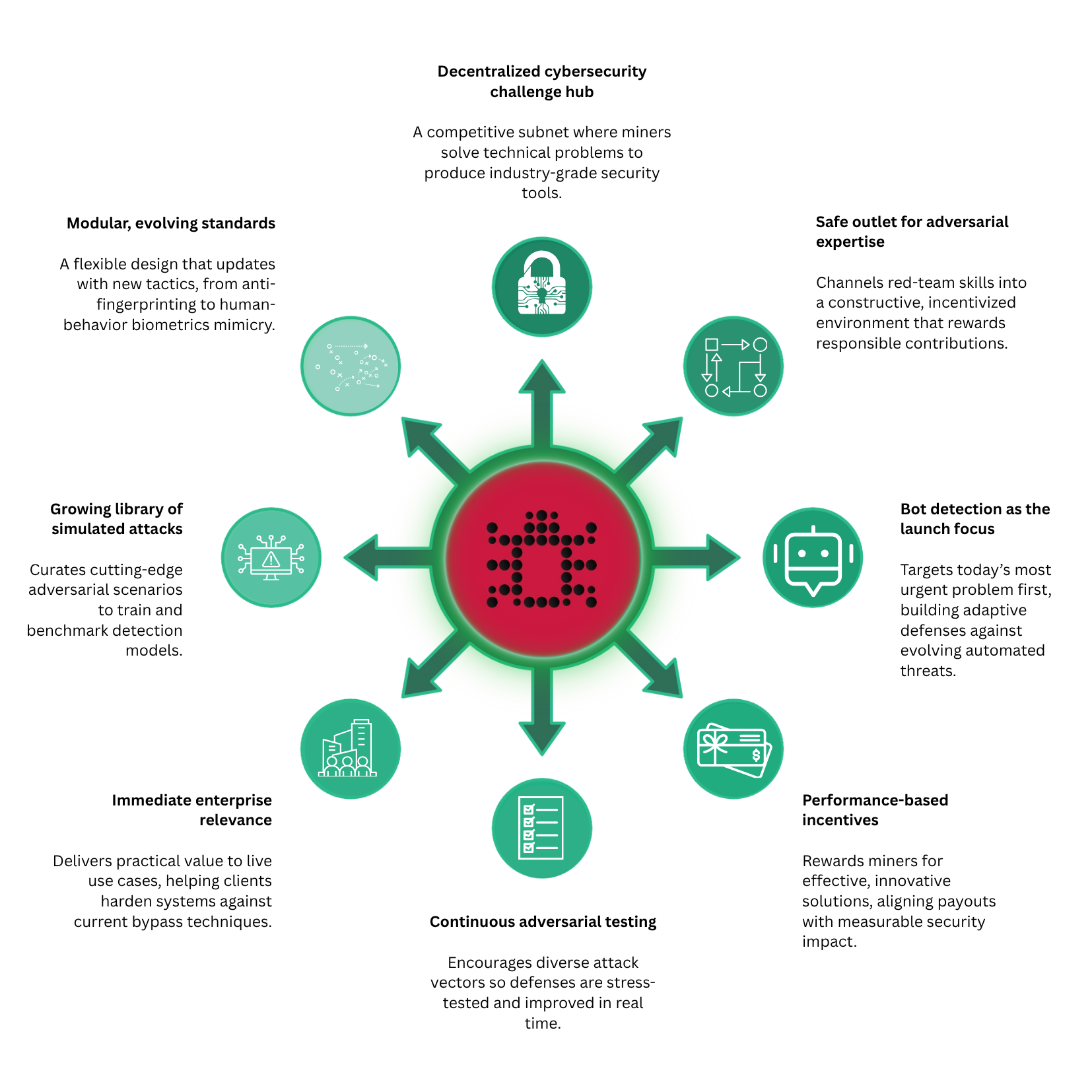
The RedTeam Subnet is a pioneering, decentralised platform created to accelerate progress in cybersecurity through competitive programming challenges. By incentivising developers—referred to as miners—to create and submit solutions to various technical problems, the subnet strives to produce industry-leading cybersecurity tools that can be directly applied to real-world applications.
This subnet offers a unique opportunity for individuals with expertise in bypassing detection mechanisms—skills typically associated with red team and adversarial roles—to use these abilities in a safe and constructive manner. By providing a secure, incentivised environment, the RedTeam Subnet allows these individuals to earn income while helping to shape the world’s leading online security standards.
Initially, the RedTeam Subnet will focus on addressing one of the most pressing issues in cybersecurity: bot detection. As automation continues to advance, human activity has become the minority in online interactions. Existing detection solutions struggle to adapt to the evolving techniques used by adversaries, as they lack a continuously adaptive approach. The RedTeam Subnet’s goal is to reverse this trend by fostering an ecosystem that proactively keeps pace with the latest methods of bypassing detection systems.
By encouraging a wide range of attack vectors from participating miners, the subnet enables detection systems to constantly test and evaluate the resilience of their solutions, identifying areas where they can be bypassed. This delivers immediate value to real-world use cases and active enterprise clients. Through a curated set of challenges that push miners to use cutting-edge adversarial techniques, the subnet aims to develop a comprehensive library of simulated attacks that will help detection models better counteract evolving threats. With its modular design, the subnet ensures continuous evolution in detection and circumvention standards, adapting to new techniques in critical threat areas such as anti-fingerprinting strategies and human behavioural biometrics mimicking.
The RedTeam Subnet is a pioneering, decentralised platform created to accelerate progress in cybersecurity through competitive programming challenges. By incentivising developers—referred to as miners—to create and submit solutions to various technical problems, the subnet strives to produce industry-leading cybersecurity tools that can be directly applied to real-world applications.
This subnet offers a unique opportunity for individuals with expertise in bypassing detection mechanisms—skills typically associated with red team and adversarial roles—to use these abilities in a safe and constructive manner. By providing a secure, incentivised environment, the RedTeam Subnet allows these individuals to earn income while helping to shape the world’s leading online security standards.
Initially, the RedTeam Subnet will focus on addressing one of the most pressing issues in cybersecurity: bot detection. As automation continues to advance, human activity has become the minority in online interactions. Existing detection solutions struggle to adapt to the evolving techniques used by adversaries, as they lack a continuously adaptive approach. The RedTeam Subnet’s goal is to reverse this trend by fostering an ecosystem that proactively keeps pace with the latest methods of bypassing detection systems.
By encouraging a wide range of attack vectors from participating miners, the subnet enables detection systems to constantly test and evaluate the resilience of their solutions, identifying areas where they can be bypassed. This delivers immediate value to real-world use cases and active enterprise clients. Through a curated set of challenges that push miners to use cutting-edge adversarial techniques, the subnet aims to develop a comprehensive library of simulated attacks that will help detection models better counteract evolving threats. With its modular design, the subnet ensures continuous evolution in detection and circumvention standards, adapting to new techniques in critical threat areas such as anti-fingerprinting strategies and human behavioural biometrics mimicking.
The RedTeam Subnet introduces a decentralized, competitive platform for cybersecurity innovation, aimed at fostering continuous improvement in security solutions through incentivized programming challenges. This modular subnet architecture enables the addition and removal of cybersecurity challenges, allowing miners (participants who submit solutions) to tackle problems and earn rewards in Bittensor’s native currency, TAO. By scoring and validating solutions through an established point system, the RedTeam Subnet ensures a dynamic, competitive environment that leads to high-quality, innovative solutions for best-in-class cybersecurity.
Key Features and Functionality
Modular and Flexible Structure:
The RedTeam Subnet employs a modular system that allows dynamic addition and removal of programming challenges. This flexibility enables the creation of various competitive environments and ensures that the subnet remains relevant and responsive to evolving cybersecurity demands. The adaptability of the subnet allows for an ever-evolving pool of challenges and rewards, keeping pace with the needs of the cybersecurity landscape.
Incentivized Participation:
Miners are rewarded based on the effectiveness and uniqueness of their solutions. Points are awarded to solutions based on how they outperform previous submissions, ensuring a competitive environment where only the best solutions receive rewards. This incentivizes continuous innovation and improvement, driving the development of cutting-edge cybersecurity solutions.
External Validation and Scoring:
Solutions submitted by miners are tested on secure external servers, which act as sandboxes for validation. These servers score the solutions based on their effectiveness, with points assigned according to how well each new solution surpasses the current best. This ensures that the solutions are rigorously tested and validated before being deemed successful.
Open-sourced Library:
The subnet will create a comprehensive, open-source library of simulated attacks. This library will help equip detection models to better counteract evolving threats. Additionally, the baseline detection capabilities of the challenges proposed will surpass the detection performance of typical commercial products, offering companies an open-source solution that is easy to implement and beneficial for real-world use cases.
Incentive Mechanism at a Glance
The RedTeam Subnet’s incentive mechanism creates a competitive and secure environment where miners earn rewards from a dynamic “emission pool” tied to each challenge. Miners submit encrypted solutions to prevent theft, and the points they earn decrease over time, requiring constant improvement to maintain or increase their reward share. For example, in the Human Mouse Movement Imitation challenge, miners compete to develop scripts that mimic human behavior, earning points based on how well their solution convinces the validator. By rewarding quality, innovation, uniqueness, and continuous improvement, the RedTeam Subnet promotes high-impact advancements in cybersecurity.
Subnet Architecture and Design
Architecture Overview:
The subnet operates on a decentralized, modular architecture designed to facilitate secure and competitive cybersecurity solution development. Programming challenges can be dynamically added or removed based on demand, with the primary focus on cybersecurity. However, the concept of a “challenge” is flexible and can include any problem that can be programmatically tested. The RedTeam Subnet is set to become a new framework for enterprises and individuals to post bounties, enabling rapid solutions with continuously improving results over time.
Roles within the Subnet:
There are three main roles within the subnet:
Incentive Mechanism
The RedTeam Subnet uses a modular structure where programming challenges can be flexibly added or removed, and their reward distribution, called the “emission pool,” can be adjusted. The emission pool refers to the percentage of total emissions allocated to a specific programming challenge. For example, if a challenge has a 10% emission pool, then 10% of miner emissions will go towards rewarding solutions to that challenge.
Miners compete for rewards by submitting encrypted code solutions to programming challenges. After 24 hours, miners release the decryption key, ensuring that solutions cannot be stolen before they are validated. The solutions are scored, and miners are awarded points based on their performance. Different challenges have different criteria for awarding points, such as rewarding points for improvements to existing solutions or for unique and diversified approaches. This continuous scoring system encourages innovation and drives the development of new and better cybersecurity solutions.
The RedTeam Subnet introduces a decentralized, competitive platform for cybersecurity innovation, aimed at fostering continuous improvement in security solutions through incentivized programming challenges. This modular subnet architecture enables the addition and removal of cybersecurity challenges, allowing miners (participants who submit solutions) to tackle problems and earn rewards in Bittensor’s native currency, TAO. By scoring and validating solutions through an established point system, the RedTeam Subnet ensures a dynamic, competitive environment that leads to high-quality, innovative solutions for best-in-class cybersecurity.
Key Features and Functionality
Modular and Flexible Structure:
The RedTeam Subnet employs a modular system that allows dynamic addition and removal of programming challenges. This flexibility enables the creation of various competitive environments and ensures that the subnet remains relevant and responsive to evolving cybersecurity demands. The adaptability of the subnet allows for an ever-evolving pool of challenges and rewards, keeping pace with the needs of the cybersecurity landscape.
Incentivized Participation:
Miners are rewarded based on the effectiveness and uniqueness of their solutions. Points are awarded to solutions based on how they outperform previous submissions, ensuring a competitive environment where only the best solutions receive rewards. This incentivizes continuous innovation and improvement, driving the development of cutting-edge cybersecurity solutions.
External Validation and Scoring:
Solutions submitted by miners are tested on secure external servers, which act as sandboxes for validation. These servers score the solutions based on their effectiveness, with points assigned according to how well each new solution surpasses the current best. This ensures that the solutions are rigorously tested and validated before being deemed successful.
Open-sourced Library:
The subnet will create a comprehensive, open-source library of simulated attacks. This library will help equip detection models to better counteract evolving threats. Additionally, the baseline detection capabilities of the challenges proposed will surpass the detection performance of typical commercial products, offering companies an open-source solution that is easy to implement and beneficial for real-world use cases.
Incentive Mechanism at a Glance
The RedTeam Subnet’s incentive mechanism creates a competitive and secure environment where miners earn rewards from a dynamic “emission pool” tied to each challenge. Miners submit encrypted solutions to prevent theft, and the points they earn decrease over time, requiring constant improvement to maintain or increase their reward share. For example, in the Human Mouse Movement Imitation challenge, miners compete to develop scripts that mimic human behavior, earning points based on how well their solution convinces the validator. By rewarding quality, innovation, uniqueness, and continuous improvement, the RedTeam Subnet promotes high-impact advancements in cybersecurity.
Subnet Architecture and Design
Architecture Overview:
The subnet operates on a decentralized, modular architecture designed to facilitate secure and competitive cybersecurity solution development. Programming challenges can be dynamically added or removed based on demand, with the primary focus on cybersecurity. However, the concept of a “challenge” is flexible and can include any problem that can be programmatically tested. The RedTeam Subnet is set to become a new framework for enterprises and individuals to post bounties, enabling rapid solutions with continuously improving results over time.
Roles within the Subnet:
There are three main roles within the subnet:
Incentive Mechanism
The RedTeam Subnet uses a modular structure where programming challenges can be flexibly added or removed, and their reward distribution, called the “emission pool,” can be adjusted. The emission pool refers to the percentage of total emissions allocated to a specific programming challenge. For example, if a challenge has a 10% emission pool, then 10% of miner emissions will go towards rewarding solutions to that challenge.
Miners compete for rewards by submitting encrypted code solutions to programming challenges. After 24 hours, miners release the decryption key, ensuring that solutions cannot be stolen before they are validated. The solutions are scored, and miners are awarded points based on their performance. Different challenges have different criteria for awarding points, such as rewarding points for improvements to existing solutions or for unique and diversified approaches. This continuous scoring system encourages innovation and drives the development of new and better cybersecurity solutions.
Validator Monetisation
Validators on the RedTeam subnet have the opportunity to earn by acquiring bounties from enterprise clients periodically through a user-friendly web app. The amount of rewards they can earn is proportional to the amount of TAO delegated to them. These validators can charge fees for submitting bounties on the subnet, with pricing determined by factors such as the complexity of the challenge and the duration for which the client wants the challenge to remain active. Enterprise clients benefit from the system’s assurance that results will be delivered promptly and continuously improved over time due to the incentive mechanism, providing clients with increasingly effective solutions and greater value for their investment.
Abstracted Mining
Looking ahead, the RedTeam subnet plans to simplify the mining process by abstracting it into a user-friendly interface through a dedicated website. This will streamline the on-chain interactions, allowing miners to focus on solving challenges without dealing with complex wallet or Web3 interactions. The platform will feature an abstracted social sign-on, enabling miners to sign in via their social accounts. They will be able to view available challenges, submit solutions, and track progress, much like platforms such as Kaggle. This abstraction removes technical barriers, encouraging wider participation. Additionally, the website will have an educational section to support miners in improving their skills. It will showcase previous challenges, explain top scorers’ methods, and offer tutorials to help miners enhance their submissions. This system is designed to lower the entry barriers and foster a continuous learning environment for all participants.
Validator Monetisation
Validators on the RedTeam subnet have the opportunity to earn by acquiring bounties from enterprise clients periodically through a user-friendly web app. The amount of rewards they can earn is proportional to the amount of TAO delegated to them. These validators can charge fees for submitting bounties on the subnet, with pricing determined by factors such as the complexity of the challenge and the duration for which the client wants the challenge to remain active. Enterprise clients benefit from the system’s assurance that results will be delivered promptly and continuously improved over time due to the incentive mechanism, providing clients with increasingly effective solutions and greater value for their investment.
Abstracted Mining
Looking ahead, the RedTeam subnet plans to simplify the mining process by abstracting it into a user-friendly interface through a dedicated website. This will streamline the on-chain interactions, allowing miners to focus on solving challenges without dealing with complex wallet or Web3 interactions. The platform will feature an abstracted social sign-on, enabling miners to sign in via their social accounts. They will be able to view available challenges, submit solutions, and track progress, much like platforms such as Kaggle. This abstraction removes technical barriers, encouraging wider participation. Additionally, the website will have an educational section to support miners in improving their skills. It will showcase previous challenges, explain top scorers’ methods, and offer tutorials to help miners enhance their submissions. This system is designed to lower the entry barriers and foster a continuous learning environment for all participants.
Novelty Search is great, but for most investors trying to understand Bittensor, the technical depth is a wall, not a bridge. If we’re going to attract investment into this ecosystem then we need more people to understand it! That’s why Siam Kidd and Mark Creaser from DSV Fund have launched Revenue Search, where they ask the simple questions that investors want to know the answers to.
Recorded in July 2025, this episode of Revenue Search features Ollie and Oscar from Red Team (Subnet 61), a decentralized cybersecurity R&D engine built on Bittensor. Their platform helps protect financial transactions—especially in crypto and payments—by determining whether a user is human or AI, verifying device authenticity, and pinpointing true geolocation. By using Bittensor miners as adversarial testers, Red Team constantly challenges its own detection systems with cutting-edge bot attacks, improving resilience faster than traditional cybersecurity approaches. The founders describe a strong existing SaaS business with high margins and active revenue, and explain how Subnet 61 serves as a real-time innovation layer, not just a tokenized side project. While they’re cautious about fixed Alpha buybacks, they prioritize sustainable miner incentives and believe their dynamic bounty model offers a fair, performance-based reward system. Their long-term goal is to lead the emerging market of synthetic threat intelligence as AI-driven fraud becomes more accessible and widespread.
@oli_innerworks @innerworksID And last but not least we wanna mention @_redteam_ 👀 Thanks for everyday improving internet security 💻
RedTeam #SN61, built on Bittensor, is actively protecting @1inch, the world’s leading DEX aggregator processing billions in swaps through Innerworks' predictive threat intelligence.
Together, we’re turning live hacker simulation and AI-driven detection into a real-time defence
New layer of security, now live.
1inch integrates Innerworks’ AI-based threat detection — to stay one step ahead of synthetic attacks and bot fraud.
DeFi’s defenses can’t be static. Innerworks feeds real-time intelligence into our system, exposing hacker tactics before they
🚨 SN61 RedTeam update: ab_sniffer_v4 launches Oct 16, 2025 @ 10:00 UTC
🧩 New validator bot frameworks: botasaurus & pydoll expand the scope of automation detection.
🧠 Human-in-the-loop verification: some requests now route to real devices — your miner must detect and return
@const_reborn and @_redteam_ discussing replacing @Cloudflare
@ridges_ai is Batman
#SN61 is Robin
What Subnet 61 (Redteam) do in Bittensor? $TAO
@_redteam_
RedTeam (Subnet 61) turns cybersecurity research into a decentralized competition.
It’s a platform where developers (called miners) solve real cybersecurity challenges like bot detection, anti-fingerprinting, or