With the amount of new subnets being added it can be hard to get up to date information across all subnets, so data may be slightly out of date from time to time
Lium (formerly Celium) is a decentralized GPU compute marketplace operating as Subnet 51 within the Bittensor AI network. It essentially functions like a peer-to-peer “cloud” for renting GPU power, connecting those with idle high-performance GPUs (the miners) to those who need affordable compute for AI and other heavy workloads (the renters). The platform is permissionless and open to anyone – “anyone can add compute, anyone can rent it, no KYC” as the team describes. This means any individual or organization can supply their GPU resources or access remote GPUs on-demand without a central provider, using cryptocurrency for payments. Lium effectively creates a decentralized GPU rental marketplace comparable to projects like io.net or Akash Network in concept, but built on Bittensor’s blockchain infrastructure and token system.
In practice, Lium provides a web interface (lium.io) where users can quickly spin up GPU instances from a global pool of machines contributed by miners. It supports cutting-edge hardware – from NVIDIA’s A100/H100 datacenter GPUs to AMD MI200s and Intel accelerators – giving users access to powerful compute that would be costly or scarce elsewhere. By leveraging spare capacity worldwide, Lium offers GPU rentals at significantly lower cost than traditional cloud providers (about 90% cheaper by some claims) while still delivering strong performance (reports of ~45% better utilization efficiency). This cost-efficiency and broad hardware support make it attractive for AI model training, inference, scientific computing, and other GPU-intensive tasks.
Lium’s importance in the Bittensor ecosystem has grown rapidly. Launched in late 2024, it quickly secured hundreds of top-tier GPUs (onboarding ~500 Nvidia H100 GPUs within its first month), demonstrating huge supply-side traction. By 2025 it became one of the top-emitting subnets on Bittensor (around 6–7% of network TAO emissions) indicating high usage and staked value. Notably, it reached a milestone where actual rental revenues began outpacing its blockchain incentives, meaning real customer demand is now exceeding the subsidy from network token emissions. Community members even dub Celium/Lium as “the AWS/Azure of Bittensor” due to its cloud-like service on a decentralized network. In short, Lium provides a distributed cloud computing service focused on GPUs, enabling cheaper and trustless access to AI computation while incentivizing providers with crypto rewards.
Lium (formerly Celium) is a decentralized GPU compute marketplace operating as Subnet 51 within the Bittensor AI network. It essentially functions like a peer-to-peer “cloud” for renting GPU power, connecting those with idle high-performance GPUs (the miners) to those who need affordable compute for AI and other heavy workloads (the renters). The platform is permissionless and open to anyone – “anyone can add compute, anyone can rent it, no KYC” as the team describes. This means any individual or organization can supply their GPU resources or access remote GPUs on-demand without a central provider, using cryptocurrency for payments. Lium effectively creates a decentralized GPU rental marketplace comparable to projects like io.net or Akash Network in concept, but built on Bittensor’s blockchain infrastructure and token system.
In practice, Lium provides a web interface (lium.io) where users can quickly spin up GPU instances from a global pool of machines contributed by miners. It supports cutting-edge hardware – from NVIDIA’s A100/H100 datacenter GPUs to AMD MI200s and Intel accelerators – giving users access to powerful compute that would be costly or scarce elsewhere. By leveraging spare capacity worldwide, Lium offers GPU rentals at significantly lower cost than traditional cloud providers (about 90% cheaper by some claims) while still delivering strong performance (reports of ~45% better utilization efficiency). This cost-efficiency and broad hardware support make it attractive for AI model training, inference, scientific computing, and other GPU-intensive tasks.
Lium’s importance in the Bittensor ecosystem has grown rapidly. Launched in late 2024, it quickly secured hundreds of top-tier GPUs (onboarding ~500 Nvidia H100 GPUs within its first month), demonstrating huge supply-side traction. By 2025 it became one of the top-emitting subnets on Bittensor (around 6–7% of network TAO emissions) indicating high usage and staked value. Notably, it reached a milestone where actual rental revenues began outpacing its blockchain incentives, meaning real customer demand is now exceeding the subsidy from network token emissions. Community members even dub Celium/Lium as “the AWS/Azure of Bittensor” due to its cloud-like service on a decentralized network. In short, Lium provides a distributed cloud computing service focused on GPUs, enabling cheaper and trustless access to AI computation while incentivizing providers with crypto rewards.
Lium’s product is a full-stack decentralized computing platform that marries blockchain-based coordination with a cloud-like user experience. On the backend, Lium is implemented as Bittensor Subnet 51 (“Compute Subnet”), which defines the protocols for miners and validators to contribute and verify GPU resources on-chain. On the frontend, the team built a web application (at lium.io) and supporting SDK/CLI tools that let users browse, rent, and manage GPU instances as easily as on a conventional cloud. Under the hood, the system uses Bittensor’s consensus and token ($TAO) to handle trust and payments: renters pay for compute in crypto, and validators on the subnet measure miners’ performance to ensure fair payout of TAO rewards to miners based on useful work delivered. This design removes the need for any centralized server or escrow – the blockchain and subnet validators coordinate matchmaking and reward distribution.
Key components of Lium’s architecture include:
Miners – Individuals or data centers providing GPU servers to the network. They run Lium’s miner software to register their hardware on Subnet 51. Their machines are continuously benchmarked and scored by the network (e.g. GPU type, bandwidth, uptime) and higher-performance nodes earn greater rewards.
Validators – Special nodes in Subnet 51 that securely connect to miners’ machines to verify their specs and performance. Validators enforce that miners actually deliver the promised compute; they can slash or reduce rewards for poor performance or fraud. They effectively maintain the network’s integrity and fairness in resource allocation.
Renters – End-users (developers, researchers, etc.) who need computational power. Renters use the Lium platform to select and rent GPUs from the available miners. They can filter by GPU model, location, price, etc., then deploy tasks on chosen nodes and monitor progress through the interface. The experience is akin to renting a VM in the cloud, but backed by decentralized infrastructure.
Frontend & SDK – The website lium.io and accompanying CLI/SDK provide the user-facing layer. Here renters create accounts, top up crypto balances, and launch “pods” (GPU instances) in a few clicks. Likewise, miners manage their contributions. The platform abstracts away blockchain complexity, providing templates and APIs so that even non-crypto-savvy users can harness the GPUs.
Bittensor Blockchain – The Subtensor blockchain underlying Bittensor keeps track of all these interactions. It logs miners’ registrations and performance metrics, handles staking of TAO, and executes the economic rules of the subnet (paying miners, charging renters). TAO tokens flow within this economy: renters’ payments and validator rewards ultimately convert to miners’ income in TAO. This blockchain foundation ensures the marketplace is trustless and transparent, without centralized intermediaries.
From a technical standpoint, the Lium team emphasizes low-level optimization and scalability in the build. The project includes custom modules for GPU scheduling, hardware abstraction, performance tuning, and energy efficiency to maximize the utilization of each machine. This allows Lium to support a wide variety of hardware and to pack jobs efficiently, achieving higher throughput at lower cost. For example, by carefully scheduling workloads and abstracting hardware differences, Lium can utilize everything from flagship H100s to consumer GPUs in a unified network, reportedly improving cost-per-compute by up to 90% versus traditional clouds. The build also integrates new Bittensor features like the EVM module – Lium’s smart-contracts manage things like collateral and slashing (penalizing miners if a rented GPU goes offline) on-chain to automate reliability guarantees. Overall, Lium’s product is the combination of decentralized blockchain protocols and a cloud service layer, delivering a novel Web3 alternative to centralized GPU providers.
Lium’s product is a full-stack decentralized computing platform that marries blockchain-based coordination with a cloud-like user experience. On the backend, Lium is implemented as Bittensor Subnet 51 (“Compute Subnet”), which defines the protocols for miners and validators to contribute and verify GPU resources on-chain. On the frontend, the team built a web application (at lium.io) and supporting SDK/CLI tools that let users browse, rent, and manage GPU instances as easily as on a conventional cloud. Under the hood, the system uses Bittensor’s consensus and token ($TAO) to handle trust and payments: renters pay for compute in crypto, and validators on the subnet measure miners’ performance to ensure fair payout of TAO rewards to miners based on useful work delivered. This design removes the need for any centralized server or escrow – the blockchain and subnet validators coordinate matchmaking and reward distribution.
Key components of Lium’s architecture include:
Miners – Individuals or data centers providing GPU servers to the network. They run Lium’s miner software to register their hardware on Subnet 51. Their machines are continuously benchmarked and scored by the network (e.g. GPU type, bandwidth, uptime) and higher-performance nodes earn greater rewards.
Validators – Special nodes in Subnet 51 that securely connect to miners’ machines to verify their specs and performance. Validators enforce that miners actually deliver the promised compute; they can slash or reduce rewards for poor performance or fraud. They effectively maintain the network’s integrity and fairness in resource allocation.
Renters – End-users (developers, researchers, etc.) who need computational power. Renters use the Lium platform to select and rent GPUs from the available miners. They can filter by GPU model, location, price, etc., then deploy tasks on chosen nodes and monitor progress through the interface. The experience is akin to renting a VM in the cloud, but backed by decentralized infrastructure.
Frontend & SDK – The website lium.io and accompanying CLI/SDK provide the user-facing layer. Here renters create accounts, top up crypto balances, and launch “pods” (GPU instances) in a few clicks. Likewise, miners manage their contributions. The platform abstracts away blockchain complexity, providing templates and APIs so that even non-crypto-savvy users can harness the GPUs.
Bittensor Blockchain – The Subtensor blockchain underlying Bittensor keeps track of all these interactions. It logs miners’ registrations and performance metrics, handles staking of TAO, and executes the economic rules of the subnet (paying miners, charging renters). TAO tokens flow within this economy: renters’ payments and validator rewards ultimately convert to miners’ income in TAO. This blockchain foundation ensures the marketplace is trustless and transparent, without centralized intermediaries.
From a technical standpoint, the Lium team emphasizes low-level optimization and scalability in the build. The project includes custom modules for GPU scheduling, hardware abstraction, performance tuning, and energy efficiency to maximize the utilization of each machine. This allows Lium to support a wide variety of hardware and to pack jobs efficiently, achieving higher throughput at lower cost. For example, by carefully scheduling workloads and abstracting hardware differences, Lium can utilize everything from flagship H100s to consumer GPUs in a unified network, reportedly improving cost-per-compute by up to 90% versus traditional clouds. The build also integrates new Bittensor features like the EVM module – Lium’s smart-contracts manage things like collateral and slashing (penalizing miners if a rented GPU goes offline) on-chain to automate reliability guarantees. Overall, Lium’s product is the combination of decentralized blockchain protocols and a cloud service layer, delivering a novel Web3 alternative to centralized GPU providers.
Lium was founded by Datura (Pierre (Fish)) and is operated by a team with extensive experience in the Bittensor ecosystem. Datura, who previously was a significant miner on Bittensor, identified the gaps in existing cloud compute platforms and set out to create Celium as a decentralized alternative. His background in managing large-scale GPU deployments and experience with Bittensor’s infrastructure helped him build a system that directly addresses the pain points in the current market.
The team’s deep knowledge of both GPU hardware and decentralized platforms has been key to Lium’s rapid development and success. They have spent the past six months refining their platform, improving security mechanisms to prevent miner exploits, optimizing GPU allocation systems, and building a user-friendly interface for both renters and GPU providers. Their focus is on providing a high-quality, reliable product while keeping the system as flexible and permissionless as possible.
Through rigorous testing, Lium has fine-tuned their incentive system, finding the right balance between rewarding miners and ensuring that GPUs are being rented at competitive prices. The team is also focused on offering robust tools for developers, such as API access, custom template creation, and integration with Kubernetes, making Lium a versatile platform for both casual users and advanced developers alike.
Lium was founded by Datura (Pierre (Fish)) and is operated by a team with extensive experience in the Bittensor ecosystem. Datura, who previously was a significant miner on Bittensor, identified the gaps in existing cloud compute platforms and set out to create Celium as a decentralized alternative. His background in managing large-scale GPU deployments and experience with Bittensor’s infrastructure helped him build a system that directly addresses the pain points in the current market.
The team’s deep knowledge of both GPU hardware and decentralized platforms has been key to Lium’s rapid development and success. They have spent the past six months refining their platform, improving security mechanisms to prevent miner exploits, optimizing GPU allocation systems, and building a user-friendly interface for both renters and GPU providers. Their focus is on providing a high-quality, reliable product while keeping the system as flexible and permissionless as possible.
Through rigorous testing, Lium has fine-tuned their incentive system, finding the right balance between rewarding miners and ensuring that GPUs are being rented at competitive prices. The team is also focused on offering robust tools for developers, such as API access, custom template creation, and integration with Kubernetes, making Lium a versatile platform for both casual users and advanced developers alike.
Lium’s roadmap is centered on scaling the network, enhancing its performance, and unlocking new capabilities with the amassed compute power. Based on team communications and community insight, key focus areas include:
Scaling Supply & Demand: Continue growing the GPU network aggressively. Lium has already onboarded hundreds of top-tier GPUs (e.g. ~500 H100 cards within a month of launch), and it aims to aggregate “billions in compute” capacity over time. This means attracting more miner nodes globally (possibly thousands of GPUs, rivaling centralized providers) and concurrently expanding the renter user base. Hitting larger scale should further drive down costs and improve network effects for the platform.
Reliability & Trust Mechanisms: Improve network reliability through protocol features. A recent upgrade introduced a slashing mechanism – if a miner’s GPU goes offline during a rental, a portion of their TAO stake is burned as a penalty. Going forward, the team will likely refine such features to ensure renters get dependable service (e.g. automated failovers or stronger verification of hardware in real-time). The goal is to make the decentralized service as stable as a centralized cloud, using on-chain incentives to discourage bad actors.
Transparency & Analytics: Increase transparency of usage and economics. Currently, much of Celium’s revenue data comes from internal reports, and community analysts have called for a live public dashboard to showcase real demand (e.g. rental revenues separate from token emissions). Delivering such monitoring tools is a probable roadmap item, as it would validate Lium’s growth to users and investors. We may see official stats on total hours rented, active renters, GPU utilization, etc., made openly available in the near future, bolstering credibility.
Advanced Compute Services: Evolve from simple rentals to coordinated large-scale compute tasks. In the long term, Lium’s vision is to leverage its distributed GPUs to train cutting-edge open-source AI models collectively. This could involve introducing new software frameworks or subnet features for distributed training across many miners. Achieving “the world’s best open LLMs” via the aggregated power of Subnet 51 is an aspirational goal. The roadmap likely includes R&D on distributed training algorithms, dataset sharing, and collaborations with other AI subnets to make use of the vast compute pool for high-impact AI projects.
User Experience & Integration: Ongoing improvements to user and developer experience. The team is actively hiring DevRel/engineering talent to enrich documentation, APIs, and one-click deployment tools. We can expect smoother onboarding for both miners and renters (e.g. easier node setup scripts, more payment options via Bittensor’s EVM, integration with AI developer platforms). By lowering the barrier to entry, Lium plans to attract more participants and cement itself as the go-to marketplace for decentralized compute.
Overall, Lium’s roadmap reflects a push to mature from a fast-growing startup subnet into a robust, self-sustaining decentralized cloud. The focus is on scaling up and proving out the model: more hardware, more users, more reliability, and eventually using that critical mass to do things in AI that centralized clouds haven’t – all while staying true to the permissionless, community-driven ethos of Bittensor. Each phase of development brings Lium closer to that vision, turning the substantial GPU resources at its disposal into tangible AI innovation.
Lium’s roadmap is centered on scaling the network, enhancing its performance, and unlocking new capabilities with the amassed compute power. Based on team communications and community insight, key focus areas include:
Scaling Supply & Demand: Continue growing the GPU network aggressively. Lium has already onboarded hundreds of top-tier GPUs (e.g. ~500 H100 cards within a month of launch), and it aims to aggregate “billions in compute” capacity over time. This means attracting more miner nodes globally (possibly thousands of GPUs, rivaling centralized providers) and concurrently expanding the renter user base. Hitting larger scale should further drive down costs and improve network effects for the platform.
Reliability & Trust Mechanisms: Improve network reliability through protocol features. A recent upgrade introduced a slashing mechanism – if a miner’s GPU goes offline during a rental, a portion of their TAO stake is burned as a penalty. Going forward, the team will likely refine such features to ensure renters get dependable service (e.g. automated failovers or stronger verification of hardware in real-time). The goal is to make the decentralized service as stable as a centralized cloud, using on-chain incentives to discourage bad actors.
Transparency & Analytics: Increase transparency of usage and economics. Currently, much of Celium’s revenue data comes from internal reports, and community analysts have called for a live public dashboard to showcase real demand (e.g. rental revenues separate from token emissions). Delivering such monitoring tools is a probable roadmap item, as it would validate Lium’s growth to users and investors. We may see official stats on total hours rented, active renters, GPU utilization, etc., made openly available in the near future, bolstering credibility.
Advanced Compute Services: Evolve from simple rentals to coordinated large-scale compute tasks. In the long term, Lium’s vision is to leverage its distributed GPUs to train cutting-edge open-source AI models collectively. This could involve introducing new software frameworks or subnet features for distributed training across many miners. Achieving “the world’s best open LLMs” via the aggregated power of Subnet 51 is an aspirational goal. The roadmap likely includes R&D on distributed training algorithms, dataset sharing, and collaborations with other AI subnets to make use of the vast compute pool for high-impact AI projects.
User Experience & Integration: Ongoing improvements to user and developer experience. The team is actively hiring DevRel/engineering talent to enrich documentation, APIs, and one-click deployment tools. We can expect smoother onboarding for both miners and renters (e.g. easier node setup scripts, more payment options via Bittensor’s EVM, integration with AI developer platforms). By lowering the barrier to entry, Lium plans to attract more participants and cement itself as the go-to marketplace for decentralized compute.
Overall, Lium’s roadmap reflects a push to mature from a fast-growing startup subnet into a robust, self-sustaining decentralized cloud. The focus is on scaling up and proving out the model: more hardware, more users, more reliability, and eventually using that critical mass to do things in AI that centralized clouds haven’t – all while staying true to the permissionless, community-driven ethos of Bittensor. Each phase of development brings Lium closer to that vision, turning the substantial GPU resources at its disposal into tangible AI innovation.
A big thank you to Tao Stats for producing these insightful videos in the Novelty Search series. We appreciate the opportunity to dive deep into the groundbreaking work being done by Subnets within Bittensor! Check out some of their other videos HERE.
In this session, the team behind Lium discusses their journey and the advancements they’ve made over the past six months. They highlight the rapid growth of the GPU rental market, their innovative approach to solving GPU rental issues, and the challenges they’ve overcome with miner exploits. The session covers the platform’s unique features, including dynamic GPU incentives, custom Docker container support, and automated onboarding for GPU providers. They also share their vision for expanding Lium’s offerings with features like confidential compute and enhanced developer tools. The discussion delves into the platform’s roadmap, stability improvements, and their commitment to providing affordable, high-performance GPU access for AI, machine learning, and other compute-intensive workloads.
This Novelty Search session, recorded in late 2024, delves into the development of a new compute subnet (now known as Lium) that allows users to rent GPU resources directly from miners, providing an alternative to traditional cloud compute services. The team discusses the progress of their testnet, where GPUs, such as the A1 100s and H100s, are available for rent by validators or users within the subnet. They showcase a user-friendly front end for managing the process, from setting up SSH keys to deploying GPUs for tasks like machine learning. Additionally, they explore the use of custom tests for validating GPU performance, and the role of validators in ensuring quality and reliability through an innovative scoring system. As they move toward mainnet launch, the discussion touches on security measures, such as nested SSH for client protection, and the incentive structure, which aims to prevent issues like weight copying by providing direct access to GPU resources. The session also highlights the potential for decentralization and the ability to run highly efficient, scalable compute clusters with minimal barriers to entry, positioning this project as a promising competitor to existing cloud providers.
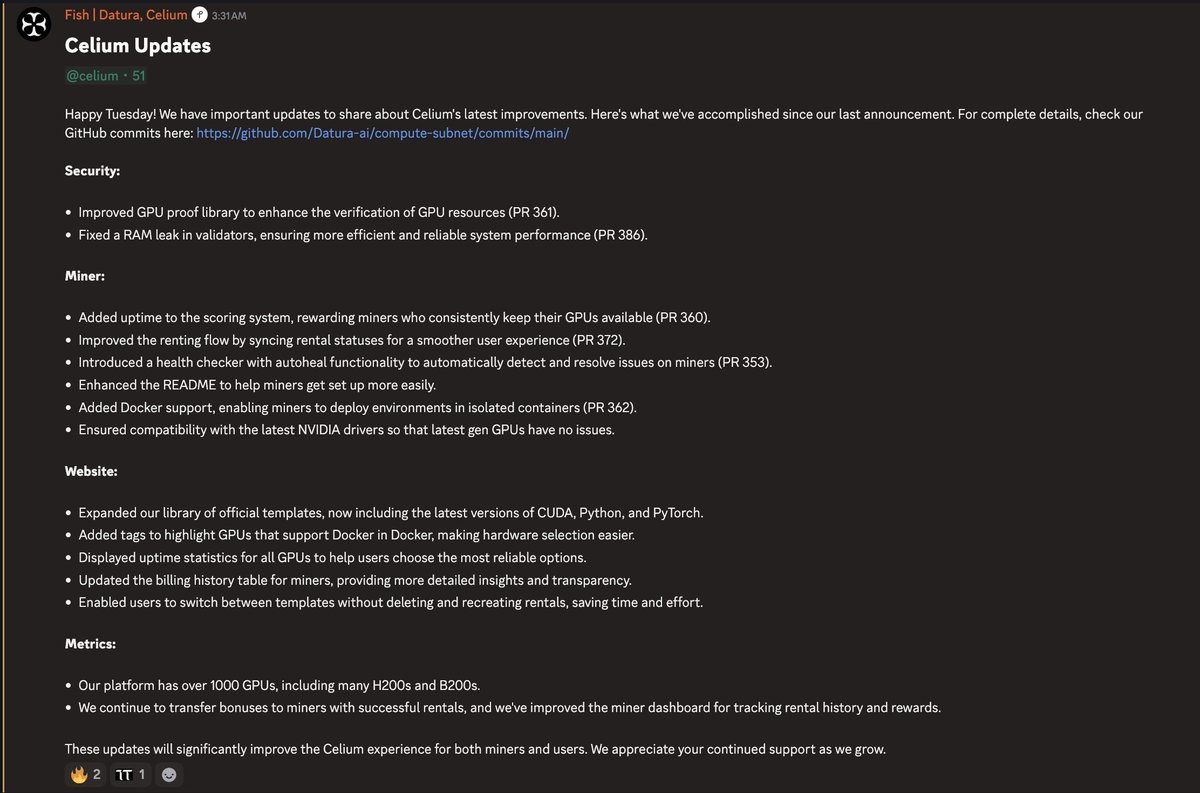
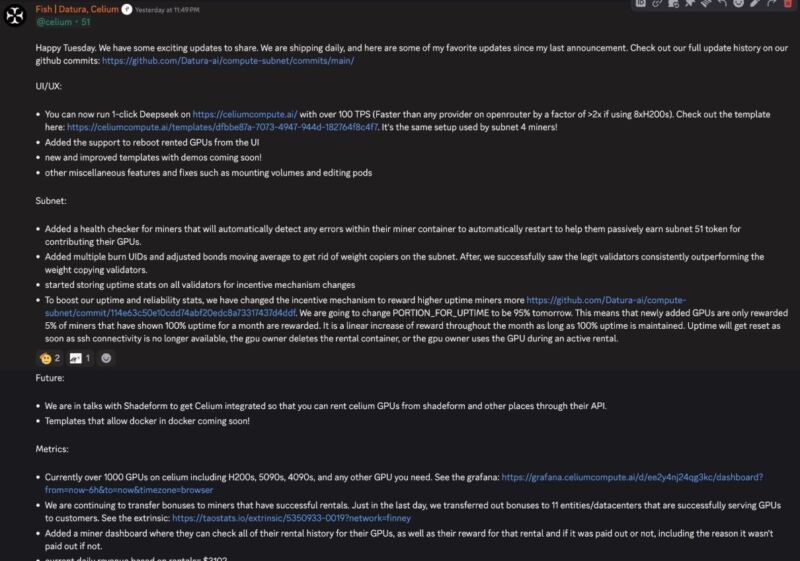
🚀 Celium Update: Easier GPU Rentals! 🚀
We've upgraded your GPU rental experience:
- Switch templates without recreating rentals
- See uptime stats on all GPUs to pick the most reliable ones
- Browse GPUs that support Docker-in-Docker with new tags
- Access latest CUDA, Python…
full dev update in our discord channel here: https://discord.com/channels/799672011265015819/1291754566957928469/1368867764265156630
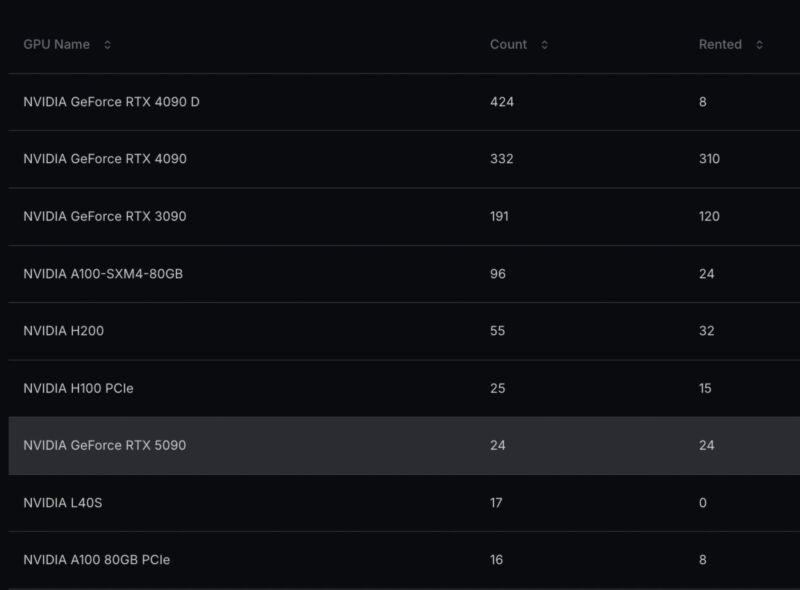
Novelty search brought us a lot of traction! We are now seeing about 70%+ of our supply being rented out across multiple GPU types.
Subnet 51 just burned ~20,000 Tao worth of alpha (150,000 tokens).
We are glad we are able to provide such a quality service while maintaining sustainable tokenomics.
5451569-... · Extrinsic · taostats
Explore the official Bittensor blockchain explorer at taostats.io, your trusted source for metagraph analytics, TAO toke...
taostats.io
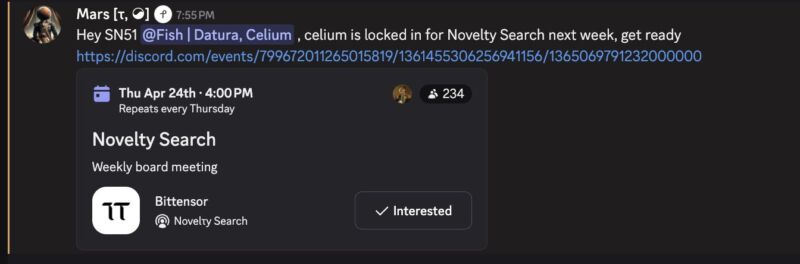
Get ready for Novelty Search on April 24th!
We will be showcasing some amazing things you can do with celium as well as the recent changes and improvements we have made to subnet 51!
Lots of new stuff going on @celiumcompute
#Bittensor >> #dTAO << $TAO
🧠 Good news on Bittensor is becoming as regular as a heartbeat.
Bittensor is building a high-performance machine... and we’re still early.
🚀 Subnet 51: celium keeps gaining momentum!
by @celiumcompute & @fish_datura
"I…
Datura AI
Datura AI is a smart-scrape cutting-edge tool, designed for effective and simplified data analysis from multiple sources.
datura.ai