
With the amount of new subnets being added it can be hard to get up to date information across all subnets, so data may be slightly out of date from time to time
Overview
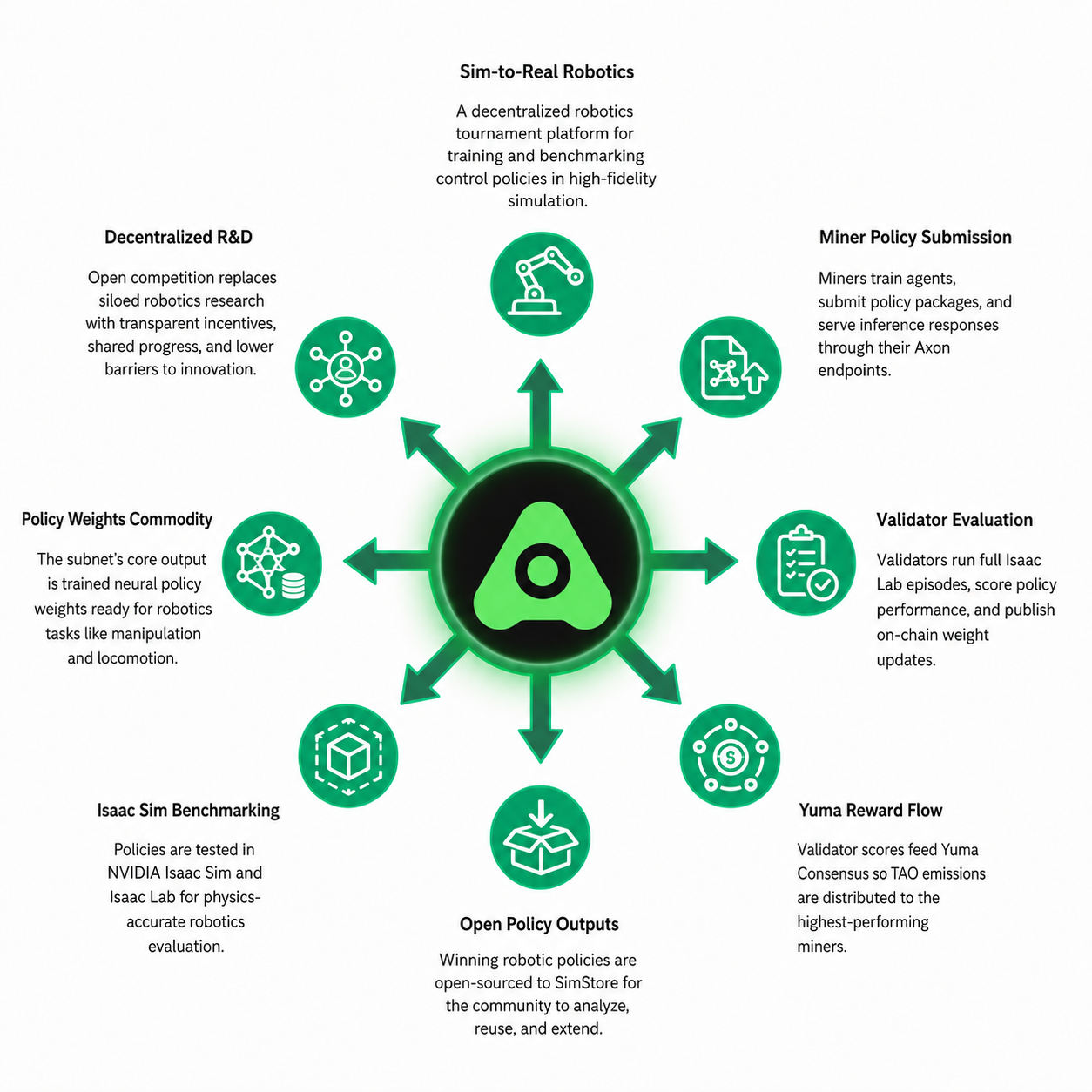
Nepher Robotics is Bittensor Subnet 49, a decentralized robotics tournament platform that leverages competitive, blockchain-based incentives to drive innovation in sim-to-real robotic policy development. As a specialized subnet on the Bittensor network, Nepher enables participants to submit and evaluate learned control policies within high-fidelity NVIDIA Isaac Sim environments, awarding network emissions to the highest-performing models and fostering a transparent, meritocratic ecosystem. This approach solves the core problem of fragmented robotics R&D by uniting researchers, engineers, and validators under a single incentive layer to collaboratively push the field forward
Miner–Validator Loop
At its heart, Nepher operates on a two-actor model common to all Bittensor subnets: miners and validators. Miners register a hotkey to claim a UID on Subnet 49, train a policy within a custom agent directory (containing a best_policy.pt file and inference scripts), and then invoke the CLI command “nepher-miner submit –path ./my-agent –config config/miner_config.yaml” to advertise their Axon endpoint to validators. This registration and submission process sinks a dynamic TAO cost, ensuring only committed participants compete for emissions.
Once registered, miners serve inference requests via their Axon, delivering action outputs in response to state observations sent by validators. These outputs embody the digital commodity produced by the subnet: policy weights that encode control strategies for robotics tasks ranging from manipulation to locomotion.
Validators
Validators are the judges of the network. Up to 64 top-ranked nodes by emissions—and meeting a minimum stake weight—receive a validator permit each epoch, allowing them to pull miner responses, run full evaluation episodes in Isaac Lab 2.3.0, and score each model according to the subnet’s incentive mechanism. GPU-based validators require NVIDIA A100+ hardware and Docker, while a CPU-only validator mode (~200 MB image) handles weight-setting and bond burns for always-on operation on cost-effective VPS instances. After scoring results, validators submit weight updates on-chain via “btcli weights commit” or the SDK’s set_weights function, feeding into the Yuma Consensus algorithm to proportionally distribute TAO emissions to miners based on performance.
Value Production
The end product of Subnet 49 is continuously refined robotic policies: trained neural network weights that have been vetted in physics-accurate simulations, ready for deployment on real hardware. Winning policies are open-sourced to the SimStore, enabling the community to download, analyze, and extend top solutions, accelerating collective progress and reducing redundant R&D efforts.
Incentive Mechanism
Nepher’s reward model mirrors Bittensor’s root economics: Subnet 49 receives a share of the protocol’s inflation according to its total stake proportion. Within the subnet, emissions (currently 0.62% per epoch with a 44% root propensity) are allocated per miner by validators’ weight submissions. Validators, in turn, earn TAO dividends proportional to their stake and alignment with consensus, creating dual incentives to produce high-quality policies and accurately judge peers.
Centralized vs. Decentralized
Traditional robotics platforms centralize simulation, model evaluation, and IP ownership within corporations, leading to siloed progress and high costs. By contrast, Nepher’s decentralized architecture democratizes access to world-class simulation (via NVIDIA Omniverse), open competition, and tokenized rewards, enabling frictionless collaboration and continuous innovation beyond the constraints of single-entity incentives.
Overview
Nepher Robotics is Bittensor Subnet 49, a decentralized robotics tournament platform that leverages competitive, blockchain-based incentives to drive innovation in sim-to-real robotic policy development. As a specialized subnet on the Bittensor network, Nepher enables participants to submit and evaluate learned control policies within high-fidelity NVIDIA Isaac Sim environments, awarding network emissions to the highest-performing models and fostering a transparent, meritocratic ecosystem. This approach solves the core problem of fragmented robotics R&D by uniting researchers, engineers, and validators under a single incentive layer to collaboratively push the field forward
Miner–Validator Loop
At its heart, Nepher operates on a two-actor model common to all Bittensor subnets: miners and validators. Miners register a hotkey to claim a UID on Subnet 49, train a policy within a custom agent directory (containing a best_policy.pt file and inference scripts), and then invoke the CLI command “nepher-miner submit –path ./my-agent –config config/miner_config.yaml” to advertise their Axon endpoint to validators. This registration and submission process sinks a dynamic TAO cost, ensuring only committed participants compete for emissions.
Once registered, miners serve inference requests via their Axon, delivering action outputs in response to state observations sent by validators. These outputs embody the digital commodity produced by the subnet: policy weights that encode control strategies for robotics tasks ranging from manipulation to locomotion.
Validators
Validators are the judges of the network. Up to 64 top-ranked nodes by emissions—and meeting a minimum stake weight—receive a validator permit each epoch, allowing them to pull miner responses, run full evaluation episodes in Isaac Lab 2.3.0, and score each model according to the subnet’s incentive mechanism. GPU-based validators require NVIDIA A100+ hardware and Docker, while a CPU-only validator mode (~200 MB image) handles weight-setting and bond burns for always-on operation on cost-effective VPS instances. After scoring results, validators submit weight updates on-chain via “btcli weights commit” or the SDK’s set_weights function, feeding into the Yuma Consensus algorithm to proportionally distribute TAO emissions to miners based on performance.
Value Production
The end product of Subnet 49 is continuously refined robotic policies: trained neural network weights that have been vetted in physics-accurate simulations, ready for deployment on real hardware. Winning policies are open-sourced to the SimStore, enabling the community to download, analyze, and extend top solutions, accelerating collective progress and reducing redundant R&D efforts.
Incentive Mechanism
Nepher’s reward model mirrors Bittensor’s root economics: Subnet 49 receives a share of the protocol’s inflation according to its total stake proportion. Within the subnet, emissions (currently 0.62% per epoch with a 44% root propensity) are allocated per miner by validators’ weight submissions. Validators, in turn, earn TAO dividends proportional to their stake and alignment with consensus, creating dual incentives to produce high-quality policies and accurately judge peers.
Centralized vs. Decentralized
Traditional robotics platforms centralize simulation, model evaluation, and IP ownership within corporations, leading to siloed progress and high costs. By contrast, Nepher’s decentralized architecture democratizes access to world-class simulation (via NVIDIA Omniverse), open competition, and tokenized rewards, enabling frictionless collaboration and continuous innovation beyond the constraints of single-entity incentives.
Live vs. In Development
At launch, Nepher provides a fully functional Tournament platform (tournament.nepher.ai) and EnvHub environment service (envhub.nepher.ai) alongside comprehensive documentation at docs.nepher.ai. The core subnet code, CLI tools, and evaluation pipelines are production-ready, while advanced features—such as user-driven asset uploads and advanced analytics dashboards—remain under active development. The homepage banner “Active Build: You’re early! We are actively building this platform” underscores the rapid iteration cadence and forthcoming enhancements.
Technical Architecture
The nepher-subnet GitHub repository (nepher-ai/nepher-subnet) encapsulates a modular architecture: a shared library nepher_core for configuration, wallet integration, and API client utilities; separate miner and validator folders containing CLI entrypoints and evaluation logic; plus Docker and docker-compose setups for reproducible GPU and CPU deployments. Config templates, environment variables, and utility scripts streamline both on-chain node interactions and NVIDIA Isaac Lab orchestration, enabling parallel, distributed evaluations with minimal setup.
Repository Structure
Key directories include:
• config/: Example YAML for miner_config.yaml and validator_config.yaml
• docs/: Detailed guides for miner and validator operations
• miner/: CLI implementation for nepher-miner with model packaging and submission
• validator/: GPU and CPU evaluation pipelines leveraging Isaac Sim and weight-setting logic
• nepher_core/: Shared Python package with wallet, logging, and network utilities
• scripts/: Helper scripts for environment management and asset handling
Developers can clone, pip install -e ., and immediately run “nepher-miner submit” or “nepher-validator run” with CPU or GPU modes for real-time participation.
Metrics
The repository has seen 92 commits and is starred by the community, with 1 star and 1 fork, reflecting early but growing adoption. On-chain metrics include a current price of 0.00922 TAO (≈$2.64) per α, market cap of 1.80 K TAO, FDV of 193.62 K TAO, and 24 H trading volume of 1.40 K TAO. Tokenomics parameters show a 0.62% emission rate and a 44% root propensity for subnet inflation allocation.
Validator Scoring
Validators adhere to the subnet’s incentive mechanism by executing evaluation episodes and computing relative performance weights for miners. These weights feed into the Yuma Consensus algorithm, where higher stake validators influence emission distribution. Permit algorithms ensure only nodes with ≥1 000 stake weight (α + 0.18×τ) and top-64 ranking serve as validators, reinforcing network security and fairness.
APIs & Integration
Nepher exposes a Tournament API (tournament-api.nepher.ai) for programmatic challenge submission and scoring retrieval, plus an EnvHub SDK available via PyPI (nepher v0.1.1) for environment management and scene loading. Integration points include Bittensor’s Python SDK for metagraph inspection, btcli for blockchain interactions, and REST endpoints for environment hosting, enabling seamless workflows for third-party developers and end users.
Live vs. In Development
At launch, Nepher provides a fully functional Tournament platform (tournament.nepher.ai) and EnvHub environment service (envhub.nepher.ai) alongside comprehensive documentation at docs.nepher.ai. The core subnet code, CLI tools, and evaluation pipelines are production-ready, while advanced features—such as user-driven asset uploads and advanced analytics dashboards—remain under active development. The homepage banner “Active Build: You’re early! We are actively building this platform” underscores the rapid iteration cadence and forthcoming enhancements.
Technical Architecture
The nepher-subnet GitHub repository (nepher-ai/nepher-subnet) encapsulates a modular architecture: a shared library nepher_core for configuration, wallet integration, and API client utilities; separate miner and validator folders containing CLI entrypoints and evaluation logic; plus Docker and docker-compose setups for reproducible GPU and CPU deployments. Config templates, environment variables, and utility scripts streamline both on-chain node interactions and NVIDIA Isaac Lab orchestration, enabling parallel, distributed evaluations with minimal setup.
Repository Structure
Key directories include:
• config/: Example YAML for miner_config.yaml and validator_config.yaml
• docs/: Detailed guides for miner and validator operations
• miner/: CLI implementation for nepher-miner with model packaging and submission
• validator/: GPU and CPU evaluation pipelines leveraging Isaac Sim and weight-setting logic
• nepher_core/: Shared Python package with wallet, logging, and network utilities
• scripts/: Helper scripts for environment management and asset handling
Developers can clone, pip install -e ., and immediately run “nepher-miner submit” or “nepher-validator run” with CPU or GPU modes for real-time participation.
Metrics
The repository has seen 92 commits and is starred by the community, with 1 star and 1 fork, reflecting early but growing adoption. On-chain metrics include a current price of 0.00922 TAO (≈$2.64) per α, market cap of 1.80 K TAO, FDV of 193.62 K TAO, and 24 H trading volume of 1.40 K TAO. Tokenomics parameters show a 0.62% emission rate and a 44% root propensity for subnet inflation allocation.
Validator Scoring
Validators adhere to the subnet’s incentive mechanism by executing evaluation episodes and computing relative performance weights for miners. These weights feed into the Yuma Consensus algorithm, where higher stake validators influence emission distribution. Permit algorithms ensure only nodes with ≥1 000 stake weight (α + 0.18×τ) and top-64 ranking serve as validators, reinforcing network security and fairness.
APIs & Integration
Nepher exposes a Tournament API (tournament-api.nepher.ai) for programmatic challenge submission and scoring retrieval, plus an EnvHub SDK available via PyPI (nepher v0.1.1) for environment management and scene loading. Integration points include Bittensor’s Python SDK for metagraph inspection, btcli for blockchain interactions, and REST endpoints for environment hosting, enabling seamless workflows for third-party developers and end users.
Core Team
Nepher Robotics is developed by the nepher-ai organization, backed by contributors on GitHub including akhenova, Superstar221, camminatore21, and qvantax, who collectively authored over 90 commits as of March 2026. Key OSS contributors have implemented features ranging from sandbox evaluation to auto-update pipelines, demonstrating a focus on modular, extensible design.
GitHub Contributors
Repository activity shows a blend of pseudonymous developers: akhenova driving core fixes and pull requests, Superstar221 refining sandbox-eval engineers, camminatore21 adding local evaluation and worker splits, and qvantax contributing early deployment tooling. This collaborative model aligns with Bittensor’s ethos of permissionless, community-driven subnet growth.
Online Presence
Nepher maintains public communication via X (Twitter) at x.com/nepher_robotics and an active Discord server (discord.gg/nepher), where participants discuss hackathons, best practices, and upcoming subnet upgrades. The team joined the Bittensor ecosystem by registering SN49 in November 2025, taking ownership from prior custodians following a network reorganization.
Background & Expertise
The nepher-ai core team combines robotics researchers with deep expertise in NVIDIA Omniverse and Isaac Sim, as evidenced by the platform’s high-fidelity modeling, SimStore open-source practices, and integration with enterprise security protocols. Their backgrounds include simulation-driven RL, physics-based asset libraries, and decentralized incentive design, positioning Nepher at the intersection of blockchain and embodied AI innovation.
Core Team
Nepher Robotics is developed by the nepher-ai organization, backed by contributors on GitHub including akhenova, Superstar221, camminatore21, and qvantax, who collectively authored over 90 commits as of March 2026. Key OSS contributors have implemented features ranging from sandbox evaluation to auto-update pipelines, demonstrating a focus on modular, extensible design.
GitHub Contributors
Repository activity shows a blend of pseudonymous developers: akhenova driving core fixes and pull requests, Superstar221 refining sandbox-eval engineers, camminatore21 adding local evaluation and worker splits, and qvantax contributing early deployment tooling. This collaborative model aligns with Bittensor’s ethos of permissionless, community-driven subnet growth.
Online Presence
Nepher maintains public communication via X (Twitter) at x.com/nepher_robotics and an active Discord server (discord.gg/nepher), where participants discuss hackathons, best practices, and upcoming subnet upgrades. The team joined the Bittensor ecosystem by registering SN49 in November 2025, taking ownership from prior custodians following a network reorganization.
Background & Expertise
The nepher-ai core team combines robotics researchers with deep expertise in NVIDIA Omniverse and Isaac Sim, as evidenced by the platform’s high-fidelity modeling, SimStore open-source practices, and integration with enterprise security protocols. Their backgrounds include simulation-driven RL, physics-based asset libraries, and decentralized incentive design, positioning Nepher at the intersection of blockchain and embodied AI innovation.
Phase 1: Alpha Launch (Jan–Feb 2026)
• Public GitHub repo creation and initial CLI tooling
• Release of nepher v0.1.0 (Feb 5, 2026) and v0.1.1 (Feb 12, 2026) on PyPI, introducing environment loading and core API bindings.
Phase 2: Beta Tournament & EnvHub (Mar 2026)
• Merge of GPU sandbox evaluation support and auto_update in March 2026 (commit 6f2180e) to stabilize competition loops and ensure seamless policy submission.
• Launch of EnvHub beta for hosting custom Isaac Sim environments, enabling rapid prototyping via REST APIs and CLI integration.
Phase 3: Public Ramp-Up (Q2 2026)
• Full validator network deployment with CPU-only validators for cost-efficient weight-setting and bond burns
• Integration of SimStore for open-sourcing winning policies and community asset sharing, with first hackathon (Quadruped Robot Sprint) outcomes published.
Phase 4: Ecosystem Growth (Late 2026)
• Launch of advanced analytics dashboard and user-driven asset upload
• Enterprise feature set including NDA compliance, air-gapped training pipelines, and Simulation-Verified Talent hiring portal
• Expansion to multi-modal tasks and cross-subnet interoperability
Future Vision
Nepher aims to serve as the de facto decentralized robotics marketplace, where policy authors, validators, and end users converge to co-develop, certify, and deploy robotic intelligence at scale. Long-term milestones include on-chain licensing, revenue-share royalty models, and full integration into the Bittensor metagraph for cross-subnet consensus and composable AI services. Continuous “Active Build” updates will deliver new features, extensions, and community-driven protocols to sustainably evolve Subnet 49.
Phase 1: Alpha Launch (Jan–Feb 2026)
• Public GitHub repo creation and initial CLI tooling
• Release of nepher v0.1.0 (Feb 5, 2026) and v0.1.1 (Feb 12, 2026) on PyPI, introducing environment loading and core API bindings.
Phase 2: Beta Tournament & EnvHub (Mar 2026)
• Merge of GPU sandbox evaluation support and auto_update in March 2026 (commit 6f2180e) to stabilize competition loops and ensure seamless policy submission.
• Launch of EnvHub beta for hosting custom Isaac Sim environments, enabling rapid prototyping via REST APIs and CLI integration.
Phase 3: Public Ramp-Up (Q2 2026)
• Full validator network deployment with CPU-only validators for cost-efficient weight-setting and bond burns
• Integration of SimStore for open-sourcing winning policies and community asset sharing, with first hackathon (Quadruped Robot Sprint) outcomes published.
Phase 4: Ecosystem Growth (Late 2026)
• Launch of advanced analytics dashboard and user-driven asset upload
• Enterprise feature set including NDA compliance, air-gapped training pipelines, and Simulation-Verified Talent hiring portal
• Expansion to multi-modal tasks and cross-subnet interoperability
Future Vision
Nepher aims to serve as the de facto decentralized robotics marketplace, where policy authors, validators, and end users converge to co-develop, certify, and deploy robotic intelligence at scale. Long-term milestones include on-chain licensing, revenue-share royalty models, and full integration into the Bittensor metagraph for cross-subnet consensus and composable AI services. Continuous “Active Build” updates will deliver new features, extensions, and community-driven protocols to sustainably evolve Subnet 49.