With the amount of new subnets being added it can be hard to get up to date information across all subnets, so data may be slightly out of date from time to time

Subnet 14

TAO Hash

Emissions
Value
Recycled
Value
Recycled (24h)
Value
Registration Cost
Value
Active Validators
Value
Active Miners
Value
Active Dual Miners/Validators
Value

ABOUT

What exactly does it do?

Tao Hash operates as a mining ecosystem where Bitcoin miners can redirect their hash rate towards the Tao Hash subnet and mine alpha tokens instead of Bitcoin. The system incentivizes miners to contribute their hash rate, and in return, they receive alpha tokens. These tokens can be used for staking or traded. This concept mirrors traditional mining pools but with a focus on a new tokenomics structure.

Miners give up mining Bitcoin, and instead, based on the amount of Bitcoin hash rate they provide, they are rewarded with alpha tokens. The subnet’s goal is to create a fair system that allows liquidity to build over time while preventing manipulation or unfair advantages, especially during the early stages when a new subnet is born. By ensuring that early price volatility settles and no insider trading occurs, the system allows for a decentralized, fair mining model.

Tao Hash operates as a mining ecosystem where Bitcoin miners can redirect their hash rate towards the Tao Hash subnet and mine alpha tokens instead of Bitcoin. The system incentivizes miners to contribute their hash rate, and in return, they receive alpha tokens. These tokens can be used for staking or traded. This concept mirrors traditional mining pools but with a focus on a new tokenomics structure.

Miners give up mining Bitcoin, and instead, based on the amount of Bitcoin hash rate they provide, they are rewarded with alpha tokens. The subnet’s goal is to create a fair system that allows liquidity to build over time while preventing manipulation or unfair advantages, especially during the early stages when a new subnet is born. By ensuring that early price volatility settles and no insider trading occurs, the system allows for a decentralized, fair mining model.

PURPOSE

What exactly is the 'product/build'?

The TAO Hash system is a decentralized marketplace that allows Alpha tokens to be automatically exchanged for Bitcoin hashrate. It operates on two fundamental principles:

Value Exchange: Miners contribute Bitcoin hashrate to validator pools. In return, they receive Alpha token rewards proportional to the value of their contributions. Validators are responsible for evaluating this contribution and distributing rewards through on-chain weight updates.

Incentive Alignment: The system leverages market mechanisms by pricing hashrate based on real-time Bitcoin hash prices. This approach naturally incentivizes efficient hashrate allocation and promotes competitive miner behavior.


System Roles and Components

The TAOHash system includes several core participants, each with specific responsibilities:

Miners (BraiinsMiner): Provide hashrate by allocating mining resources across validator pools.

Validators (BraiinsValidator): Evaluate miner performance and set network weights accordingly.

External Pools: Execute the actual Bitcoin mining operations and provide real-time metrics.


High-Level System Architecture

The architecture integrates components from Bittensor, external Bitcoin mining infrastructure, and external data sources to ensure smooth operation. The main architectural components include:

TAOHash Subnet 14: The designated Bittensor subnet responsible for handling hashrate-based tasks.

Bittensor Blockchain and Metagraph: Used for subnet synchronization, hotkey registration, and on-chain weight management.

External Mining Infrastructure: Actual mining tasks are carried out via connected mining pools and hardware.

Market Data Sources: Hash price information is pulled from services like Braiins Insights and CoinGecko.

Storage Systems: Persist miner data, schedules, and configurations using either Redis-based or JSON-based backends.


Key System Components

Miners (BraiinsMiner)

Miners manage and direct hashrate across multiple validator pools using scheduling and allocation strategies. They function through several key subsystems:

  • MiningScheduler: Manages timed transitions between different validator pools.
  • Allocation Strategies: Supports different methods of distributing hashrate — including stake-based, equal-weighted, and multi-pool distribution algorithms.
  • BraiinsProxyManager: Interfaces with mining hardware by updating proxy configurations to redirect mining output.
  • Storage Layer: Stores pool configurations and scheduler settings using either Redis or JSON-based systems.


Validators (BraiinsValidator)

Validators assess the quality and impact of miner contributions. Their responsibilities include:

  • BraiinsPoolAPI Integration: Pulls real-time statistics and worker data from external mining pools.
  • Hash Price Integration: Fetches live Bitcoin hash prices to convert hashrate into value terms.
  • Scoring Algorithms: Uses time-windowed metrics (typically 5-minute and 60-minute windows) to evaluate performance.
  • Weight Updates: Adjusts miner weights on-chain based on the calculated performance scores.


Storage Systems

Two types of storage backends are supported:

Redis Storage (BaseRedisStorage)

  • Used for high-performance caching.
  • Includes TTL (Time-To-Live) functionality for expiring outdated entries.


JSON Storage (BaseJsonStorage)

  • Used for simple, local storage.
  • Appropriate for smaller or less resource-intensive deployments.


Both systems extend a common interface (BaseStorage) and allow uniform access to pool configuration and scheduling data.


Data Flow and Integration Points

Bittensor Network Integration

  • Supports hotkey registration and subnet joining via the Bittensor library.
  • Keeps validators synchronized through the metagraph.
  • Handles on-chain weight updates to ensure accurate and fair reward distribution.


External Mining Pool Integration

  • Collects real-time worker performance metrics using the BraiinsPoolAPI.
  • Verifies hashrate output by cross-referencing with mining pool data.
  • Manages mining pool configurations through proxies to control actual mining behavior.


Market Data Integration

  • Pulls live Bitcoin hash price data from APIs like CoinGecko and Braiins Insights.
  • Uses this data to evaluate and price hashrate contributions fairly.
  • Supports continuous incentive calibration based on current market conditions.


Network Parameters

The TAOHash system is configured with specific network parameters designed to align with Bitcoin’s mining and block generation rhythms:

Subnet ID: 14
(Specifies the Bittensor subnet under which TAOHash operates.)

Evaluation Window: 720 blocks (approx. 2.5 hours)
(Defines the time period used by validators to evaluate miner performance.)

Metrics Sampling Frequency: Every 5 minutes (25 blocks)
(Controls how often miner hashrate is measured and evaluated.)

Minimum Stake for Validators: 10,000 TAO
(The minimum amount of TAO required to run a validator on this subnet.)

Minimum Block Allocation per Validator: 40 blocks
(Defines the shortest allocation window to ensure reliable hashrate measurements.)

These parameters ensure reward cycles are meaningful and provide miners with sufficient time to demonstrate contribution, while still allowing for responsive, dynamic reward updates.

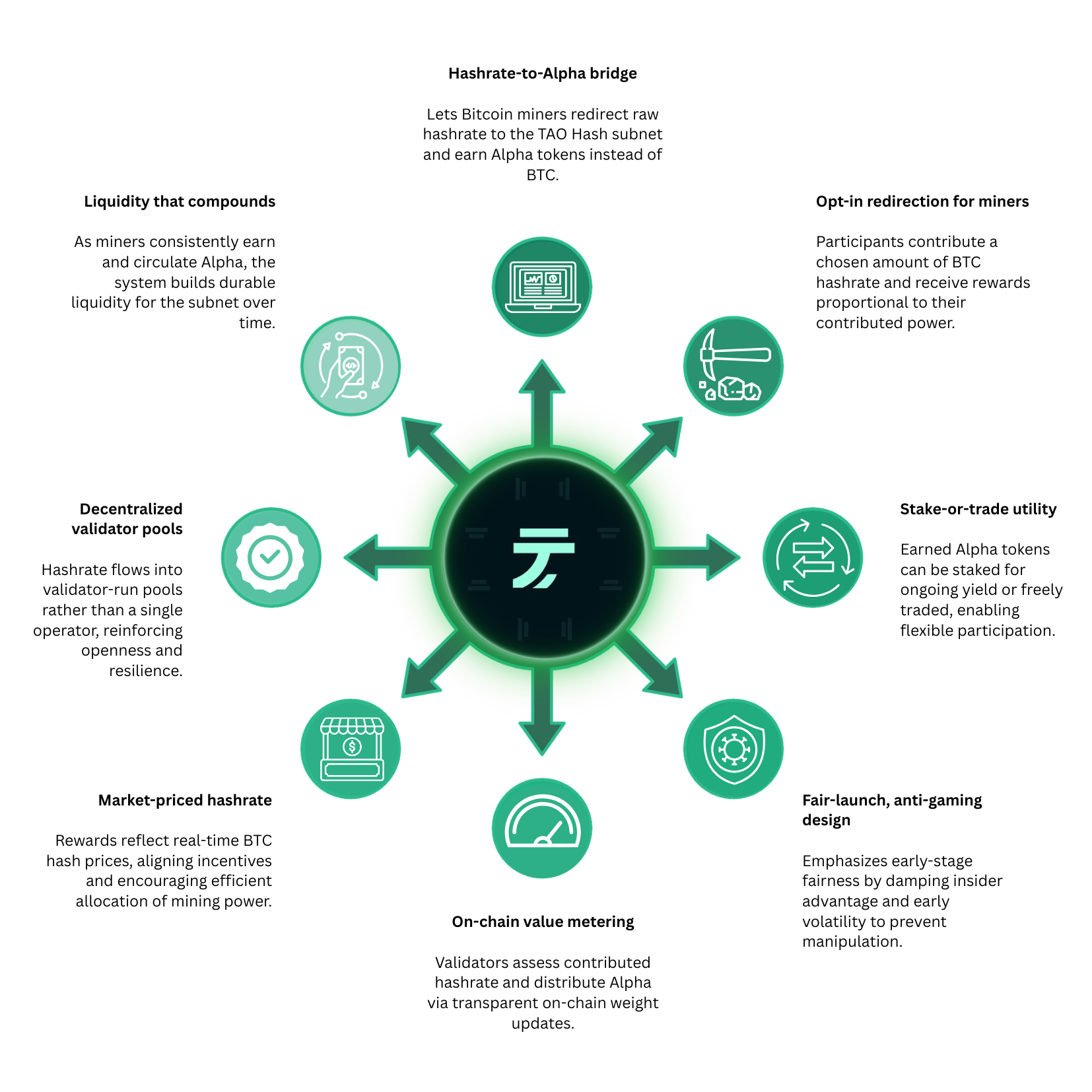
 

The TAO Hash system is a decentralized marketplace that allows Alpha tokens to be automatically exchanged for Bitcoin hashrate. It operates on two fundamental principles:

Value Exchange: Miners contribute Bitcoin hashrate to validator pools. In return, they receive Alpha token rewards proportional to the value of their contributions. Validators are responsible for evaluating this contribution and distributing rewards through on-chain weight updates.

Incentive Alignment: The system leverages market mechanisms by pricing hashrate based on real-time Bitcoin hash prices. This approach naturally incentivizes efficient hashrate allocation and promotes competitive miner behavior.


System Roles and Components

The TAOHash system includes several core participants, each with specific responsibilities:

Miners (BraiinsMiner): Provide hashrate by allocating mining resources across validator pools.

Validators (BraiinsValidator): Evaluate miner performance and set network weights accordingly.

External Pools: Execute the actual Bitcoin mining operations and provide real-time metrics.


High-Level System Architecture

The architecture integrates components from Bittensor, external Bitcoin mining infrastructure, and external data sources to ensure smooth operation. The main architectural components include:

TAOHash Subnet 14: The designated Bittensor subnet responsible for handling hashrate-based tasks.

Bittensor Blockchain and Metagraph: Used for subnet synchronization, hotkey registration, and on-chain weight management.

External Mining Infrastructure: Actual mining tasks are carried out via connected mining pools and hardware.

Market Data Sources: Hash price information is pulled from services like Braiins Insights and CoinGecko.

Storage Systems: Persist miner data, schedules, and configurations using either Redis-based or JSON-based backends.


Key System Components

Miners (BraiinsMiner)

Miners manage and direct hashrate across multiple validator pools using scheduling and allocation strategies. They function through several key subsystems:

  • MiningScheduler: Manages timed transitions between different validator pools.
  • Allocation Strategies: Supports different methods of distributing hashrate — including stake-based, equal-weighted, and multi-pool distribution algorithms.
  • BraiinsProxyManager: Interfaces with mining hardware by updating proxy configurations to redirect mining output.
  • Storage Layer: Stores pool configurations and scheduler settings using either Redis or JSON-based systems.


Validators (BraiinsValidator)

Validators assess the quality and impact of miner contributions. Their responsibilities include:

  • BraiinsPoolAPI Integration: Pulls real-time statistics and worker data from external mining pools.
  • Hash Price Integration: Fetches live Bitcoin hash prices to convert hashrate into value terms.
  • Scoring Algorithms: Uses time-windowed metrics (typically 5-minute and 60-minute windows) to evaluate performance.
  • Weight Updates: Adjusts miner weights on-chain based on the calculated performance scores.


Storage Systems

Two types of storage backends are supported:

Redis Storage (BaseRedisStorage)

  • Used for high-performance caching.
  • Includes TTL (Time-To-Live) functionality for expiring outdated entries.


JSON Storage (BaseJsonStorage)

  • Used for simple, local storage.
  • Appropriate for smaller or less resource-intensive deployments.


Both systems extend a common interface (BaseStorage) and allow uniform access to pool configuration and scheduling data.


Data Flow and Integration Points

Bittensor Network Integration

  • Supports hotkey registration and subnet joining via the Bittensor library.
  • Keeps validators synchronized through the metagraph.
  • Handles on-chain weight updates to ensure accurate and fair reward distribution.


External Mining Pool Integration

  • Collects real-time worker performance metrics using the BraiinsPoolAPI.
  • Verifies hashrate output by cross-referencing with mining pool data.
  • Manages mining pool configurations through proxies to control actual mining behavior.


Market Data Integration

  • Pulls live Bitcoin hash price data from APIs like CoinGecko and Braiins Insights.
  • Uses this data to evaluate and price hashrate contributions fairly.
  • Supports continuous incentive calibration based on current market conditions.


Network Parameters

The TAOHash system is configured with specific network parameters designed to align with Bitcoin’s mining and block generation rhythms:

Subnet ID: 14
(Specifies the Bittensor subnet under which TAOHash operates.)

Evaluation Window: 720 blocks (approx. 2.5 hours)
(Defines the time period used by validators to evaluate miner performance.)

Metrics Sampling Frequency: Every 5 minutes (25 blocks)
(Controls how often miner hashrate is measured and evaluated.)

Minimum Stake for Validators: 10,000 TAO
(The minimum amount of TAO required to run a validator on this subnet.)

Minimum Block Allocation per Validator: 40 blocks
(Defines the shortest allocation window to ensure reliable hashrate measurements.)

These parameters ensure reward cycles are meaningful and provide miners with sufficient time to demonstrate contribution, while still allowing for responsive, dynamic reward updates.


WHO

Team Info

TAO Hash (Subnet-14) is developed and maintained by Latent Holdings. Latent Holdings was founded in 2024 with a mission to accelerate the digital transformation of intelligence. Key team members include:

Joseph Jacks (JJ) – Co-Founder

JJ is the founder of OSS Capital, the first and only early-stage VC firm exclusively focused on commercial open source software (COSS) startups. Previously, he co-founded Kismatic, the first Kubernetes startup, and launched KubeCon, later donating it to the Linux Foundation as part of CNCF. Under his leadership, OSS Capital has backed 70+ companies supporting 150M+ users and 1M+ GitHub stars. JJ has led over 40 funding rounds, helping generate over $20B in value capture across sectors like AI, data, infrastructure, and developer tools.

Cameron Fairchild – Co-Founder

Cameron is a core contributor to the OpenTensor Foundation and is the co-founder of TAO Hash. He has a background in computer science (Univ. of Toronto) and previously worked on the OpenTensor Foundation. Profiles: GitHub camfairchild (Latent CTO); Twitter @KibibyteMe.

Benjamin Himes – Senior Engineer

Benjamin joins Laten Holdings from the Opentensor Foundation, the non-profit supporting the development of the Bittensor blockchain. At OTF, he played a key role in enhancing the Bittensor developer toolchain, including the SDK, CLI, and major upgrades like RAO and dTAO. His work focused on improving the developer experience and enabling scalable contributions to decentralized AI. Benjamin now continues this mission as part of a growing team dedicated to advancing the state of the art in artificial intelligence and open-source infrastructure.

Roman Chkhaidze – Engineer

A seasoned software developer with over 10 years of experience, specializing in Python and full-stack web development. Proficient in building robust applications using frameworks like Flask, FastAPI, Django, and Vue.js, with strong command of HTML5, CSS3, and modern JavaScript (ES6/TypeScript). Experienced across databases (PostgreSQL, MySQL, MongoDB, GCP), cloud platforms (AWS, GCE), and containerization tools (Docker, VMWare). Skilled in test automation with PyTest, Selenium, and more. Known for strong problem-solving, rapid tech adaptation, and driving process improvements across teams and environments.

Ibraheem Nadeem – Engineer

Michael Trestman – Technical Documentation lead.

Clément Blaise – Infrastructure

Xavier Lyu – Research

Yasmine Ibrahim – Compliance

Maciej Kula – Education


TAO Hash (Subnet-14) is developed and maintained by Latent Holdings. Latent Holdings was founded in 2024 with a mission to accelerate the digital transformation of intelligence. Key team members include:

Joseph Jacks (JJ) – Co-Founder

JJ is the founder of OSS Capital, the first and only early-stage VC firm exclusively focused on commercial open source software (COSS) startups. Previously, he co-founded Kismatic, the first Kubernetes startup, and launched KubeCon, later donating it to the Linux Foundation as part of CNCF. Under his leadership, OSS Capital has backed 70+ companies supporting 150M+ users and 1M+ GitHub stars. JJ has led over 40 funding rounds, helping generate over $20B in value capture across sectors like AI, data, infrastructure, and developer tools.

Cameron Fairchild – Co-Founder

Cameron is a core contributor to the OpenTensor Foundation and is the co-founder of TAO Hash. He has a background in computer science (Univ. of Toronto) and previously worked on the OpenTensor Foundation. Profiles: GitHub camfairchild (Latent CTO); Twitter @KibibyteMe.

Benjamin Himes – Senior Engineer

Benjamin joins Laten Holdings from the Opentensor Foundation, the non-profit supporting the development of the Bittensor blockchain. At OTF, he played a key role in enhancing the Bittensor developer toolchain, including the SDK, CLI, and major upgrades like RAO and dTAO. His work focused on improving the developer experience and enabling scalable contributions to decentralized AI. Benjamin now continues this mission as part of a growing team dedicated to advancing the state of the art in artificial intelligence and open-source infrastructure.

Roman Chkhaidze – Engineer

A seasoned software developer with over 10 years of experience, specializing in Python and full-stack web development. Proficient in building robust applications using frameworks like Flask, FastAPI, Django, and Vue.js, with strong command of HTML5, CSS3, and modern JavaScript (ES6/TypeScript). Experienced across databases (PostgreSQL, MySQL, MongoDB, GCP), cloud platforms (AWS, GCE), and containerization tools (Docker, VMWare). Skilled in test automation with PyTest, Selenium, and more. Known for strong problem-solving, rapid tech adaptation, and driving process improvements across teams and environments.

Ibraheem Nadeem – Engineer

Michael Trestman – Technical Documentation lead.

Clément Blaise – Infrastructure

Xavier Lyu – Research

Yasmine Ibrahim – Compliance

Maciej Kula – Education


FUTURE

Roadmap

Acquisition and Relaunch: On April 22, 2025, Joseph Jacks announced via X (formerly Twitter) that Latent Holdings had acquired Subnet 14 and planned to launch a new subnet implementation. This announcement marked a significant turning point for the project, as it brought new resources and direction to the subnet.

Successful Bootstrapping: TAO Hash has successfully bootstrapped approximately 6 EH/s (equivalent to about 0.7% of the Bitcoin network) with zero capital expenditure. This achievement demonstrates the effectiveness of the subnet’s incentive mechanism in attracting mining resources.

Market Establishment: The subnet has effectively created a perpetual futures market for hashrate, where miners swap their BTC payouts for SN14 tokens, while validators buy those same tokens with earned BTC to keep mining rigs pointed at them. This creates a perpetual buy-back loop that sustains the ecosystem.

Financial Growth: Data from taostats.io shows that TAO Hash has achieved a market capitalization of $64.71 million with a 24-hour trading volume of $28.90 million as of May 21, 2025. The subnet has attracted 3,391 holders, indicating strong community interest and participation.

Technical Implementation: The GitHub repository shows that the project has gone through multiple releases, with the latest version (v0.1.5) released on May 13, 2025. The repository contains comprehensive documentation for both miners and validators, including setup guides and technical requirements.


Acquisition and Relaunch: On April 22, 2025, Joseph Jacks announced via X (formerly Twitter) that Latent Holdings had acquired Subnet 14 and planned to launch a new subnet implementation. This announcement marked a significant turning point for the project, as it brought new resources and direction to the subnet.

Successful Bootstrapping: TAO Hash has successfully bootstrapped approximately 6 EH/s (equivalent to about 0.7% of the Bitcoin network) with zero capital expenditure. This achievement demonstrates the effectiveness of the subnet’s incentive mechanism in attracting mining resources.

Market Establishment: The subnet has effectively created a perpetual futures market for hashrate, where miners swap their BTC payouts for SN14 tokens, while validators buy those same tokens with earned BTC to keep mining rigs pointed at them. This creates a perpetual buy-back loop that sustains the ecosystem.

Financial Growth: Data from taostats.io shows that TAO Hash has achieved a market capitalization of $64.71 million with a 24-hour trading volume of $28.90 million as of May 21, 2025. The subnet has attracted 3,391 holders, indicating strong community interest and participation.

Technical Implementation: The GitHub repository shows that the project has gone through multiple releases, with the latest version (v0.1.5) released on May 13, 2025. The repository contains comprehensive documentation for both miners and validators, including setup guides and technical requirements.


MEDIA

A special thanks to Mark Jeffrey for his amazing Hash Rate series! In this series, he provides valuable insights into Bittensor Subnets and the world of decentralized AI. Be sure to check out the full series on his YouTube channel for more expert analysis and deep dives.

In this May 2025 episode of Hashrate, Mark Jeffrey chats with Cameron Fairchild the creator of Subnet 14 TaoHash. They dive deep into the technical workings of Subnet 14, which allows Bitcoin miners to redirect their hash rate to earn Subnet 14 alpha tokens instead of Bitcoin. Cameron explains the mechanics behind how miners are compensated, the liquidity issues that arise in the early stages of a subnet’s launch, and the incentive structures that drive miner behavior. The conversation also explores the challenges and innovations within the broader Bittensor ecosystem, including the introduction of a new liquidity pool model and the ongoing debate around the governance and emissions within the root network. Cameron defends the expanding role of Bittensor beyond AI, advocating for its flexible incentivization model that can be applied to various industries. He also discusses the recent market reactions to changes in Subnet 8 and the evolving dynamics of dTao emissions.

A big thank you to Tao Stats for producing these insightful videos in the Novelty Search series. We appreciate the opportunity to dive deep into the groundbreaking work being done by Subnets within Bittensor! Check out some of their other videos HERE.

Recorded in August 2025: This community call brings together Jake, Roberto, Cameron (“Vune”), Joseph Jacks (Lantent Holdings), Abe, and Carol to discuss recent and upcoming work across the Bittensor ecosystem. After intros and banter, the group spotlights Cameron’s long-running contributions (API/SDK, infra) and Lantent’s stewardship of core open-source tooling and docs. The main segment dives into Subnet 14—a Bitcoin-mining-pool subnet redesigned to pay miners directly in BTC, target ~1.5–1.75% net pool fees with Lightning payouts, reduce trust in validators, and lay groundwork for a smart-contract-custodied pool fee and an EVM hash-rate marketplace. In the second half, Leighton and partners unveil a Subnet 5 collaboration on hierarchical AI pre-training (JePA-style), aiming to beat the ARC-AGI 2 benchmark with smaller, sample-efficient models; miners contribute gradients, validators verify improvements, and Subnet 4 compute can participate—pushing open, cost-efficient progress toward advanced reasoning.

NEWS

Announcements

Load More